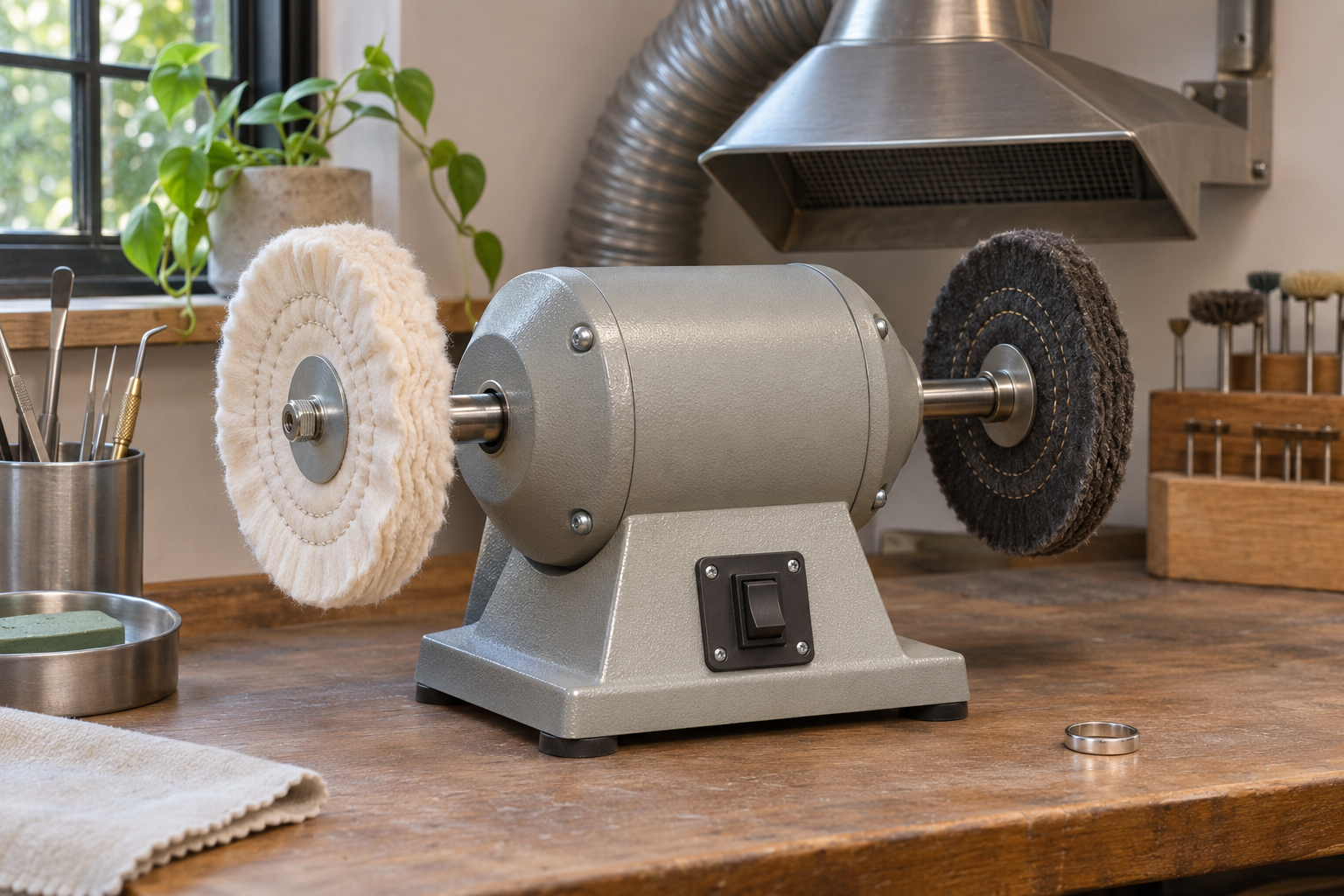
Choose a bench polisher for jewelry by wheel size, speed, stability and dust control. Five researched setups cover compact motors through enclosed studio stations.
A polishing motor earns its bench space when your pieces fit the wheel and your work area can capture the dust.
A bench polisher is most useful when you repeatedly finish accessible jewelry surfaces with a buff wheel. The motor is only part of the setup: wheel size and speed affect control, while mounting and dust capture affect whether the station is practical at your bench. If you mainly finish tight settings, small recesses or one-off pieces, a flex shaft may earn its space first.
Quick answer
Which jewelry polisher should I choose?
The Bench Basics BB-812 is the compact, lower-cost starting point when you already have a plan for dust capture. Foredom’s K.3390 gives a more complete buff-and-compound kit. Handler’s 26A-TS is the heavier two-speed motor for regular work. Choose the enclosed ARBE SS-206 for one-bench dust collection, or Durston’s Pro Single when a larger, dedicated extraction station fits your workload and space.
Match the machine to the work you actually buff
A small 3–4 inch buff suits rings, earrings and other pieces you can control at a short contact patch. A larger enclosure matters when you polish repeatedly and need to collect dust close to the wheel. An open motor is easier to move and costs less, but it still needs a suitable hood or collection setup. More motor power does not fix poor surface preparation or a wheel that is too large for the piece.
Choose a bench polisher by the constraint at your bench
Your main constraint
Setup to consider
Why it fits
Small bench and occasional pieces
Bench Basics BB-812
Compact variable-speed dual-spindle motor
Starting a full buffing sequence
Foredom K.3390
Lathe, six buffs and four compounds in one kit
Frequent work and a stable motor
Handler 26A-TS
Heavy cast-iron base and two fixed speeds
Dust capture at a single bench
ARBE SS-206
One spindle inside a compact extraction cabinet
Dedicated studio polishing station
Durston Pro Single
Larger enclosure, lighting and higher stated extraction airflow
Five bench polishing setups
Compact adjustable starter: Bench Basics BB-812
The BB-812 has a 1/4 hp motor, a 500–8,000 rpm dial and two tapered spindles. Pepetools specifies buffs up to 4 inches and includes two 3-inch buffs, mounting screws and spare motor brushes. Its small body leaves more working surface than a cabinet machine, and speed adjustment gives you room to change between cutting and final buffing. Secure it to a firm bench, select wheels rated for the chosen speed, and arrange dust capture before routine use. This is the least contained setup here.
Best for a small first polishing station
Bench Basics · BB-812, 110/115 V
Bench Basics BB-812 variable speed bench lathe
Price tier: $Budget
A compact dual-spindle motor with 500–8,000 rpm dial control and space for buffs up to 4 inches.
Best for: Small jewelry benches that need adjustable speed without a cabinet-sized machine.
Specs, strengths and limitations
Polishing setup
Dual spindle, open bench
Polishing motor
1/4 hp
Speed
500–8,000 rpm, variable
Wheel capacity
Buffs up to 4 in
Dust extraction
Separate hood required
Strengths
Small motor body leaves room for other bench tools
Speed dial accommodates different buff and surface jobs
Includes left and right spindles and two 3-inch buffs
Limitations
No integrated dust extraction
Lighter 6 lb motor needs secure mounting for repeated work
Foredom pairs its 115 V M.BL lathe with two tapered spindles, two 4-inch buffs, four 3-inch buffs and four compounds. That is a useful starting set for keeping coarse cutting and final coloring stages separate. The motor runs from 500 to 7,000 rpm and its cast-iron base has mounting holes. Foredom’s buffing guide limits its buffs of 3 inches and larger to 5,000 rpm, so the motor’s top speed is not a target for every supplied wheel. Add an appropriate hood if this will be a regular station.
The 26A-TS low-base lathe weighs about 39 lb and supplies left and right tapered polishing spindles. Its 1/4 hp motor runs at 1,725 or 3,450 rpm. That lower fixed setting gives a straightforward choice when a high-speed variable motor feels too aggressive for small work, while the heavy base suits a permanent bench position. Handler’s manual says to start on low before switching to high. Check wheel and spindle ratings, allow clearance around the 15.5 by 8 inch body, and provide separate dust collection.
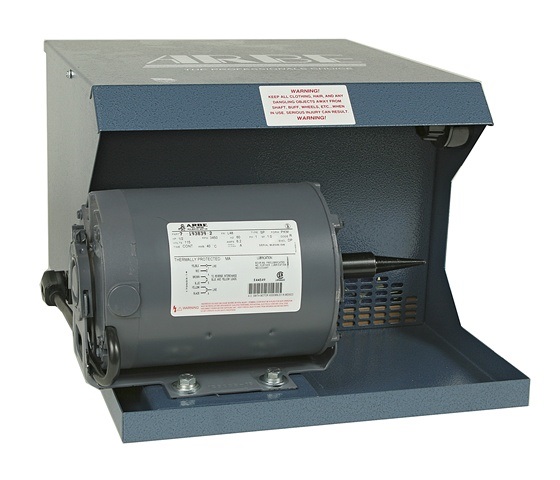
ARBE’s SS-206 combines a single 1/2 hp polishing motor with a 165 CFM blower in a sealed cabinet. Its 15 by 17 inch footprint is much deeper than an open lathe, but the wheel and collection opening stay together as one bench station. A replaceable filter makes upkeep part of the routine. The single spindle means changing wheels between compounds, or keeping separate buffs close at hand, rather than leaving two stages mounted at once.
Best for dust capture at one bench
ARBE · SS-206, 110 V
ARBE SS-206 single spindle polishing machine
Price tier: $$$Upper mid-range
A single-spindle 1/2 hp polisher in a sealed bench cabinet with a 165 CFM extraction blower.
Best for: One-bench studios ready to contain polishing dust in the same machine.
Specs, strengths and limitations
Polishing setup
Single spindle, enclosed bench
Polishing motor
1/2 hp
Dust extraction
Integrated 165 CFM blower
Footprint
15 × 17 × 10 in
Voltage
110 V
Strengths
Cabinet collects dust at the wheel
Single spindle keeps the machine compact for an enclosed unit
Durston’s Pro Single is a 31 kg enclosed station with a 1/2 hp polishing motor, stated 720 CFM extraction, lighting and a removable filter. The 457 by 382 by 415 mm machine needs a sturdy, dedicated position and considerably more budget than the compact machines. It makes sense when polishing is a regular production step and a larger enclosure matters more than easy storage. It still has one spindle, so plan wheel changes and keep the filter maintained.
Best for a dedicated studio station
Durston · Pro Single, 110 V option
Durston Pro Single polishing machine
Price tier: $$$$Professional
A larger enclosed single-spindle station with a 1/2 hp motor, 720 CFM extraction and built-in lighting.
Best for: A production bench that needs a larger dedicated polishing enclosure and stronger extraction.
Specs, strengths and limitations
Polishing setup
Single spindle, enclosed station
Polishing motor
1/2 hp
Dust extraction
Integrated 720 CFM blower
Footprint
457 × 382 × 415 mm
Voltage
110 V option
Strengths
Large enclosure and extraction suit sustained buffing
Integrated light improves visibility at the wheel
Removable filter and storage tray support workshop upkeep
Limitations
31 kg machine needs substantial bench space and support
Higher cost than a compact single-spindle station
One spindle still requires wheel changes between compounds
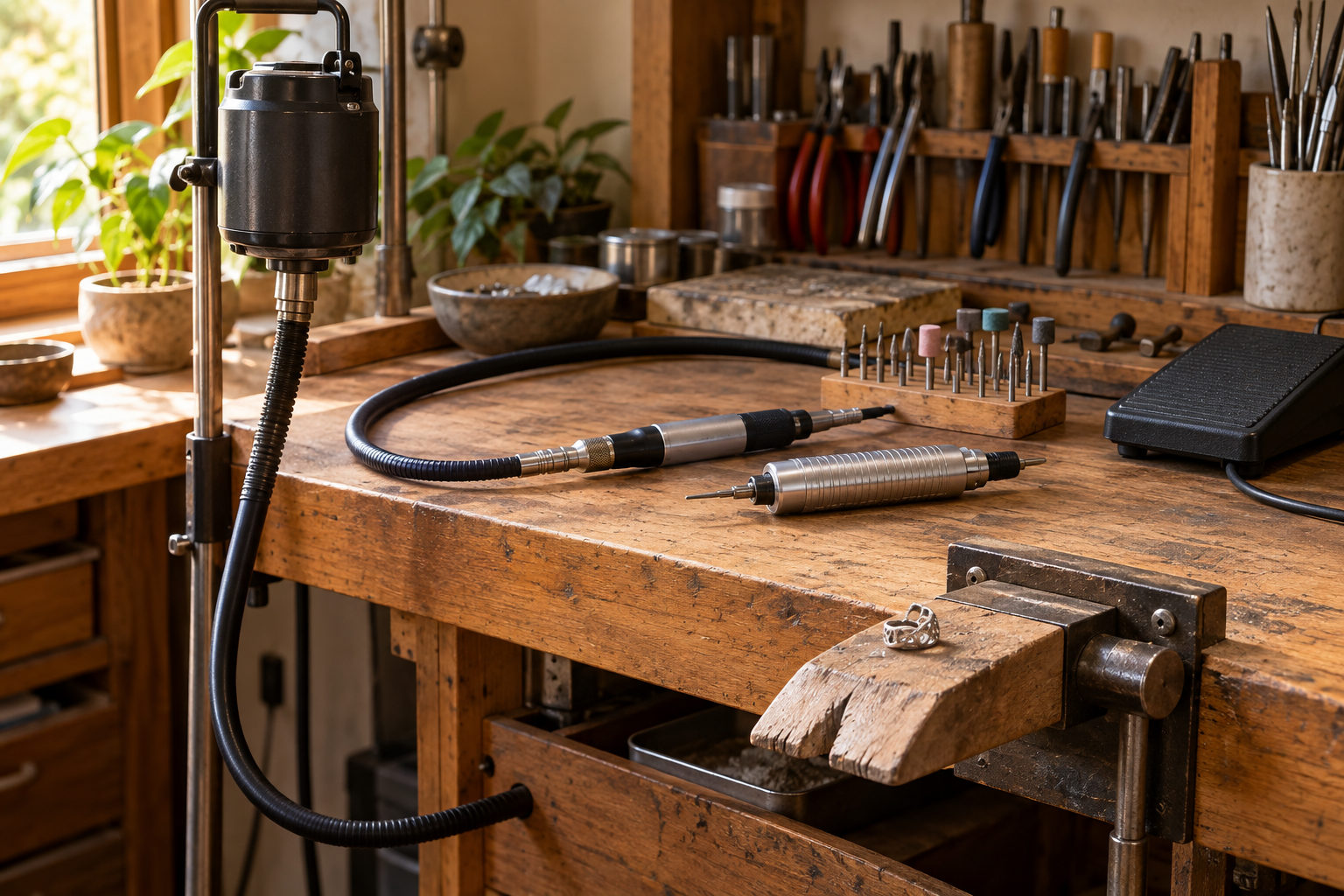
Use a flex shaft for local control: inner contours, narrow recesses and small attachments. Use a bench buff for broad surfaces that can meet a wheel safely and repeatedly. A flex shaft does not replace dust control, and a large buff will not reach every part of a complex setting. Many jewelers prepare with files and abrasives, use small rotary accessories where geometry demands them, then buff accessible faces. The polishing tools guide compares other finishing methods, including tumblers and cleaning.
Set up a safer polishing sequence
Prepare the surface. Remove file marks and progressively refine scratches with suitable abrasives before final compound. A bright buff cannot erase deep marks evenly.
Mount and rate the wheel. Fasten an open motor to a solid bench. Match each buff, spindle and attachment to its stated maximum speed; a larger diameter moves faster at the edge at the same rpm. Inspect for loose or damaged wheels before switching on.
Control dust and grip. Place a suitable extraction hood at the work area. Wear eye protection and appropriate respiratory protection, keep clothing and hair clear, and hold tiny pieces with suitable workholding rather than fingertips close to the wheel. Avoid buffing loose chain on an exposed wheel.
Separate compounds. Keep coarse and fine buffs apart and clean the piece between stages so abrasive carryover does not spoil the final surface. Apply compound lightly and let the abrasive do the work.
Maintain collection. Check filter and tray condition before the next batch, following the machine maker’s instructions. Captured precious-metal dust can be kept separate for recovery.
If you are building the rest of the station, our jewelry bench setup guide covers lighting, layout and clear working space.
Frequently asked questions
Do I need a bench polisher to make jewelry?
No. Files, abrasive paper and a flex shaft can finish small pieces. A bench polisher becomes useful when you repeatedly buff accessible surfaces and can provide dust capture, a stable mounting surface and safe wheel clearance.
Is a flex shaft or bench polisher better for rings?
A flex shaft reaches recesses and works with small attachments; a bench polisher is quicker on broad, accessible surfaces. Many workshops use both, with careful abrasive preparation before either polishing stage.
What speed should I use to polish jewelry?
Follow the wheel and compound maker's speed rating, not only the motor maximum. Lower speed and light pressure help control delicate pieces; larger wheels have faster surface travel at the same rpm. Foredom rates its buffs of 3 inches and larger to 5,000 rpm maximum.
Do enclosed polishers eliminate the need for personal protection?
No. Collection at the wheel helps contain dust, but eye protection, suitable respiratory protection, secure workholding and good ventilation still matter. Follow the machine and material safety instructions.
Tools in this guide
Bench Basics
Bench Basics BB-812 variable speed bench lathe
$Small jewelry benches that need adjustable speed without a cabinet-sized machine.
We have not personally used every product in this guide. Recommendations are based on specifications, manufacturer documentation, specialist references and owner experiences.
Specifications come from manufacturer documentation where it is available.
Specialist references, supplier catalogs and owner experiences are used to understand real-world strengths and weaknesses.
We do not claim physical testing, and we do not publish scores or star ratings.
Choose a Foredom flex shaft by motor, handpiece, foot control and kit contents, with clear picks for general jewelry work, quick bur changes, heavy grinding and stone setting.
Build a first jewelry making toolkit by task. Learn which bench, cutting, forming, soldering, measuring and finishing tools to buy first, and what can wait.
Choose a rotary tumbler for jewelry by barrel size, batch separation and controls. Five researched picks cover a small bench through production burnishing.
Choose a magnetic pin finisher for intricate jewelry by bowl size, batch capacity and controls. Five researched picks span a small bench to production work.