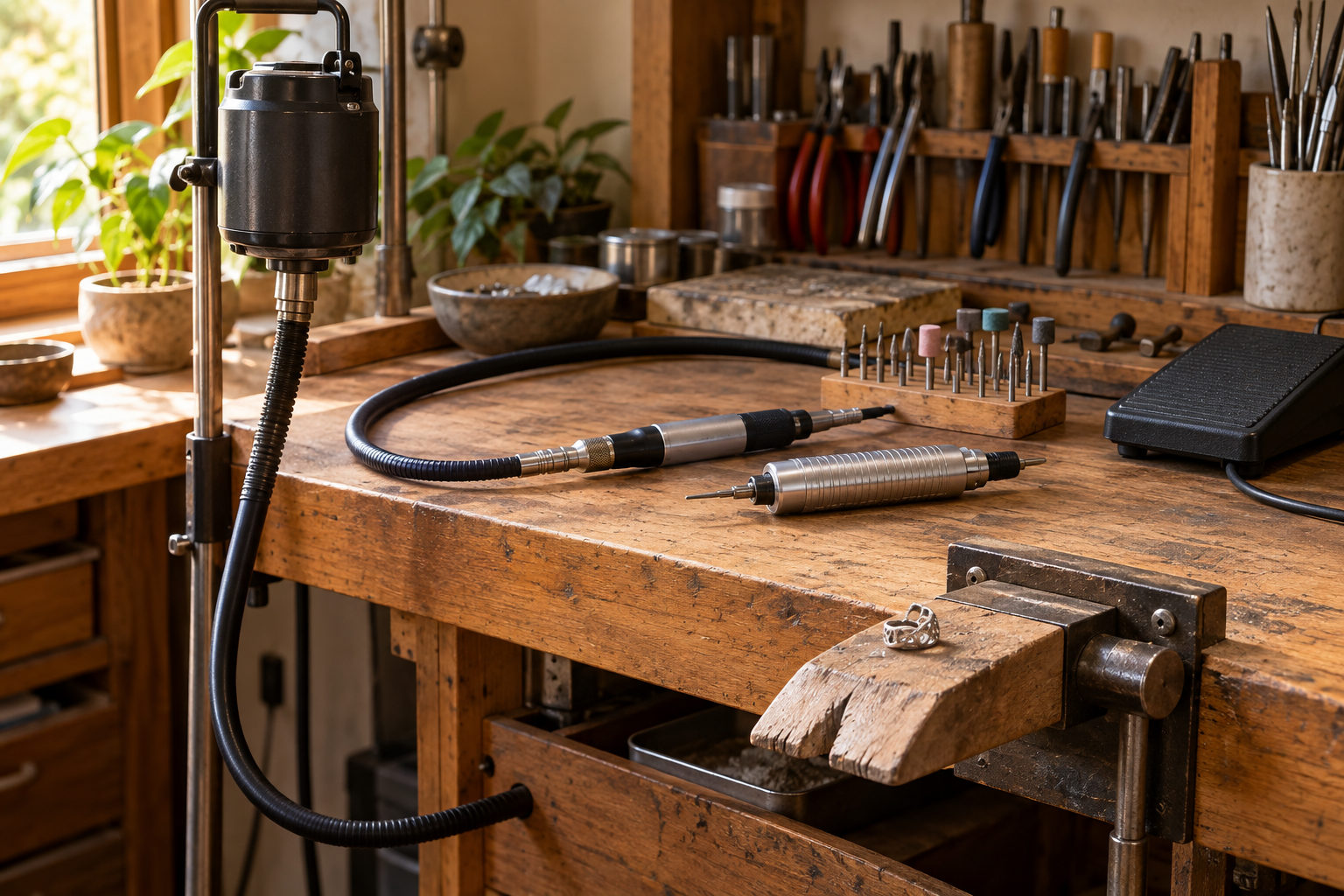
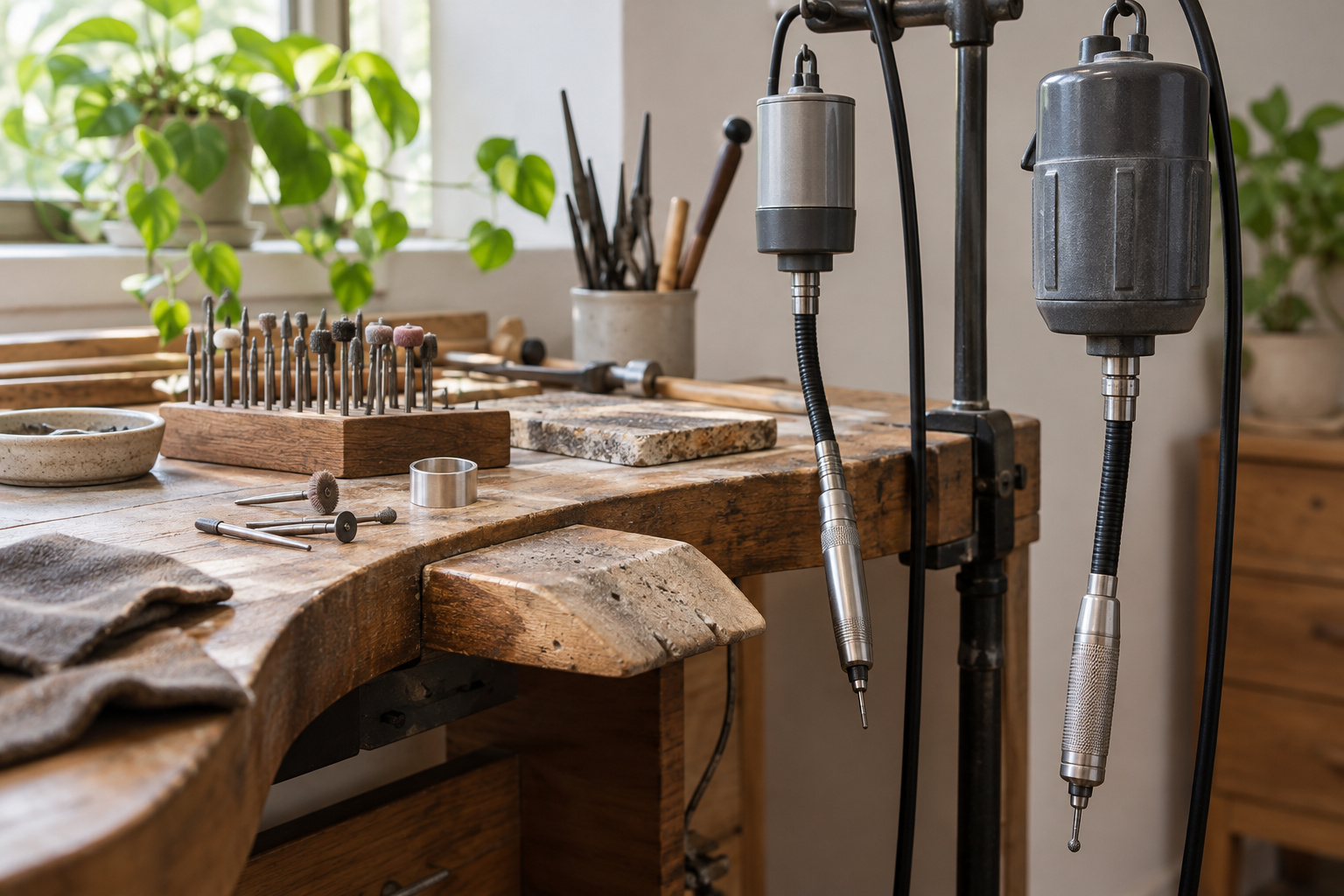
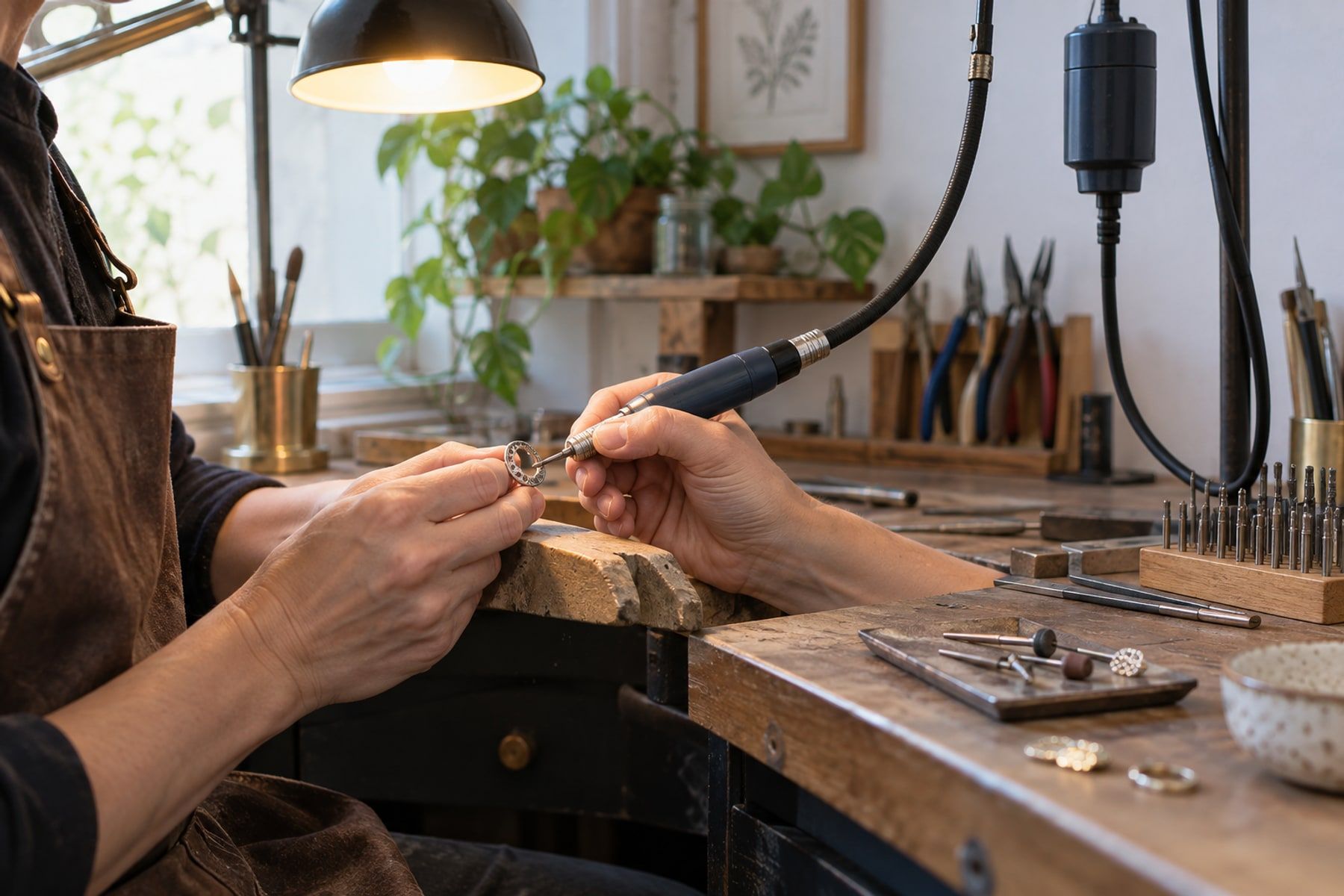
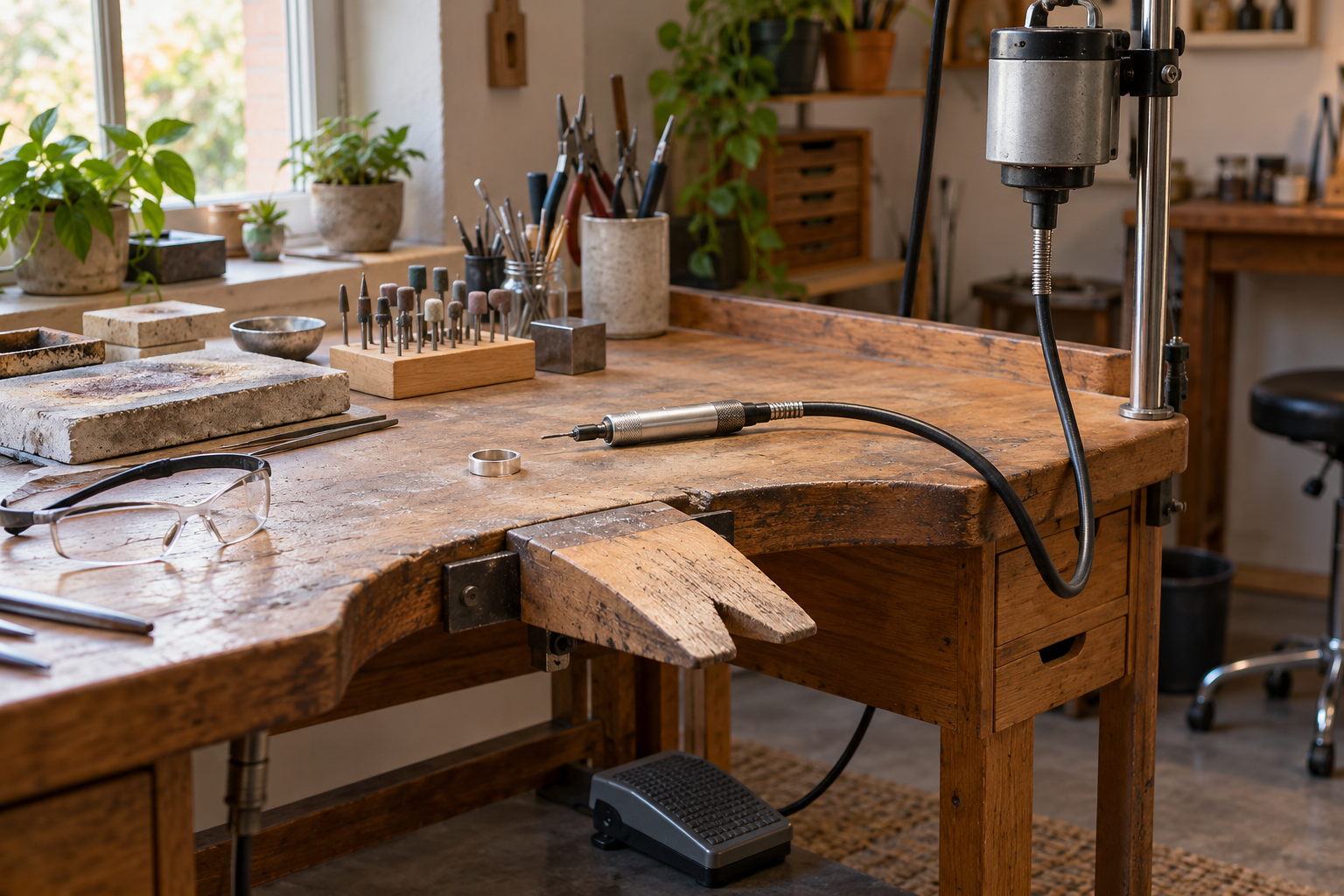
Choose a Foredom flex shaft by motor, handpiece, foot control and kit contents, with clear picks for general jewelry work, quick bur changes, heavy grinding and stone setting.
Choose the motor for the load and speed you need, then choose a handpiece that fits the burs you use most.
The right Foredom flex shaft starts with your most frequent task, not the biggest motor. For mixed drilling, burs, sanding and small buffs, start with an SR and an H.30 handpiece. Move to quick-change, TX or LX configurations only when your workflow gives their different speed, torque or handpiece a clear job.
Quick answer
Which Foredom flex shaft should a jeweler buy?
Choose the K.8301 SR set if you already own the burs and abrasives you need; its H.30 chuck accepts varied shank sizes. Choose the K.2230 kit if you also need a starter assortment. The K.8304 speeds up repeated 3/32-inch bur changes, the K.TX300 suits sustained heavy grinding, and the K.2240 LX concentrates on slow stone-setting work.
Match the motor to the work
Foredom’s SR is a reversible, 1/6 hp motor rated to 18,000 rpm. It is the broadest choice for an everyday jewelry bench. The TX is a forward-only, 1/3 hp motor rated to 15,000 rpm; its stronger torque matters when a larger cutter stays under load. The LX tops out at 5,000 rpm and is built for torque at low speeds, which suits setting, controlled drilling and compatible hammer handpieces. The TX range is 115 V only; SR and LX have 230 V configurations. Match the exact motor and control to your local supply. For a closer motor comparison, see SR versus TX.
Choose a Foredom configuration by bench task
Your main work
Start with
Why it fits
Mixed drills, burs and polishing tools
K.8301 SR with H.30
Reversible motor and chuck for varied shanks
Many 3/32-inch bur changes
K.8304 SR with H.20
Quick-change handpiece avoids repeated chuck-key use
First bench with few accessories
K.2230 SR jewelry kit
H.30 plus a metalworking accessory assortment
Repeated heavy grinding
K.TX300 TX jewelry kit
More torque under sustained cutter load
Slow setting and fine drilling
K.2240 LX setting kit
Low-speed motor and slim quick-change handpiece
Five configurations worth comparing
Best general-purpose set: K.8301 SR with H.30
The K.8301 combines the reversible SR motor, a 39-inch key-tip shaft, C.FCT foot control and H.30 chuck handpiece. The H.30 accepts shanks from 0 to 5/32 inch (4 mm), so it handles mixed burs, drills and mandrels without committing you to one collet size. It does not include an abrasive or bur assortment. Choose this if you have a working accessory collection and want to buy only the complete drive system.
A complete general-purpose flex-shaft set with the reversible M.SR motor, C.FCT variable foot control, 39-inch key-tip shaft and versatile H.30 chuck handpiece.
Best for: Most home jewelers buying a first professional hanging flex shaft.
Specs, strengths and limitations
Maximum speed
18,000 rpm
Motor power
1/6 hp, 125 W (115 V)
Forward / reverse
Yes
Speed control
Variable C.FCT foot control
Handpiece
H.30 three-jaw chuck, 0–5/32 in (4 mm)
Strengths
Complete motor, control and handpiece set
Reversible motor suits varied working directions
H.30 chuck accepts a wide range of bur and drill shanks
Standard key-tip shaft supports many interchangeable handpieces
Limitations
H.30 accessory changes require the supplied chuck key
No bur or abrasive assortment is included
Less torque than the TX for sustained heavy material removal
Best for repeated bur changes: K.8304 SR with H.20
The K.8304 keeps the SR motor but swaps in the H.20 lever-operated quick-change handpiece. It saves time when you move among many 3/32-inch (2.35 mm) burs during a setting or cleanup session. That handpiece does not accept larger drill or mandrel shanks; keep an H.30 or another compatible handpiece in mind if your work is mixed. This set includes a compatible C.FCH foot control and no rotary accessory assortment.
Best for frequent 3/32-inch changes
Foredom · K.8304
Foredom K.8304 SR flex shaft set
Price tier: $$$Upper mid-range
Reversible SR hanging motor with a compatible C.FCH foot control and H.20 quick-change handpiece for 3/32-inch burs.
Best for: Jewelers who change 3/32-inch setting and finishing burs repeatedly in one session.
Specs, strengths and limitations
Maximum speed
18,000 rpm
Motor power
1/6 hp
Forward / reverse
Yes
Speed control
C.FCH variable foot control
Handpiece
H.20 quick-change; 3/32 in (2.35 mm) shanks only
Strengths
Fast lever changes for 3/32-inch burs
Reversible SR motor suits varied working directions
Standard key-tip shaft accepts other compatible handpieces
The K.2230 uses the same general-purpose SR and H.30 pairing as the K.8301, then adds an AK11 assortment of metalworking abrasives, brushes, burs, mandrels and polishing materials, plus a rotating bur holder. Its value is in starting work without building that small accessory collection piece by piece. A motor hanger is a separate configuration choice, so check the exact kit number and your bench mounting plan.
Best for a first accessory kit
Foredom · K.2230
Foredom K.2230 Classic Jewelers Kit
Price tier: $$$Upper mid-range
SR motor, C.FCT foot control and H.30 chuck handpiece with an AK11 metalworking accessory assortment and rotating bur holder.
Best for: A first professional flex shaft when the bench also needs a starter assortment of abrasives, burs and brushes.
Specs, strengths and limitations
Maximum speed
18,000 rpm
Motor power
1/6 hp
Forward / reverse
Yes
Speed control
C.FCT variable foot control
Handpiece
H.30 three-jaw chuck, 0–5/32 in (4 mm)
Strengths
AK11 metalworking accessories cover several starting tasks
H.30 chuck handles varied bur and drill shanks
Reversible SR motor and 230 V configurations broaden setup choices
Limitations
Costs more than the K.8301 set if you own accessories already
Best for sustained heavy work: K.TX300 TX with H.30
The K.TX300 pairs Foredom’s TX motor with its required C.TXR foot control, an H.30 handpiece and the AK11 jewelry accessory assortment. TX torque is useful when grinding castings or removing material with a cutter that stays engaged. Its top speed is lower than the SR’s, it runs forward only, and the motor is 115 V. Those tradeoffs make it a poor upgrade for someone who mainly runs small burs in short passes.
Best for sustained grinding
Foredom · K.TX300
Foredom K.TX300 Jewelers Kit
Price tier: $$$$Professional
TX hanging motor with compatible C.TXR foot control, H.30 chuck handpiece and AK11 metalworking accessory assortment.
Best for: Jewelers doing repeated heavy grinding or casting cleanup with a cutter held under load.
Specs, strengths and limitations
Maximum speed
15,000 rpm
Motor power
1/3 hp
Forward / reverse
No
Speed control
C.TXR variable foot control
Handpiece
H.30 three-jaw chuck, 0–5/32 in (4 mm)
Strengths
TX motor maintains stronger torque during sustained grinding
The K.2240 is a different kind of specialist setup: an LX motor with a 5,000 rpm ceiling, compatible C.TXR foot control, H.18 quick-change handpiece and a small setting-bur assortment. The H.18 holds 3/32-inch shanks only. Choose it for controlled setting, small drilling and low-speed work; its limited top speed makes it a poor sole machine for broad sanding or polishing. K.2240 has 115 V and 230 V versions with corresponding components.
Best for slow stone-setting work
Foredom · K.2240
Foredom K.2240 Quick Change Stone Setting Kit
Price tier: $$$$Professional
Low-speed LX motor with compatible C.TXR foot control, H.18 quick-change handpiece and a 13-piece setting accessory assortment.
Best for: Stone setters who prioritize slow, controlled work with 3/32-inch burs.
Specs, strengths and limitations
Maximum speed
5,000 rpm
Motor power
1/10 hp
Forward / reverse
No
Speed control
C.TXR variable foot control
Handpiece
H.18 quick-change; 3/32 in (2.35 mm) shanks only
Strengths
LX motor provides torque at low working speeds
Slim H.18 handpiece supports quick bur changes
Setting accessory assortment is included
Limitations
5,000 rpm ceiling limits broader sanding and polishing
H.18 accepts only 3/32-inch shanks
A different handpiece is needed for larger drills or mandrels
The H.30 uses a keyed three-jaw chuck and accepts mixed shank sizes up to 5/32 inch. It is the safer first handpiece when your drills, setting burs and mandrels come from different ranges. The H.20 and H.18 use quick-change levers for 3/32-inch shanks. Their advantage is speed when every bur in the session fits; their limit is that a larger drill needs another handpiece. Check the shaft connection as well: these configurations use Foredom’s standard key-tip shaft, while square-drive systems need their own matching handpieces.
The distinction between a set and a kit is also practical. A set supplies the motor, compatible control, shaft and handpiece. A jewelry kit adds accessories for particular jobs. Check whether the exact configuration includes the abrasive shapes you actually use, a hanger, a chuck key and spare service parts. If you need to compare Foredom with other makers, use the broader flex-shaft guide; for a lower-cost starting point, see budget flex shafts.
Set up safely and keep the shaft serviceable
Mount the motor securely and leave a broad, relaxed curve in the shaft. Keep hair and loose clothing clear, secure small work in a clamp or vise, and wear eye protection. Use only a control specified for the motor series and voltage; a similar-looking pedal is not necessarily electrically compatible. Disconnect power before changing a shaft or servicing the motor, and follow the manual for cleaning and lubrication rather than packing the sheath with grease.
Frequently asked questions
Which Foredom flex shaft is best for jewelry making?
The SR with an H.30 handpiece is the most adaptable starting point for mixed jewelry work. Choose an H.20 quick-change setup if you mostly use 3/32-inch burs, a TX for sustained heavy cutting, or an LX for low-speed stone-setting work.
What is the difference between a Foredom set and a jewelry kit?
A set includes a motor, compatible speed control, shaft and handpiece. A jewelry kit also includes an accessory assortment. Check whether a motor hanger is included in the exact configuration.
Should I choose an H.30 or H.20 handpiece?
Choose the H.30 for mixed shank sizes up to 5/32 inch. Choose the H.20 for fast changes among 3/32-inch shank burs; other shank sizes need a different handpiece.
Is an LX or TX motor better for stone setting?
The LX is designed for high torque at speeds up to 5,000 rpm and pairs with quick-change and hammer handpieces for setting. The TX is intended for sustained heavier cutting and grinding, with a higher speed range but forward-only rotation.
Can I use any foot control with a Foredom motor?
No. Use a control specified for the motor series and the voltage on its nameplate. TX and LX permanent-magnet motors require compatible controls, while SR configurations use their own compatible controls.
We have not personally used every product in this guide. Recommendations are based on specifications, manufacturer documentation, specialist references and owner experiences.
Specifications come from manufacturer documentation where it is available.
Specialist references, supplier catalogs and owner experiences are used to understand real-world strengths and weaknesses.
We do not claim physical testing, and we do not publish scores or star ratings.
Find Your Foredom (opens in a new tab) — Foredom Electric CompanyIdentifies current motor lines, kit components, handpieces and voltage configurations.Accessed
K.8301 SR set (opens in a new tab) — Foredom Electric CompanySpecifies SR motor, H.30 chuck, C.FCT control and included components.Accessed
Compare Foredom SR and TX flex-shaft motors by torque, speed, reverse, voltage, controls and handpiece setup to choose the right system for jewelry work.
Flex shaft vs Dremel for jewelry making: compare control, hand comfort, speed, drilling, polishing, stone setting and cost to decide which rotary tool fits your bench.