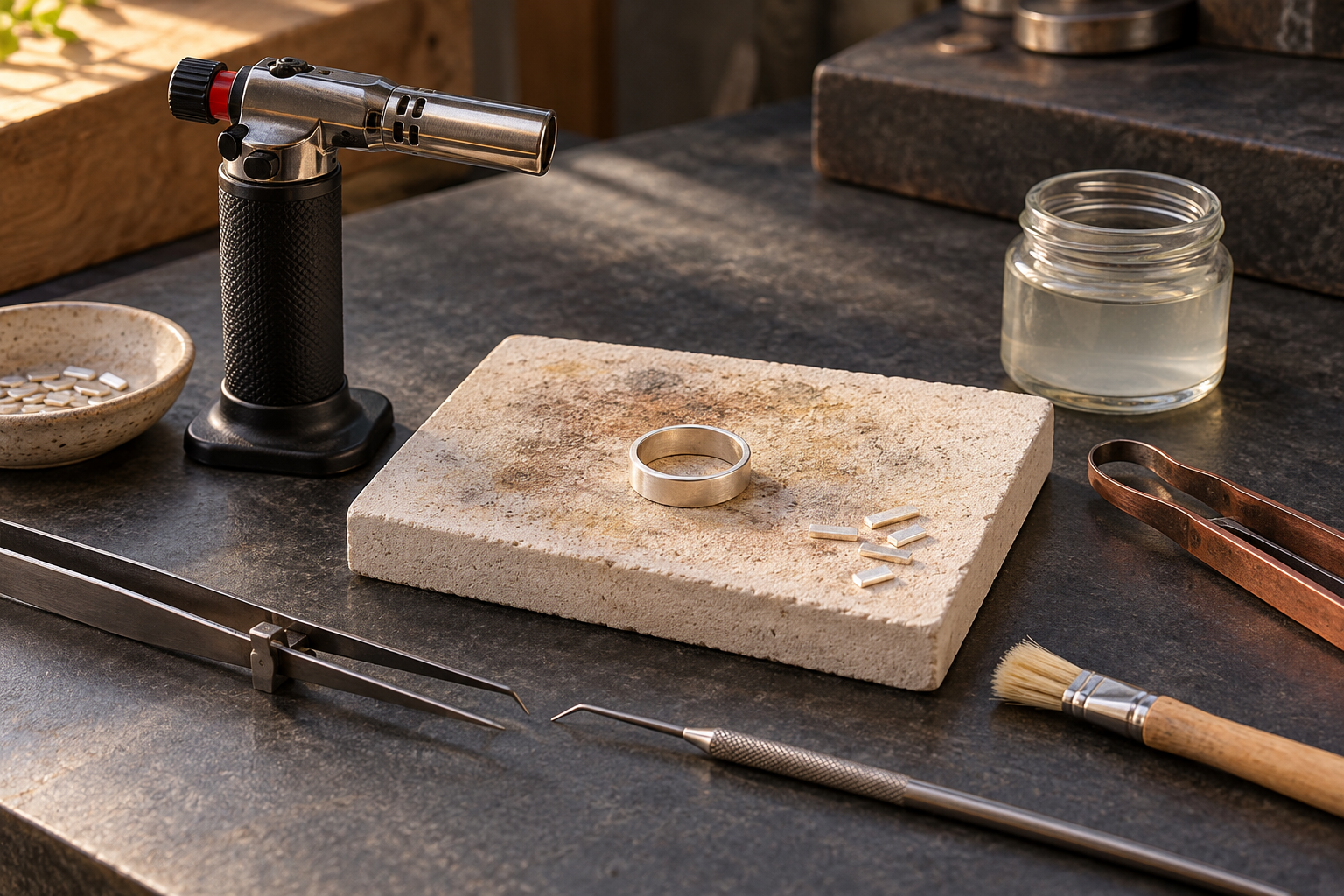
Buying guide
Best Jewelry Soldering Kits
Choose a beginner jewelry soldering kit by torch, solder, work surface and cleanup tools. Compare five researched setups and see what each still needs.
Workshop section
A practical guide to jewelry soldering tools — torches, fuel systems, soldering blocks, flux, workholding, pickle and the equipment needed for a safe home bench.
Jewelry soldering does not require a huge collection of equipment, but the tools need to work together.
At minimum, a practical jewelry soldering setup needs a torch capable of heating the size of work you make, a heat-resistant soldering surface, appropriate solder and flux, tools for positioning hot metal, and a safe way to quench and clean the piece afterward.
For small rings, jump rings and light sterling work, a refillable butane torch may be enough. As pieces become larger, heavier or more conductive, the more important question becomes heat capacity rather than simply flame temperature. Larger air-fuel or oxygen-fuel systems can deliver heat across a greater area and provide more flexibility for demanding work.
The goal is not to buy the most powerful torch. It is to build a soldering station that matches the jewelry you actually make.
| If you mainly want to… | Start by looking for… |
|---|---|
| Solder jump rings, small earrings and light components | Compact butane torch and basic soldering block |
| Make rings and small sterling pieces regularly | Torch with enough flame size to heat the whole joint area evenly |
| Solder heavier cuffs, bangles or larger assemblies | Higher-output torch system with broader flame capability |
| Work on both tiny details and larger pieces | Torch system with interchangeable tips or adjustable flame range |
| Hold awkward components in position | Cross-lock tweezers, binding wire or a third-hand system |
| Reduce oxidation and help solder flow | Flux suited to the solder and metal being joined |
| Remove oxides after heating | Dedicated pickle container and appropriate pickling solution |
| Build a permanent home soldering bench | Fire-resistant work area, ventilation and appropriate fire-safety equipment |
The exact torch and accessories depend on your work. A person mainly closing jump rings needs a very different system from someone fabricating wide silver cuffs.
A complete soldering station has several jobs to perform.
You need to:
That normally means a torch, soldering block, flux, solder, tweezers or soldering pick, workholding tools, quench container and pickle setup.
A beginner does not necessarily need the most sophisticated version of every item. The torch and safe working area deserve the most attention because they determine what size of work you can heat effectively.
The torch is the central tool in the setup, but choosing one by maximum advertised temperature alone is a mistake.
What matters is whether the flame can put enough heat into the entire workpiece before heat escapes into the surrounding metal and bench.
Refillable butane torches are attractive for beginners because they are compact, relatively simple and do not require separate gas cylinders.
They can be a practical choice for:
Their limitation is not necessarily whether the flame is technically hot enough to melt jewelry solder. The problem appears when the workpiece absorbs and dissipates heat faster than the torch can supply it.
A small torch that works comfortably on a jump ring may struggle with a thick silver bangle.
For someone learning on small-scale projects, however, starting compact can be entirely reasonable.
An air-fuel torch mixes a fuel gas with surrounding air rather than carrying a separate oxygen supply.
These systems can provide considerably more usable heat than a tiny handheld torch and may suit jewelers who regularly work on medium-sized pieces.
They also avoid some of the complexity of a dual-gas setup.
The trade-off is that they generally offer less concentrated heat than an oxygen-fuel torch, although the actual capability depends heavily on the torch, tip and fuel.
Adding oxygen allows a torch to produce a smaller, more concentrated and more intense flame.
That can be useful when:
They also introduce more equipment: cylinders or an oxygen source, regulators, hoses, compatible fittings and appropriate safety procedures.
For someone soldering small silver jewelry occasionally, that complexity may be unnecessary.
For frequent fabrication, however, greater flame range can become valuable.
One of the most useful soldering principles is simple:
Heat the workpiece appropriately, not just the solder.
Solder flows when the joint reaches the necessary temperature. Pointing a very narrow flame directly at a solder chip while the surrounding metal remains comparatively cool can produce poor results.
For larger pieces, a broader flame can often be more useful than an extremely sharp flame because it heats the surrounding metal more evenly.
For delicate work, the opposite may apply: too broad or aggressive a flame can make it difficult to control where heat goes.
This is why interchangeable tips and a good adjustment range can matter more than a headline flame-temperature figure.
Never treat the soldering block as simply somewhere to put the piece.
The surface affects heat reflection, stability and how easily you can position the work.
Common bench options include:
Soft blocks can be carved or pinned into, making them useful when a piece needs support or a custom recess.
They wear with use and may gradually become uneven.
Hard ceramic-style blocks provide a firm, reusable working surface and are useful for general bench work.
Some are designed to reflect heat efficiently; others prioritize durability.
A perforated ceramic board allows pins or wire supports to be positioned through the surface.
That can be especially useful for assemblies where several components must stay aligned.
There is no universally best soldering surface. Many benches eventually use more than one because different workholding problems favour different materials.
Flux helps keep the joint surface usable while the metal is heated.
Heating copper-containing alloys such as sterling silver promotes oxidation. Oxides interfere with clean solder flow, so flux is applied around the joint to help protect and clean the surface during heating.
Some workflows also use a broader protective coating over the piece to reduce oxidation or firescale.
Flux is not a substitute for preparation. The joint surfaces should still be clean and fit closely together.
If two components have a large gap, adding more solder usually does not solve the underlying problem.
Jewelry solder is available in different flow temperatures.
Terms such as hard, medium and easy describe relative solder flow temperatures rather than physical hardness.
A common fabrication strategy is to use higher-temperature solder for early joints and progressively lower-temperature solder for later operations. This reduces the likelihood of reopening previous seams as the piece is reheated.
That does not mean every project needs three grades.
A beginner making simple single-joint projects may only need one suitable solder initially.
Solder also comes in different forms, including:
The form mainly changes how the solder is placed and controlled. The correct alloy and flow characteristics matter more than whether it arrives as wire or sheet.
Soldering often becomes easier when you stop trying to hold everything by hand.
Useful workholding tools include:
Cross-lock tweezers remain closed until pressure is applied, which can make them useful for holding parts or supporting work.
Be aware that any metal tool touching the piece can conduct heat away from it.
A soldering pick lets you position solder and manipulate small components while heating.
It can also be useful for controlling solder placement on delicate work.
A third hand combines articulated arms with tweezers or clamps.
It is convenient for awkward assemblies, but it should not automatically be used for every joint. Large metal clamps can act as heat sinks.
Thin binding wire is often useful where several components must remain aligned without bulky clamps surrounding the joint.
The best holding method is usually the one that keeps the pieces stable while interfering with heat flow as little as possible.
Soldering leaves oxidation and flux residue on the piece.
After the work has cooled to an appropriate point, it may be quenched and then placed into a pickle solution, which removes surface oxides produced during heating.
A simple pickle station normally consists of:
Keep pickle equipment separate from food preparation equipment.
Also check the instructions for whichever chemical you use rather than assuming all pickling products are handled identically.
Understanding the workflow makes it easier to understand why each tool exists.
The surfaces being joined should be clean and fit closely.
Solder is best treated as a joining alloy rather than gap filler.
Arrange the piece so the joint stays aligned as the flux dries and the metal expands during heating.
Use tweezers, wire, pins or another support only when needed.
Apply flux to the joint and any surrounding area required by the chosen process.
Use appropriately sized solder rather than adding far more than the joint requires.
Bring the surrounding metal up to temperature evenly.
The ideal flame size depends on the mass and shape of the work.
Once the joint reaches soldering temperature, solder should flow through a properly prepared close-fitting seam.
Remove heat once the joint has flowed rather than continuing to cook the piece.
After cooling appropriately, remove oxides and flux residues before filing, sanding or polishing.
This sequence explains why buying a more powerful torch does not automatically fix soldering problems. Poor fit, contaminated metal, insufficient flux or uneven heating can all cause unsuccessful joints.
For a small home jewelry bench, you can start considerably simpler than a professional repair or fabrication shop.
A practical beginner setup might include:
Add more elaborate holding systems and higher-output torch equipment when your projects actually require them.
Buying everything at the beginning often results in paying for tools whose purpose only becomes clear later.
Upgrade because your existing torch is limiting the work, not because a larger torch appears more professional.
Signs that additional heat capacity may be useful include:
Before blaming the torch, rule out poor technique.
A piece sitting on a heat-sinking surface or held with several heavy steel clamps may be difficult to heat even with a capable torch.
If you make rings, pendants, chains, settings, bangles or fabricated components from metal, soldering quickly becomes a core bench process.
Owning the equipment lets you design around fabrication rather than limiting projects to cold connections.
Someone primarily stringing beads, assembling purchased findings or using wire-wrapping techniques may have little immediate need for a torch.
There is no reason to build a fuel-gas workstation simply because soldering appears on a traditional jeweler’s tool list.
A simple handheld torch has relatively little infrastructure.
A permanent cylinder-based installation is different. Fuel selection, regulators, hoses, ventilation, storage requirements and local fire rules all need consideration.
Learning the process in an equipped workshop can make it much easier to decide what your own bench actually requires.
Jewelry soldering involves open flame, hot metal, chemicals and potentially compressed gases.
Your work area should therefore be designed around the process rather than squeezing a torch into whatever corner of the bench is available.
At minimum, think about:
Gas components are not automatically interchangeable simply because fittings appear similar. Use equipment intended for the chosen fuel and follow the torch and regulator manufacturers’ instructions.
More heat is useful only if it suits the work.
An unnecessarily aggressive flame can make small components harder to control.
The opposite problem is common too.
A microtorch may solder earrings comfortably yet become frustrating when asked to heat a heavy cuff.
Solder should flow through a properly prepared seam.
If the components barely touch or have an obvious gap, the joint should usually be corrected before adding solder.
The surrounding metal needs to reach soldering temperature.
Trying to melt the solder directly often produces a solder ball while the joint remains too cold for proper flow.
More solder rarely compensates for poor preparation and creates more cleanup afterward.
Large clamps and tweezers conduct heat away from the piece.
Use only as much support as necessary.
Ventilation and fire safety are part of the soldering workstation, not accessories to buy later.
Starter kits are convenient, but convenience does not guarantee that every included tool matches the work you plan to make.
Evaluate the torch, soldering surface and essential accessories individually.
At minimum, you generally need a torch, heat-resistant soldering surface, appropriate solder, flux, tools for positioning or handling the work, a quench container and a method of removing oxidation after heating. A safe soldering area and ventilation are also part of the setup.
It can be. Small butane torches are useful for many small-scale jobs such as jump rings, earrings and light ring work. Their limitation becomes more noticeable as the mass and size of the work increases.
There is no single best torch. Small butane systems favour portability and simplicity; larger air-fuel systems provide greater heating capacity; oxygen-fuel systems offer wider flame-control and heat capabilities but require more equipment.
Choose according to the largest pieces you realistically expect to solder.
Some general-purpose torches can provide enough heat for jewelry fabrication, but flame size, control, ergonomics and compatibility with very small work may differ from purpose-built jeweler’s torches.
Heat output alone does not determine suitability.
You need an appropriate heat-resistant work surface. A jewelry soldering block makes positioning safer and can improve heat management compared with working on an ordinary bench surface.
You need a way to remove oxides after soldering, but a sophisticated heated pickle pot is not necessarily the first purchase a beginner must make. A dedicated chemical-safe setup appropriate to the pickling product can be sufficient for occasional work.
Common causes include insufficient heating of the parent metal, oxidation, contamination, inadequate flux or a poorly fitting joint.
Melting the solder itself is not enough; the joint must reach the correct condition and temperature for solder to flow.
A kit can be convenient if its torch and accessories match your projects. Buying individually gives you more control and may avoid accumulating low-priority tools. Evaluate the torch first, then the soldering surface and safety setup.
Once you understand the overall workstation, the individual decisions become easier to tackle separately.
Learn how different jewelry torches compare, how much heat you actually need and which systems make sense for small home benches versus heavier fabrication.
Butane, propane, air-fuel and oxygen-fuel systems solve overlapping but different problems. Compare the complexity, flame characteristics and practical limitations before committing to a permanent setup.
Soldering blocks, charcoal-style surfaces, ceramic boards and honeycomb boards each behave differently and suit different holding methods.
Learn what flux does, how hard, medium and easy solder differ, and how solder form affects placement.
Workholding, soldering picks, tweezers, quenching and pickling complete the workflow once the core heating setup is established.
If you already understand the fundamentals, compare complete torch systems and starter kits side by side to see which combination of torch, surface and accessories best fits the work you plan to make.
Which tool to buy, and which configuration fits your bench.
Buying guide
Choose a beginner jewelry soldering kit by torch, solder, work surface and cleanup tools. Compare five researched setups and see what each still needs.
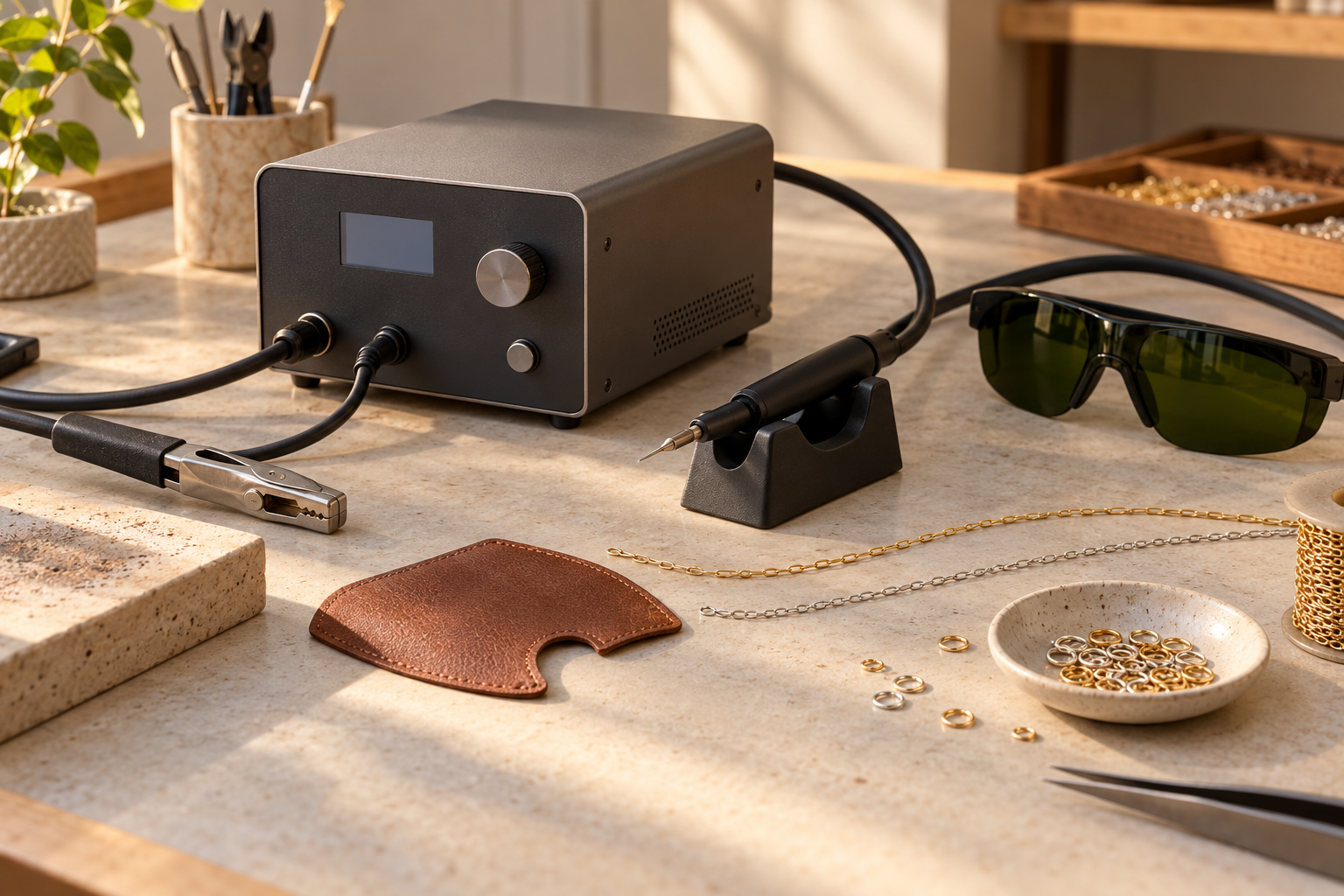
Buying guide
Compare five permanent jewelry welders by energy range, control, portability, argon setup and eye protection before building a client-safe work area.
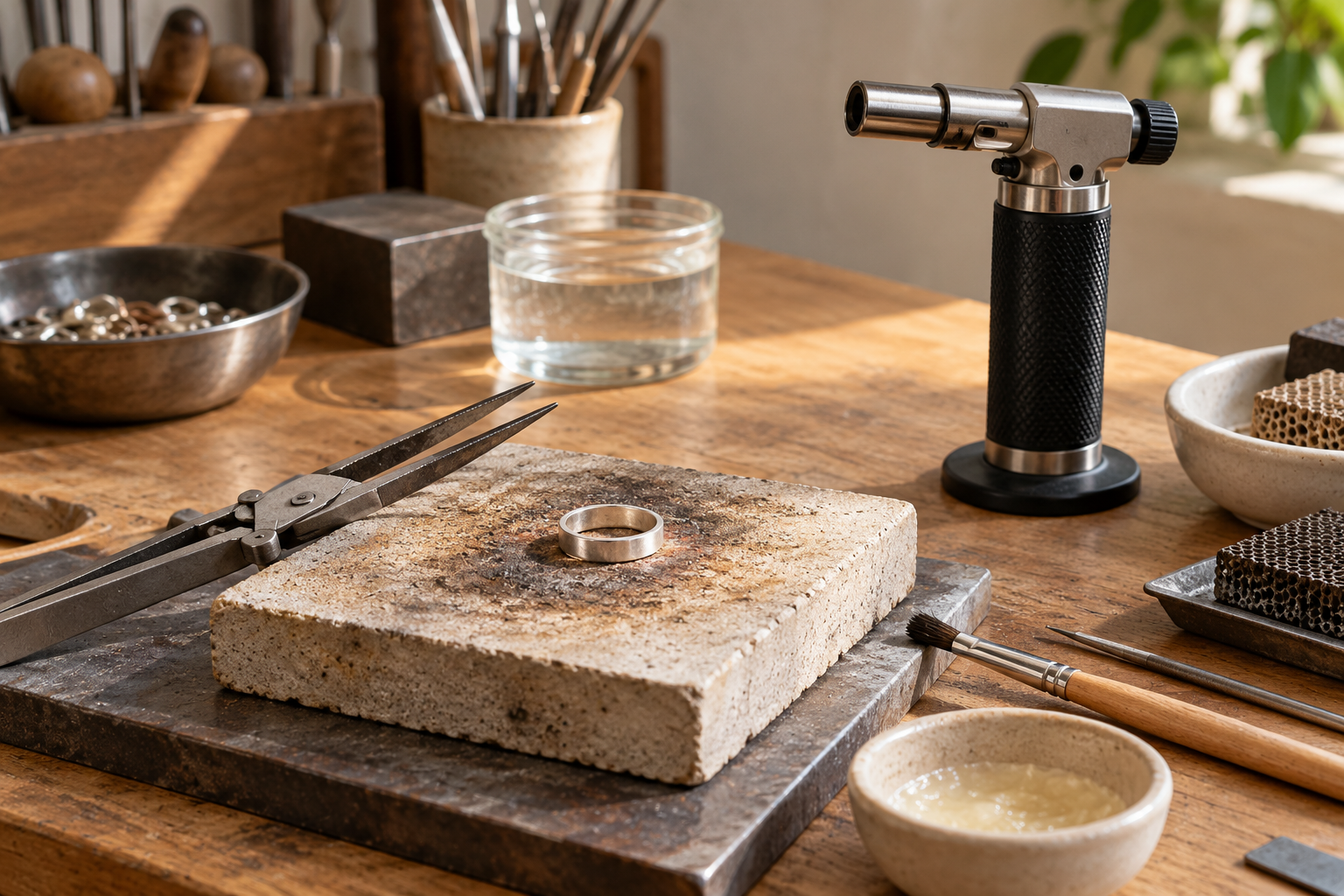
Buying guide
Choose a jewelry torch by workpiece size, flame shape and gas setup. Compare five researched tools for small repairs, bench soldering and broad heating.