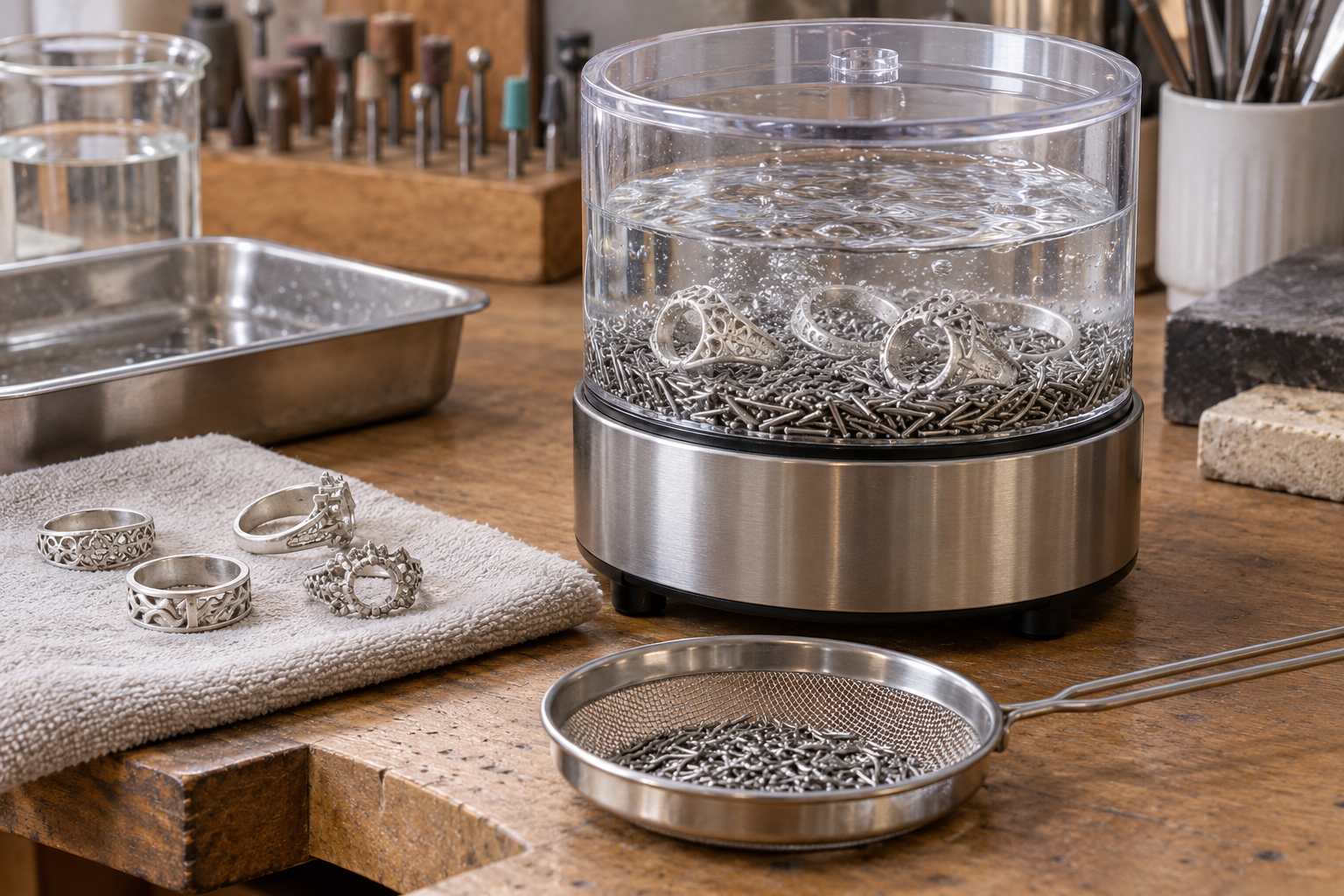
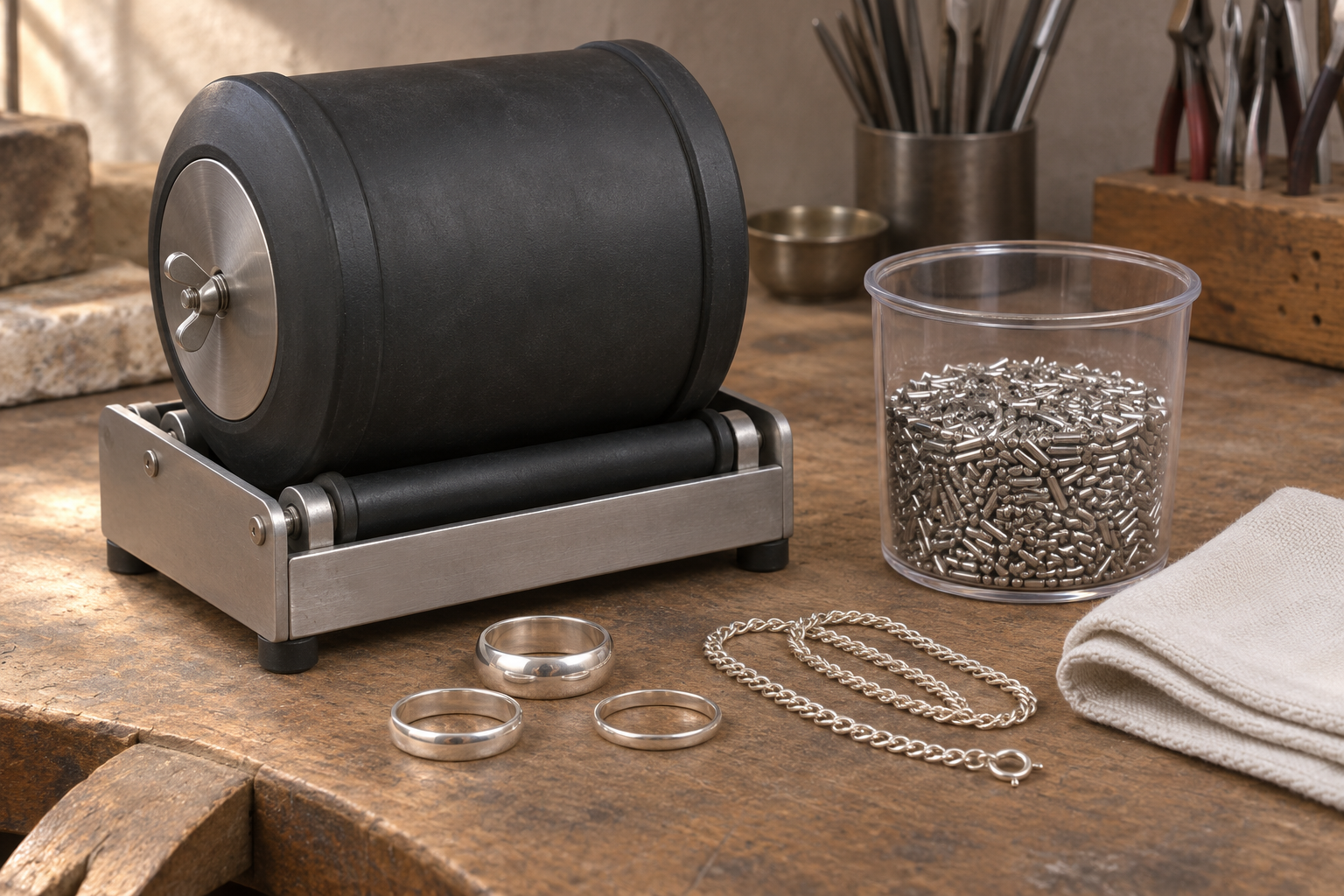
Choose a magnetic pin finisher for intricate jewelry by bowl size, batch capacity and controls. Five researched picks span a small bench to production work.
Size the bowl for the pieces you actually process, then compare controls and pin handling.
A magnetic tumbler is a useful second finishing machine when fine stainless pins need to reach filigree, galleries, chain links and tight recesses. It does not erase file marks or replace every polishing step. Choose by the size of a normal batch, how much control you need over the pin movement, and the space available for unloading and rinsing.
Quick answer
Which magnetic tumbler suits my jewelry bench?
For a few detailed pieces, start with the eight-ring Arbe KMT-15. The VEVOR KT-1851 has a larger 185 mm bowl and adjustable short cycles at a lower price tier. Foredom’s MF105 adds two bowls for a 30-ring bench workflow; Pepetools Polimag is sized for repeated batches of small castings. Raytech’s CMF-900 is a production-scale step with a 100-ring rating.
Match the bowl to your work
The maker’s ring count is a comparison point, not a promise that every shape will fit equally well. A heavy signet, a delicate chain and several hollow castings displace media differently. Leave room for pins to circulate, keep the load below the maker’s limit and test a representative batch before filling the bowl. The Raytech magnetic-finisher guide distinguishes workpiece capacity from pin capacity; check both figures rather than treating bowl diameter as the whole specification.
Choose a magnetic finisher by batch and control need
Typical work
Machine to consider
Practical reason
A few intricate rings at one bench
Arbe KMT-15
Eight-ring rating and compact four-inch bowl
Larger irregular pieces on a tight budget
VEVOR KT-1851
185 mm bowl, adjustable direction and short-cycle timer
Separate pin sizes across regular bench batches
Foredom MF105
Two bowl assemblies and a 30-ring rating
Repeated runs of small castings with variable power supply
Pepetools Polimag
Dual-voltage design, speed control and automatic reverse
Production batches beyond a bench-size bowl
Raytech CMF-900
Nine-inch bowl and 100-ring rating
Five magnetic finishers for different workloads
Best for a few detailed rings: Arbe KMT-15
Arbe rates the KMT-15 for eight rings and supplies 65 g of 0.5 × 5 mm stainless pins. Its faceted four-inch bowl keeps a small load moving without committing a large bench area to finishing. The fixed-speed machine makes sense when your process is consistent and batches are small. Its limit becomes apparent if castings regularly queue up; move to a larger bowl rather than overloading it. Arbe’s specifications also state a one-year warranty.
Best for small intricate batches
Arbe · KMT-15
Arbe Super Mini KMT-15 magnetic finisher
Price tier: $$$Upper mid-range
A small magnetic pin finisher with a faceted bowl and a maker-rated load of about eight rings.
Best for: A detail-focused bench finishing recesses in a few intricate pieces per batch.
Specs, strengths and limitations
Tumbler type
Magnetic pin
Capacity
Up to 8 rings per batch
Media included
65 g of 0.5 × 5 mm stainless pins
Strengths
Fine pins can reach narrow decorative recesses
Small footprint suits a fixed jewelry bench
Maker documents the included pin size and one-year warranty
Limitations
Small batch size
Costs more than the compact rotary choices
Fine pins require careful inspection of holes and hollow work
Best larger bowl at a lower price tier: VEVOR KT-1851
The 110 V KT-1851 has a clear 185 mm bowl, a maker-stated 800 g workpiece load, adjustable 1,400–2,000 rpm speed, reversible action and a 0–60 minute timer. That combination helps when the shape of the work, rather than a ring count, determines the batch. The large bowl needs more clear bench space and careful pin collection after each run. Check the KT-1851 model number and 110 V version, included pins, replacement bowl support and shipping for your country before ordering.
Foredom rates the MF105’s 5.25-inch bowl interior for about 30 rings and supplies two bowl assemblies and a pin separator. Separate bowls make it easier to keep 0.3 mm and 0.5 mm pins assigned to different work. The timer runs up to 120 minutes, although the appropriate cycle depends on the metal and desired finish. This is a substantial cost step above compact machines, so its value comes from a regular workflow that benefits from two bowls. Check the 115 V or 230 V plug version and the media included with the unit.
Product image unavailable
Best for separate pin-size workflows
Foredom · MF105, 115 V
Foredom MF105 magnetic finisher, 115 V
Price tier: $$$$Professional
A 30-ring magnetic finisher with two bowl assemblies, a pin separator and a 120-minute timer.
Best for: A working bench that changes pin size between delicate and heavier nonmagnetic metal pieces.
Specs, strengths and limitations
Tumbler type
Magnetic pin
Capacity
Up to 30 rings; 5.25 in bowl interior
Timer
Up to 120 minutes
Strengths
Two bowls help keep pin sizes separate
Pin separator eases unloading
Maker documents both 115 V and 230 V options
Limitations
Higher cost than compact machines
30-ring limit is too small for large production batches
Check the plug and voltage version before ordering
Best for repeated casting batches: Pepetools Polimag
The Polimag combines a large canister with adjustable speed, single-direction or automatic-reverse operation and selectable input voltage. Pepetools’ instructions describe a batch of up to 50 small to average castings with 100 g of pins; larger or more delicate shapes need a smaller test load. It suits a studio processing repeated runs and willing to dedicate space and rinse time to a larger vessel. Set the rear voltage switch to match the local supply before first use, as the maker directs.
Product image unavailable
Best for repeated small-casting runs
Pepetools · 275.10
Pepetools Polimag magnetic tumbler
Price tier: $$$$Professional
A dual-voltage magnetic finisher with a large canister, adjustable speed and automatic reverse.
Best for: A studio processing repeated batches of small castings and needing flexible power and direction control.
Specs, strengths and limitations
Tumbler type
Magnetic pin
Capacity
Up to 50 small to average castings
Media included
100 g magnetic pins and solution concentrate
Barrel / bowl material
Polycarbonate canister
Strengths
Dual-voltage switch supports different workshop power supplies
Automatic reverse and speed control suit repeat batches
Large canister handles more castings than the compact picks
Limitations
Costs more than the compact machines
Takes more space and liquid per batch
Voltage switch must match the local supply before first use
Raytech rates the CMF-900’s nine-inch bowl for the equivalent of 100 rings or up to 800 g of workpieces. It has programmable time, variable speed and forward/reverse operation, but the maker says pin media is purchased separately. Its footprint, weight and media demand only make sense when smaller machines constrain a genuine production workload. Match the 115 V #23052R or 230 V #24143R configuration to the workshop supply and confirm parts support where you operate.
Product image unavailable
Best for high-volume production
Raytech · CMF-900, 115 V (#23052R)
Raytech CMF-900 magnetic finisher, 115 V
Price tier: $$$$Professional
A nine-inch programmable magnetic finisher rated for the equivalent of 100 rings.
Best for: A production shop whose batches exceed the capacity of bench-scale magnetic finishers.
Specs, strengths and limitations
Tumbler type
Magnetic pin
Capacity
Equivalent of 100 rings; 9 in bowl
Speed
Variable
Timer
Programmable
Strengths
100-ring rating gives a clear production step-up
Forward and reverse programs suit repeatable batches
Maker lists replaceable parts and separate voltage versions
Limitations
Large footprint and heavy shipping weight
Pin media is purchased separately
More capacity than most single-bench jewelers need
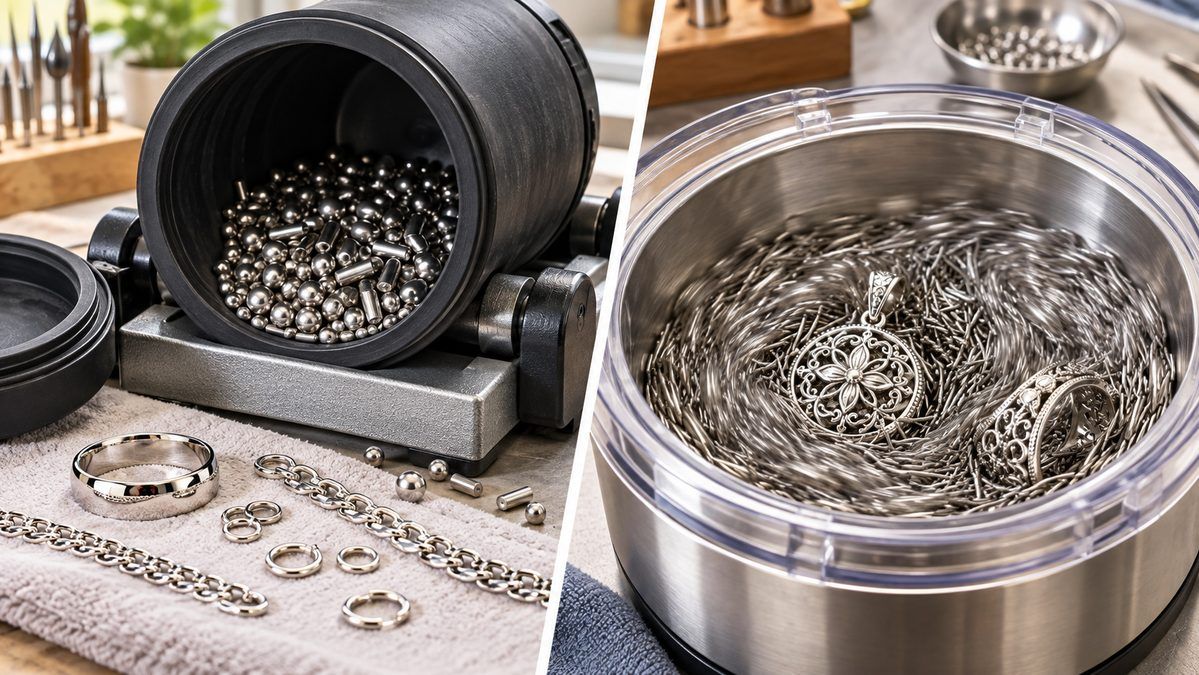
Prepare the metal first. Remove sprues, file marks and deep scratches before burnishing. Pins reach recesses, but they cannot level a rough surface into a mirror finish. See our magnetic versus rotary comparison for the different surface effects.
Choose the pin size for the geometry. Fine pins enter smaller details but can lodge in holes, hollow areas and narrow settings. Keep pin sizes separate if you switch between them.
Load for movement. Follow the maker’s pin, water, compound and workpiece limits. A crowded bowl leaves uneven action, while too little liquid or the wrong compound can impair the process.
Test, rinse and inspect. Run one representative piece before a whole batch. Rinse jewelry and media after processing, then check every recess for retained pins and every setting for damage.
Keep the machine dry and follow magnetic safety instructions. Turn the machine off before removing its bowl or handling contents. The Raytech operating instructions warn people with pacemakers not to use its magnetic finisher and require a dry environment around the base.
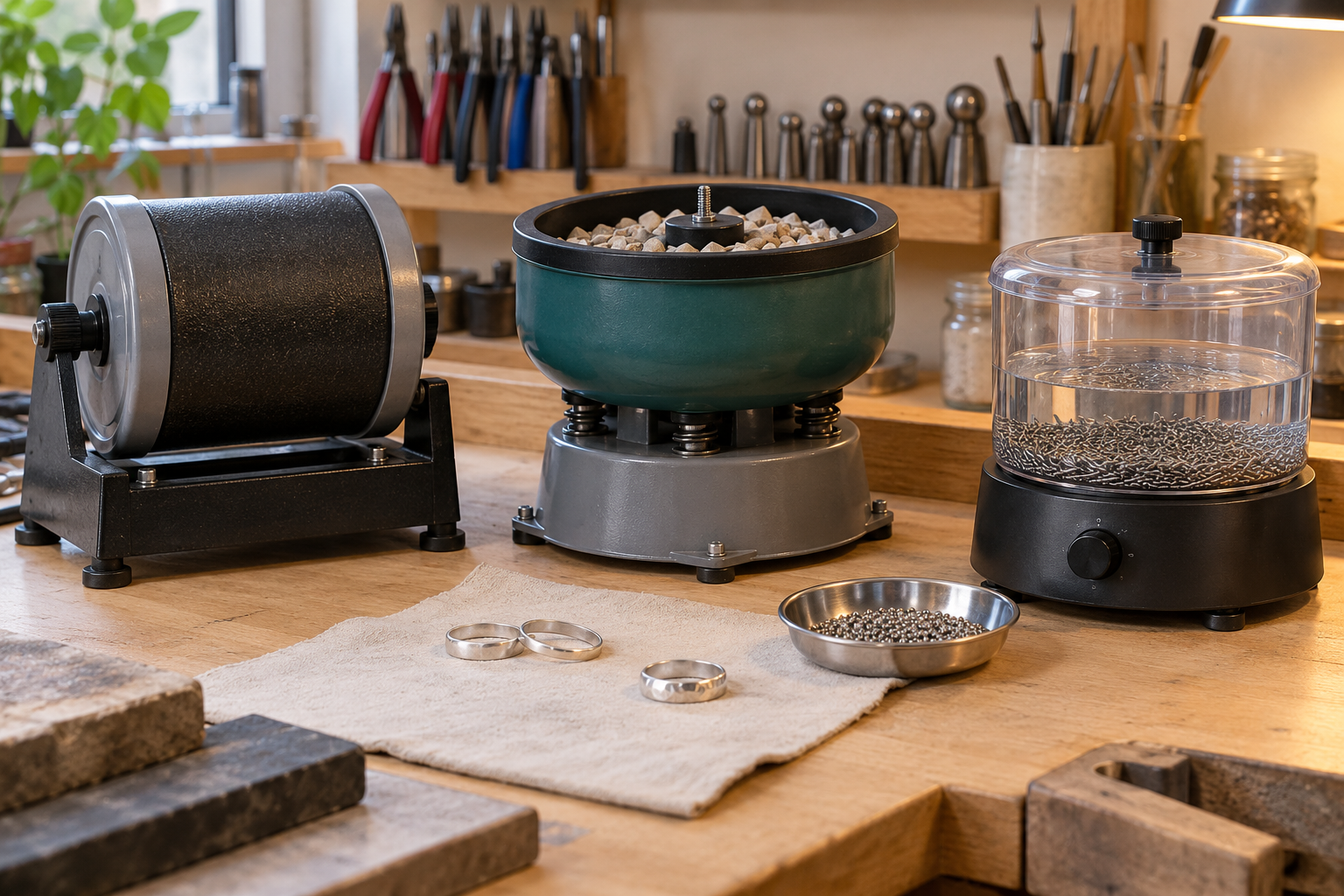
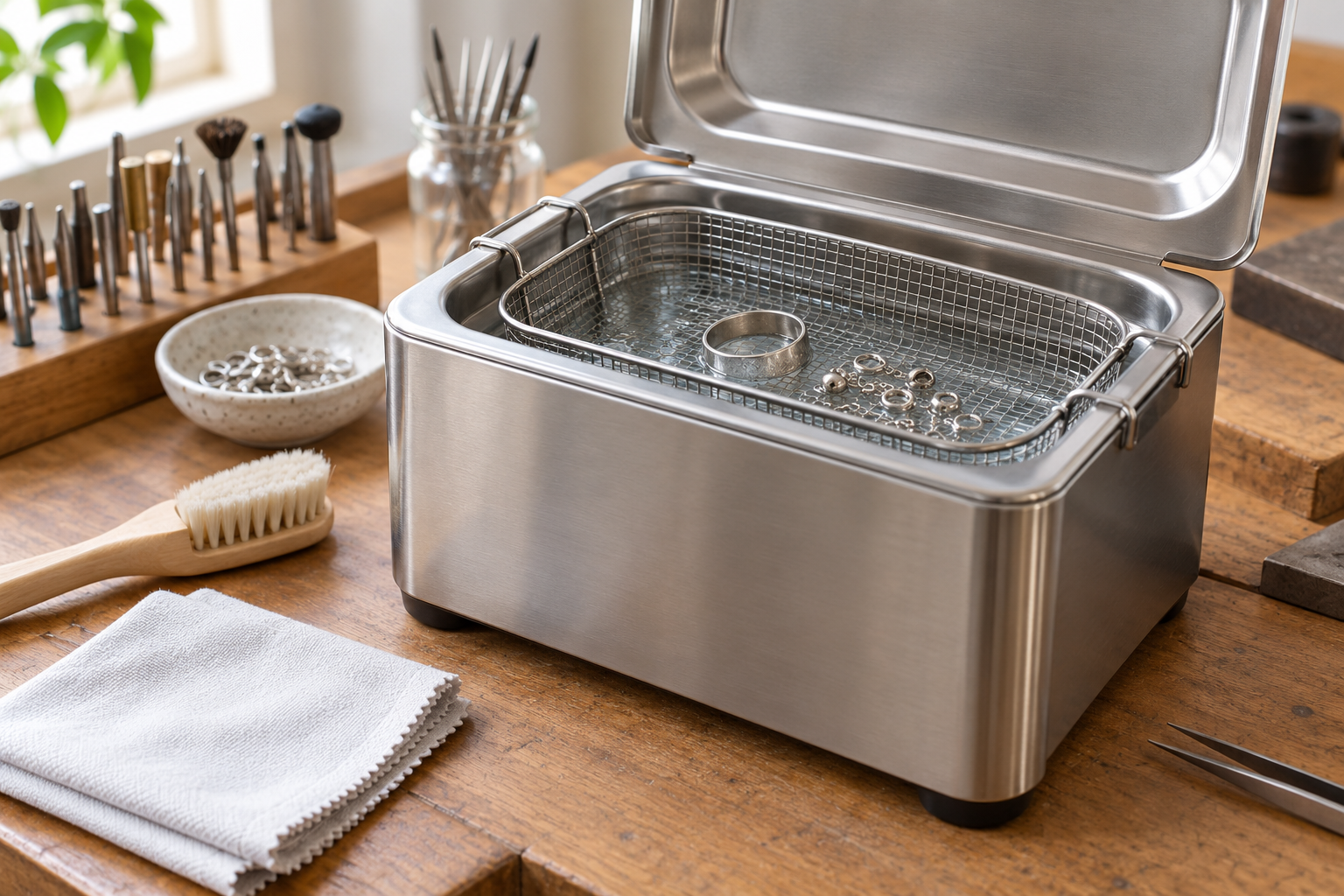
If the main task is broad burnishing of simple metal surfaces, compare the other machines in our jewelry tumbler guide. For removing dirt or polishing compound from suitable finished jewelry, see our ultrasonic cleaner guide.
Frequently asked questions
Is a magnetic tumbler the best first tumbler for jewelry?
Usually only when fine recesses are the recurring problem. A rotary barrel with suitable steel shot is a simpler first choice for general burnishing of prepared, accessible surfaces. Magnetic pins are especially useful around filigree, small castings and detailed settings.
Will magnetic pins remove scratches and leave a mirror finish?
No. File marks and deep scratches need surface preparation first. Pins burnish accessible metal and reach narrow details, but broad faces may retain a fine peened texture that needs another finishing step.
How many rings can I process at once?
Use the maker's stated capacity as a starting limit, then leave enough room for pins and jewelry to circulate. Ring counts are approximate because heavy or complex pieces occupy more of the bowl than simple bands.
What should I check before processing set jewelry?
Check the stone, treatment, setting security and maker guidance. Fragile or porous stones and loose settings may be damaged. Test a representative piece, and inspect small holes and settings for trapped pins after the cycle.
Tools in this guide
Arbe
Arbe Super Mini KMT-15 magnetic finisher
$$$A detail-focused bench finishing recesses in a few intricate pieces per batch.
We have not personally used every product in this guide. Recommendations are based on specifications, manufacturer documentation, specialist references and owner experiences.
Specifications come from manufacturer documentation where it is available.
Specialist references, supplier catalogs and owner experiences are used to understand real-world strengths and weaknesses.
We do not claim physical testing, and we do not publish scores or star ratings.
Choose a rotary tumbler for jewelry by barrel size, batch separation and controls. Five researched picks cover a small bench through production burnishing.