Buying guide
Best Jeweler's Saw
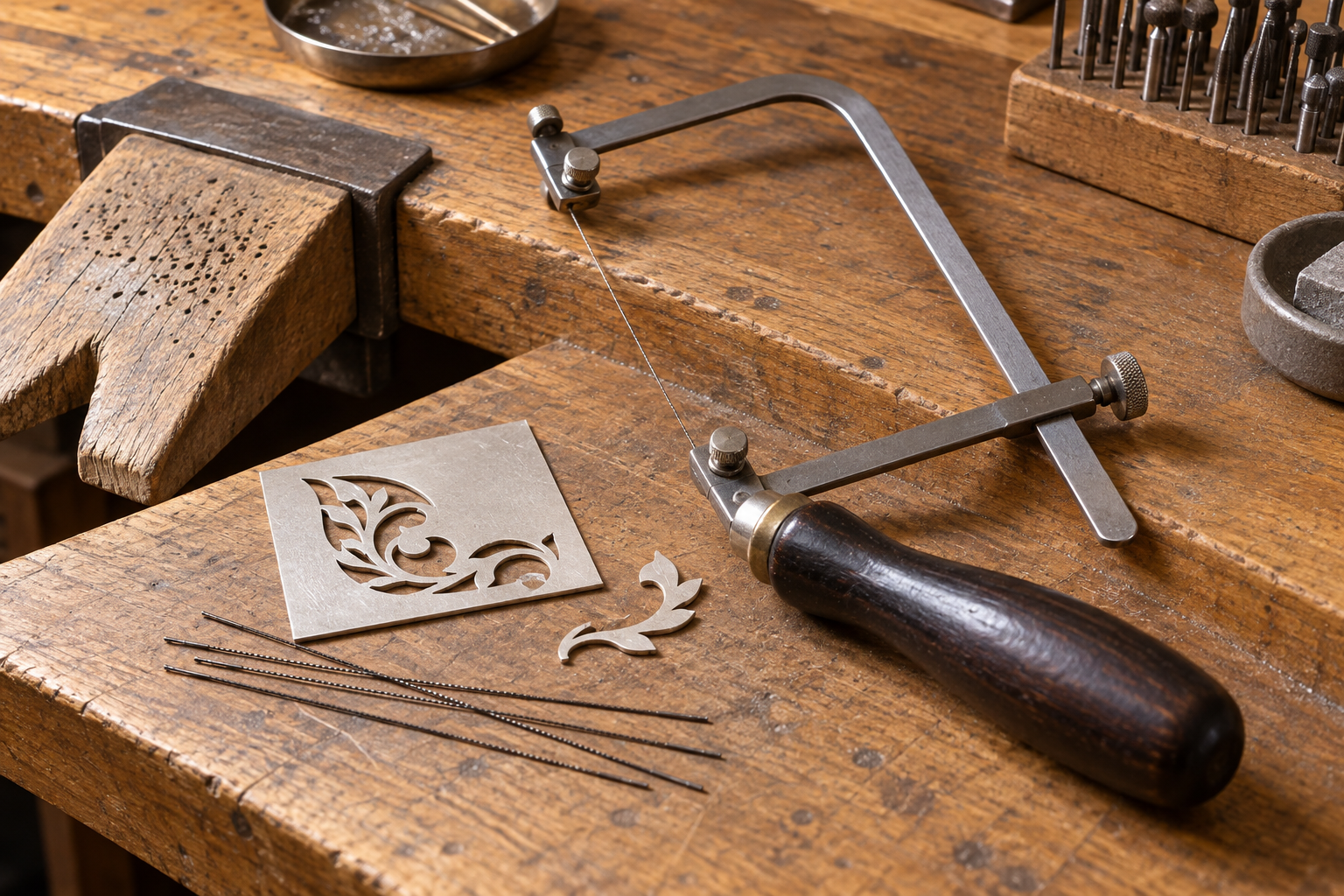
Compare jeweler's saw frames by throat depth, blade tension, clamps and grip, from a simple adjustable starter frame to a cam-lever saw for repeated piercing.
Workshop section
How to choose jewelry cutting tools — when to use a jeweler's saw, saw blades, flush cutters, shears or a disc cutter, and what to buy first for your bench.
Cutting is one of the first bench skills that changes what you can make from raw metal. Wire needs trimming to length. Sheet needs roughing out before filing. Pendants and earrings may need detailed outlines cut from metal, while pierced designs require you to cut shapes from inside the workpiece.
There is no single jewelry cutting tool that handles all of these jobs equally well.
For most bench jewelers, a jeweler’s saw is the most versatile cutting tool because it can cut sheet, wire, tubing, curves and internal shapes. Wire cutters are faster for wire and findings, shears are useful for straightforward cuts in suitable sheet, and specialized punches or disc cutters make sense when you need the same shape repeatedly.
The right choice depends less on how expensive the tool is and more on what material you are cutting, its thickness and how controlled the finished cut needs to be.
| If you mainly want to… | Start with… | Why |
|---|---|---|
| Cut shapes from metal sheet | Jeweler's saw | Gives much greater control over curves and detailed outlines. |
| Pierce openings inside sheet | Jeweler's saw | The blade can be threaded through a drilled opening. |
| Cut thick wire or tubing cleanly | Jeweler's saw | Produces a controlled cut without crushing the material. |
| Trim thin wire and findings quickly | Flush or side cutters | Faster than setting up a saw. |
| Make simple cuts in suitable sheet | Jewelry shears or snips | Quick for relatively straightforward cuts. |
| Produce many identical metal circles | Disc cutter | Faster and more consistent than sawing every circle individually. |
| Separate heavy stock or sprues | Heavy-duty cutter or appropriate saw | Prevents overloading delicate flush cutters. |
You do not need every cutting tool when setting up a first bench. A saw frame, an appropriate selection of blades and one suitable pair of wire cutters cover a surprisingly large amount of beginner work.
A jeweler’s saw — also called a piercing saw — holds a very fine replaceable blade under tension. Unlike ordinary workshop saws, it is designed to make controlled cuts through relatively small pieces of metal.
Its main advantage is versatility.
A saw can be used to cut:
For an external shape, you normally cut inward from the edge of the sheet. For an internal pierced shape, a small hole is drilled first, the saw blade is passed through the hole and then reattached to the frame.
This ability to cut both around and inside a design is one reason a jeweler’s saw remains such a fundamental bench tool.
The frame holds and tensions the blade, but buying the largest or most elaborate frame is not automatically better.
The main considerations are throat depth, rigidity, weight, blade tensioning and how comfortably the frame can be controlled. A deeper frame allows you to reach farther into a large sheet, but most small jewelry pieces do not require extreme depth.
For many beginners, a conventional adjustable frame is sufficient. Better frames can offer improved stiffness, ergonomics or faster blade changes, but technique and correct blade selection matter at least as much as frame price.
A jeweler’s saw frame is only half of the system. The blade determines how aggressively and cleanly the metal is cut.
Jewelry saw blades use an unusual numbering system. Very fine blades carry “aught” sizes such as 2/0, 4/0 and 6/0. Moving toward larger positive numbers gives you progressively heavier blades.
The correct blade is not simply the finest blade you can buy.
Thin sheet and intricate work generally suit finer blades. Thicker material needs a coarser blade so that the teeth can clear chips properly instead of rubbing, clogging or breaking.
A useful rule is to choose a blade that keeps several teeth engaged with the material thickness during the cut. In practice, the exact size also depends on how tight the curves are and how delicate the work is.
That means it is normal to keep several blade sizes at the bench rather than using one size for every job.
Breaking blades is normal when learning, but repeated breakage usually points to technique or setup rather than simply poor blades.
Common causes include:
A properly tensioned saw should do most of its cutting on the stroke without excessive forward pressure. Supporting the metal firmly on a bench pin also makes control considerably easier — see our bench setup guide for how to position one.
Blade lubricant can reduce friction, but it cannot compensate for poor tension or an unsuitable blade.
For wire, jump rings, head pins and findings, reaching for cutters is often much quicker than setting up a saw.
But jewelry cutters come in different forms.
Flush cutters are designed so one side of the cut is flatter than the wedge-shaped cut produced by many general-purpose cutters.
That can reduce cleanup when trimming wire close to a component.
The limitation is capacity. Fine flush cutters are not meant for every gauge or hardness of wire. Cutting stock beyond the tool’s intended range can damage the cutting edges.
Side cutters are general-purpose cutting pliers that handle many everyday jewelry tasks.
They are useful when the finish of the cut will later be filed, hidden or otherwise refined. They can also be more appropriate than very delicate flush cutters for heavier routine work, provided the manufacturer’s capacity is respected.
Heavy wire, hard wire, sprues and other substantial stock may require a dedicated heavy-duty cutter.
The mistake is assuming one small cutter can cover everything from fine beading wire to heavy sterling stock.
If cutting force suddenly becomes excessive, moving to a more suitable tool is generally better than squeezing harder.
Jewelry shears and metal snips can make quick cuts through suitable sheet without installing a saw blade.
They are useful for rough cutting, trimming sheet and some relatively simple outlines.
Their limitation is control.
A pair of shears physically displaces the metal as it cuts. Depending on the material and tool, this can distort the edge or surrounding sheet more than a saw would. Tight internal shapes and detailed curves are also much harder to produce.
For that reason:
Use shears when speed matters more than a precise finished outline. Use a jeweler’s saw when the cut itself needs to follow the design accurately.
Many jewelers use both: shears to remove excess material quickly and a saw for the controlled portion of the job.
Sawing a circle by hand is entirely possible, but producing ten circles with matching diameters is a different problem.
A disc cutter uses hardened punches and matching openings to shear circular blanks from sheet.
It is most useful for:
A disc cutter therefore does not replace a jeweler’s saw. It replaces a repetitive sawing operation with a faster and more consistent one.
Before buying one, pay attention to the available diameter range, the type and thickness of metal you intend to cut and the force required to use it. Some users will also need a suitable hammer or press depending on the cutter design.
If you only make an occasional circle, careful sawing may be sufficient. Once identical circles become a recurring part of your work, the specialist tool becomes easier to justify.
Think about the finished edge first.
The saw is usually the strongest choice for:
It takes longer than simply clipping a wire, but it gives you much more control over where material is removed.
Cutters make sense when the workpiece fits comfortably within the tool’s intended capacity and the job consists mainly of shortening or trimming.
Examples include:
The cut end may still need filing depending on the tool and application.
Shears are useful for quickly reducing larger sheet or creating basic straight or gently curved cuts.
They are less suitable when a precise outline is part of the final design.
A specialist cutting tool becomes attractive when it repeatedly replaces a slow manual operation.
Disc cutters are the obvious example, but the same decision principle applies to other shape punches and production tooling.
Usually not.
A beginner’s priority should be obtaining tools that function properly and learning how each cutting method behaves.
A sensible first cutting setup is often:
That setup handles far more work than a drawer full of specialized cutting tools.
More expensive saw frames can improve ergonomics, stiffness and blade-changing convenience. Premium cutters may give better alignment, edge geometry or durability. Those differences become more valuable as the tool gets used frequently.
But paying more does not remove the need to match the tool to the job.
Start with the metal, thickness and shape you actually expect to cut.
A tool intended for fine copper or silver wire is not automatically suitable for hardened wire or heavy stock. Likewise, a blade selected for delicate sheet may be unnecessarily fragile when cutting something substantially thicker.
This matters particularly for cutters and specialty punches.
Check what the manufacturer actually specifies for material type and thickness rather than assuming a physically large tool can cut anything that fits between its jaws.
Saw blades are consumables. You will break them, wear them out and use different sizes.
A saw frame therefore belongs to an ongoing system that includes blades, lubricant, bench support and occasionally drill bits for pierced openings.
Consumable availability can matter more than a minor feature difference between frames.
Few jewelry cutting methods leave every surface completely finished.
Saw marks may need filing. Cutter ends may need flattening. Sheared sheet may need edge refinement. Punched blanks may still require deburring.
A faster cut is not necessarily faster overall if it creates significantly more finishing work.
A disc cutter can be extremely useful for someone making circular earrings every week and unnecessary for someone who rarely uses round blanks.
The same logic applies to expensive precision saw frames and heavy-duty cutters.
Buy the general-purpose tool first. Add the specialist tool when a repeated task shows you exactly what problem it will solve.
This can nick or misalign cutting edges. Check the stated capacity and use a saw or heavier tool when appropriate.
A blade that is too fine for thick metal cuts slowly and can clog or break more easily.
Match the blade to the work rather than equating finer with better.
Jeweler’s saws respond better to controlled strokes than excessive forward pressure. Let the teeth remove material and turn the work gradually rather than twisting the blade.
Metal should be well supported close to the cut. Excessive vibration makes the cut harder to control and contributes to blade breakage.
Cutting gets the workpiece close to its final shape.
Files, abrasives and other finishing tools still play an important role in bringing an edge to its final line and surface quality.
It is difficult to know which production tools matter until you have established a workflow.
Start with versatile tools and allow repeated jobs to determine what you buy next.
Anyone moving beyond assembling prefabricated findings will eventually benefit from proper bench cutting tools.
A jeweler’s saw becomes especially useful when you start working with:
Someone mainly stringing beads or assembling purchased components may only need wire cutters initially.
A disc cutter, premium saw frame or multiple specialized cutters can wait until fabrication becomes a regular part of the work.
The important distinction is between tools that unlock a new process and tools that merely make an existing process faster.
A saw unlocks a large range of fabrication techniques. A disc cutter mainly accelerates one type of shape-making. That makes the saw a much higher priority for a developing bench.
For metal fabrication, a jeweler’s saw is usually the most versatile. It can cut sheet, wire, tubing, curves and internal pierced shapes. A pair of suitable wire cutters is the other basic cutting tool worth having early.
Not effectively in most cases. Wire cutters are shaped for relatively narrow stock. Jewelry shears can handle suitable sheet for simple cuts, while a jeweler’s saw provides much better control for accurate shapes.
There is no single correct beginner blade because blade size should match material thickness. Keeping a small selection of commonly useful blade sizes is better than trying to use one blade for everything.
Common causes include poor blade tension, excessive forward force, twisting the blade through curves, inadequate support and choosing a blade that is too fine for the material.
They are better when you specifically want one side of the cut to be relatively flat. They are not automatically better for heavier wire, and fine flush cutters should not be overloaded beyond their intended capacity.
Not necessarily when starting. A saw is more versatile. Shears become useful when you frequently make quick, relatively simple cuts in sheet and want to save time.
It is worth considering if you repeatedly need clean, consistently sized circular blanks. For occasional circles or irregular designs, a jeweler’s saw remains more flexible.
Start with a saw frame, several suitable blades, good support at the bench and a pair of cutters matched to the wire you use. Add shears, disc cutters and other specialist tools when your projects create a recurring need for them.
Detailed guides to saw frames, saw blades and jewelry cutters are in development. In the meantime, the principles above cover the decisions that matter most for a first cutting kit.
Cutting is only one part of fabrication. Once the blank has been cut, filing, drilling, forming, soldering and polishing determine how the finished piece comes together.
Which tool to buy, and which configuration fits your bench.
Buying guide
Compare jeweler's saw frames by throat depth, blade tension, clamps and grip, from a simple adjustable starter frame to a cam-lever saw for repeated piercing.