Buying guide
Best Rolling Mills for Home Jewelers
Choose the right jewelry rolling mill by roller width, configuration, gearing and bench space, with a research-based look at budget and professional options.
Workshop section
Learn how to choose a jewelry rolling mill, including roller width, combination vs flat rollers, gear ratios, brands, uses and whether you need one at all.
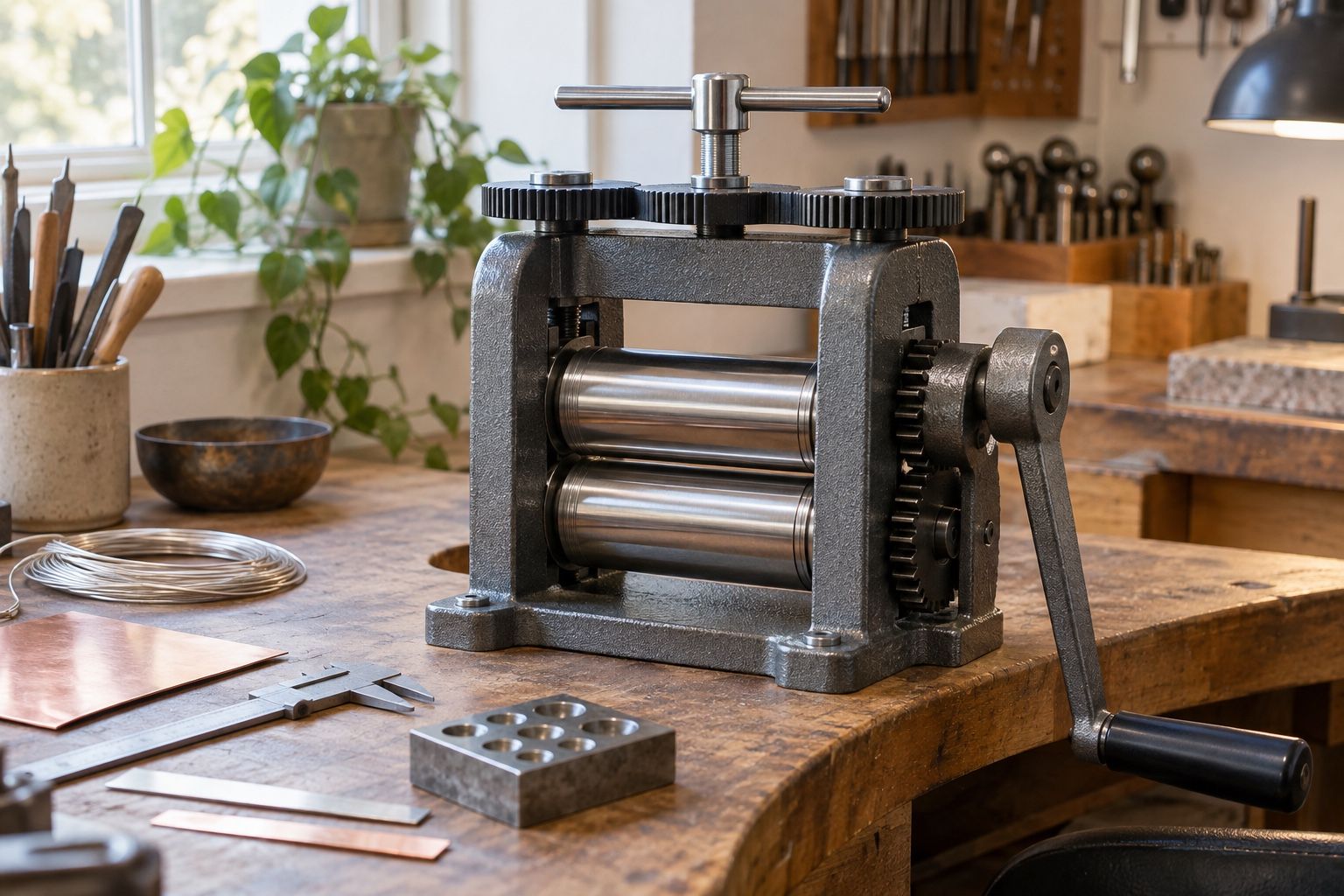
A jewelry rolling mill uses hardened steel rollers to compress, flatten, texture or reshape metal. Jewelers use them to reduce sheet thickness, resize wire, imprint textures and turn melted scrap or thick stock into material that can be worked again.
For a home jewelry workshop, choosing the right mill is mostly about roller width, roller configuration, gearing and build quality rather than simply buying the most expensive model.
For many home jewelers, a manual combination mill around the 100–110 mm class is a useful starting point because it can handle both sheet and wire without taking up as much bench space as a larger mill. That does not make it the right choice for everyone: someone working mainly with wide sheet may be better served by flat rollers, while a jeweler who buys all of their metal pre-sized may not need a rolling mill yet.
If you are comparing rolling mills, start with the work you actually expect to do.
| If you mainly want to… | Look for… |
|---|---|
| Roll sheet for rings, pendants and small projects | Adequate flat roller width |
| Make both sheet and square wire | Combination rollers |
| Roll relatively wide sheet | Wider flat rollers |
| Reduce heavy stock with less effort | Geared mill |
| Texture metal | Smooth, accurately aligned rollers |
| Recycle scrap into usable stock | Strong frame and sufficient roller capacity |
| Work occasionally at home | Manual mill |
| Produce repeatedly or in volume | Consider a powered mill |
The specification that matters most is therefore not necessarily the largest number on the product page. It is whether the mill’s usable working area matches the metal you expect to put through it.
Rolling mills compress metal between two rollers. Moving the rollers closer together reduces the thickness of the material as it passes through.
That makes the mill useful for several common jewelry-making jobs.
You can use one to roll sheet thinner, reduce square or rectangular wire, prepare stock from ingots, texture annealed metal and gradually bring recycled metal back to useful dimensions.
A rolling mill does not replace every forming tool on the bench. You will still use tools such as hammers, mandrels, stakes, drawplates and presses for jobs that require bending, stretching, drawing or three-dimensional forming.
Think of the rolling mill primarily as a controlled metal-reduction tool.
Roller width determines the widest piece of sheet that can physically pass through the useful flat portion of the mill.
Common compact jewelry mills fall around the 80–130 mm range, although both smaller and considerably larger mills exist.
For many home workshops, mills around 100–110 mm provide a practical middle ground between usable capacity, cost and bench space.
However, the number printed in the specification does not always tell you the usable sheet width.
On a combination rolling mill, part of the roller may contain grooves for rolling wire. A mill advertised as having 110 mm rollers therefore might not provide 110 mm of uninterrupted flat rolling surface.
That distinction becomes important if you make wider cuffs, bangles, boxes or larger sheet-metal pieces.
Read our detailed guide to choosing the right rolling mill size before deciding how much width you actually need.
The next decision is whether you want combination rollers or fully flat rollers.
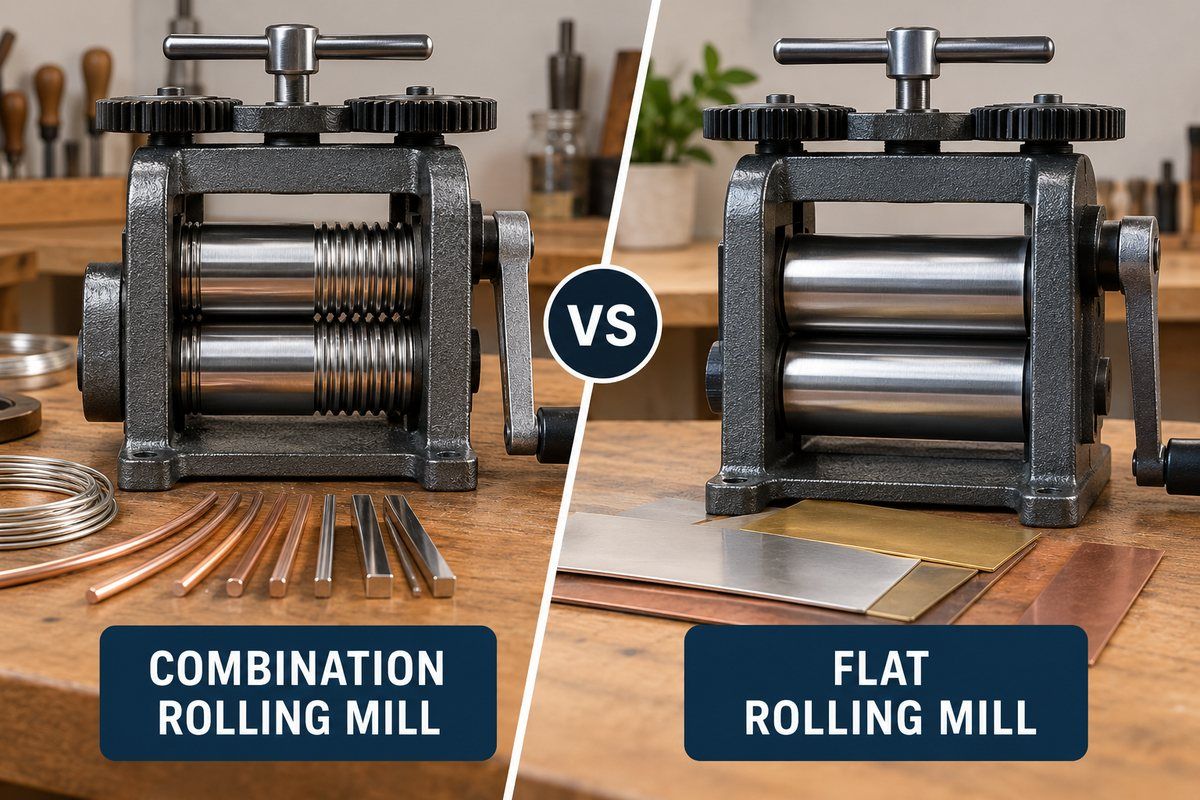
A combination rolling mill divides its working surface between smooth flat rollers and shaped grooves. The grooves are normally used to reduce square wire or other stock while the flat portion handles sheet.
This makes combination mills attractive for general-purpose jewelry benches because one machine can handle several jobs.
The trade-off is usable sheet width.
A flat rolling mill dedicates almost the entire roller face to sheet. If most of your work involves sheet metal rather than wire, that additional uninterrupted width can be more valuable than having wire grooves.
There is no universally better configuration.
A beginner making rings, earrings and small fabricated pieces may appreciate the versatility of a combination mill. Someone making larger sheet-based work may quickly find the narrower flat section restrictive.
Our combination vs flat rolling mill comparison explains the trade-offs in more detail.
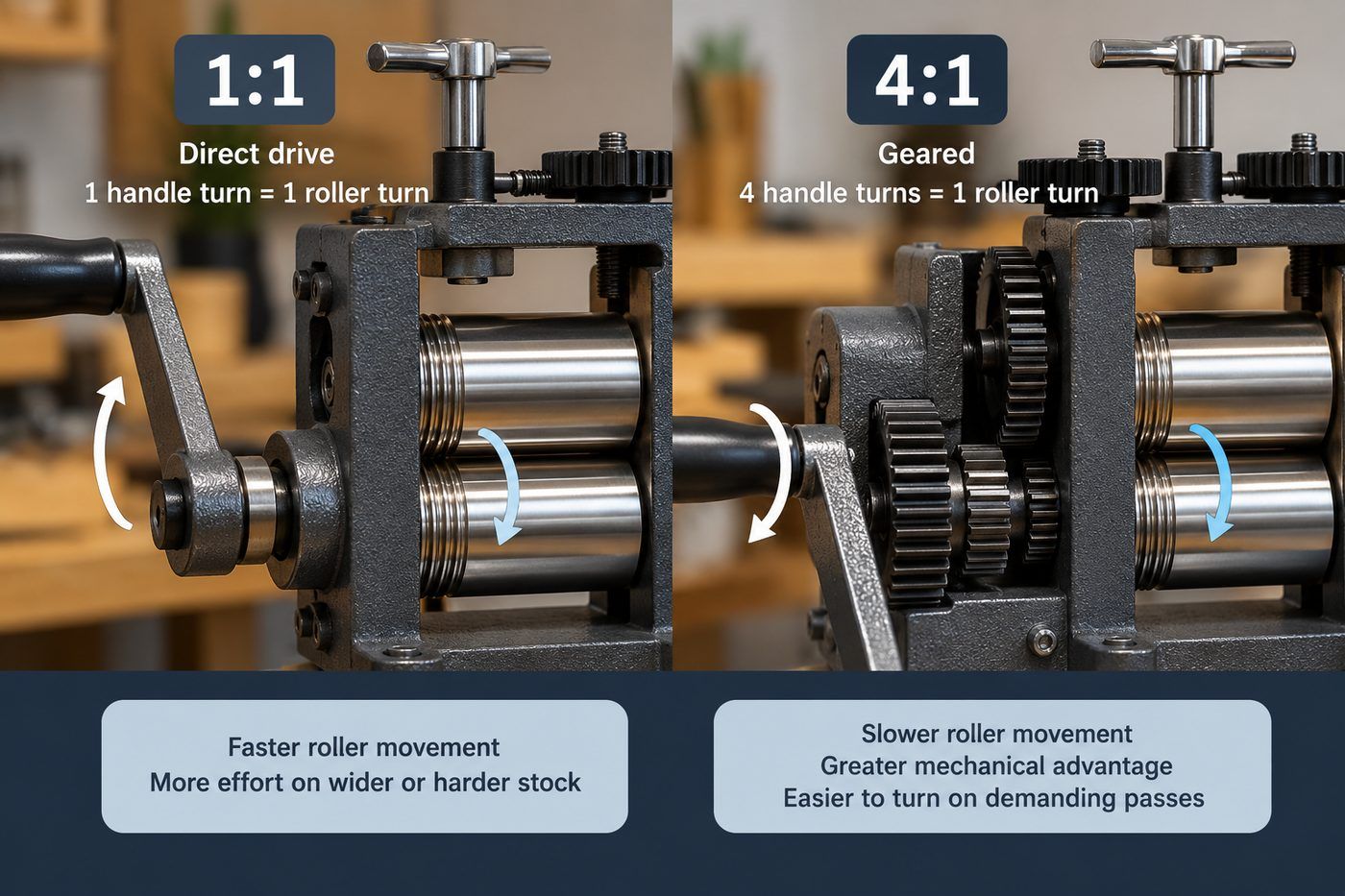
When you turn the handle of a geared rolling mill, internal gears trade handle speed for mechanical advantage.
A higher reduction ratio generally means you turn the handle more times to rotate the rollers, but each turn requires less effort.
For example, a heavily geared mill can feel considerably easier to operate when reducing thicker stock than a direct-drive mill where the handle turns the rollers more directly.
This becomes increasingly useful when you work with wider material, make larger reductions or use the mill frequently.
Gearing does not mean you should force very large reductions through the mill in a single pass. Jewelry metal is normally reduced gradually, with annealing when required for the alloy and process.
If specifications such as 4:1 or 5:1 are confusing, see our guide to rolling mill gear ratios.
Two rolling mills with similar specifications can feel very different in use.
The quality of the rollers, bearings, gears, frame, adjustment mechanism and machining all affect how consistently the mill operates.
Important practical considerations include roller alignment, smooth adjustment, gear backlash, frame rigidity, roller finish and the availability of replacement parts or manufacturer support.
This is one reason inexpensive mills and established jewelry-tool brands can have very different prices even when their basic dimensions appear similar.
A budget mill can still be appropriate for occasional hobby use, particularly if you are comfortable checking alignment and setup.
A more expensive mill may make more sense when consistency, long-term serviceability and frequent use matter more than minimizing the initial purchase price.
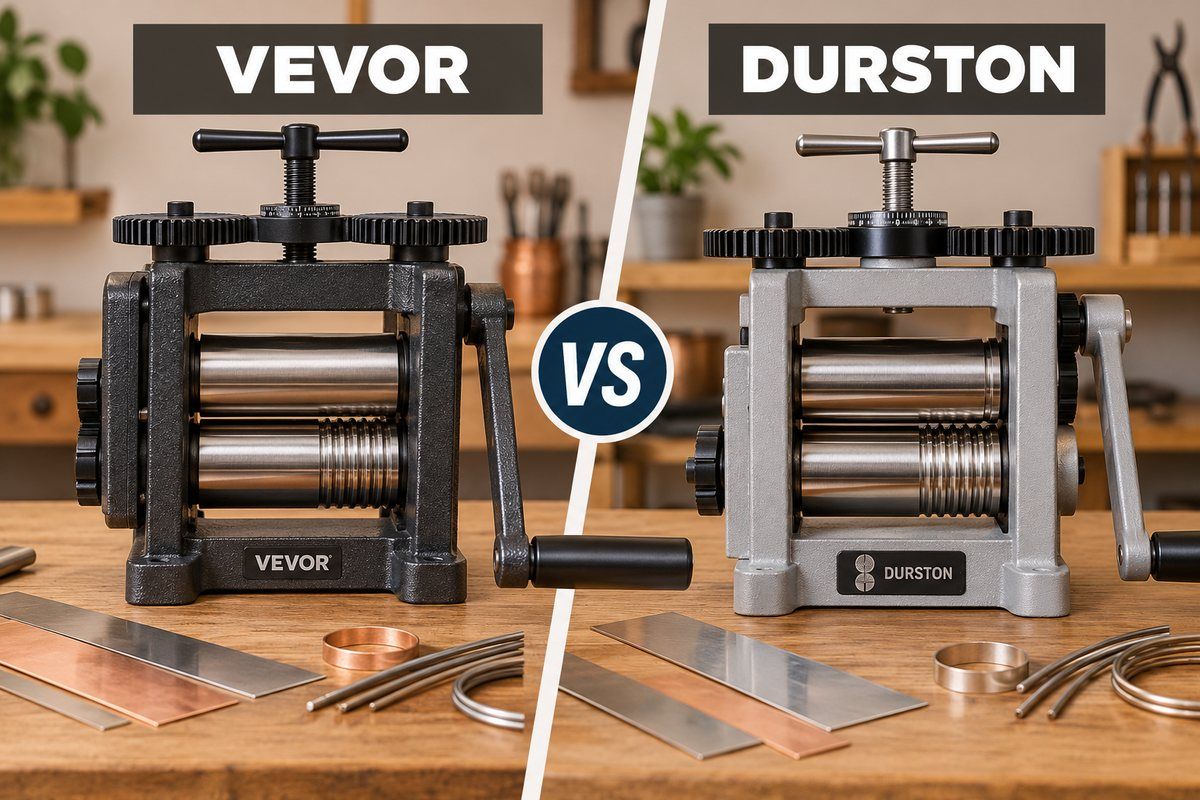
Our VEVOR vs Durston rolling mill comparison examines this decision using two very different positions in the market.
Most home jewelry benches use a manual rolling mill.
A hand crank keeps the machine relatively compact, reduces cost and gives the jeweler direct control over each pass.
For small-batch jewelry work, that is often sufficient.
Powered rolling mills become more attractive when rolling is repetitive, the stock is large or production volume makes repeated hand cranking inefficient.
They also require a substantially larger budget and introduce additional space and safety considerations.
For someone assembling a first or second home jewelry bench, buying a good manual mill is usually more practical than paying immediately for powered equipment.
Not every jewelry maker needs one.
If you purchase sheet and wire in exactly the dimensions you use and rarely texture or recycle metal, other tools may improve your workshop more than a rolling mill.
A mill becomes much easier to justify when you regularly need to change metal thickness rather than ordering another size of stock.
It is particularly useful if you want to recycle clean scrap, roll your own sheet, create wire stock, experiment with textures or gain more control over the dimensions of your material.
Because a good mill can occupy both significant bench space and budget, it is worth identifying the problem it will solve before buying one.
If you are still deciding whether the investment makes sense, start with our guide to the best rolling mills for jewelry making.
A rolling mill becomes particularly useful once you begin fabricating jewelry rather than assembling mostly pre-made components.
Typical projects include ring shanks, bezel stock, pendants, earrings, textured sheet, bracelet components and custom wire.
It also allows you to reuse offcuts more effectively.
Scrap can be melted into an ingot and progressively rolled into sheet or wire stock, although producing clean and consistent material requires more than simply feeding an ingot through the rollers. The metal must be prepared, reduced progressively and annealed appropriately during the process.
One of the easiest mistakes is buying according to the advertised roller width without checking how much of that width is actually flat.
Another is assuming that larger automatically means better. A wide, heavy mill can be excellent equipment, but it also occupies more bench space and costs more. If your work consists mainly of small rings and earrings, that additional capacity may rarely be used.
It is also easy to focus entirely on the rollers and overlook gearing. The difference becomes much more noticeable once you start reducing heavier stock.
Finally, consider how the mill will be mounted. Rolling generates considerable force at the handle. A mill that moves around the bench is frustrating to use and potentially unsafe, so the bench or dedicated stand needs to be rigid enough to support it.
There is no single best size, but the 100–110 mm class is a common practical range for home jewelry workshops. The more important measurement is the usable flat roller width required for the pieces you intend to make.
A combination mill is often convenient for beginners because it can roll both sheet and wire. The disadvantage is that the wire grooves reduce the width available for flat sheet.
A combination rolling mill can progressively reduce suitable metal stock using grooves in the rollers. A drawplate may still be required when you need accurately sized round wire or want to continue reducing wire beyond what the mill produces.
Yes. Annealed metal can be rolled with suitable texture materials or pattern plates to transfer a surface pattern. The materials used and the pressure applied must be appropriate for the mill because excessively hard or unsuitable materials can damage the rollers.
A budget rolling mill can be adequate for occasional hobby work, but manufacturing consistency varies. Check roller alignment, surface condition, adjustment and gearing carefully. Frequent users may place greater value on machining quality, replacement parts and manufacturer support.
Jewelry rolling mills can be used with common precious-metal alloys including silver and gold. Keep the rollers clean to avoid transferring dirt, steel particles or unwanted metal contamination to the work.
For many beginners, a flex shaft or rotary tool is used in a wider range of everyday cutting, grinding, drilling and polishing tasks. A rolling mill becomes particularly valuable once your work requires changing stock dimensions, creating textures or recycling metal. The better first purchase depends on the type of jewelry you are making.
If you are choosing your first mill, start with What Size Rolling Mill Do You Need? and then decide whether combination or flat rollers suit your work.
If you are comparing specifications, read Rolling Mill Gear Ratios Explained.
If your decision is mainly about price and build quality, see VEVOR vs Durston Rolling Mills.
For specific models and buying recommendations, continue to our Best Rolling Mills for Jewelry Making guide.
Read these in order if you are setting up this part of your bench for the first time.
Which tool to buy, and which configuration fits your bench.
Buying guide
Choose the right jewelry rolling mill by roller width, configuration, gearing and bench space, with a research-based look at budget and professional options.
Two approaches or two tools, side by side.
Comparison
Combination vs flat rolling mills compared for jewelry making — including usable sheet width, wire grooves, versatility and which type is better for your bench.
Comparison
Compare VEVOR and Durston rolling mills on gearing, roller finish, alignment, usable width, durability and support to decide whether a premium mill is worth the extra cost.
Terminology, specifications and technique — what matters and why.
Explainer
How to choose rolling mill size for jewelry making — usable flat width vs roller width, 80 vs 110 vs 130 mm mills, cuffs, texture plates and bench space.
Explainer
Learn what 1:1, 2:1 and 4:1 rolling mill gear ratios mean, how reduction gearing changes torque and handle effort, and whether a geared rolling mill is worth it.