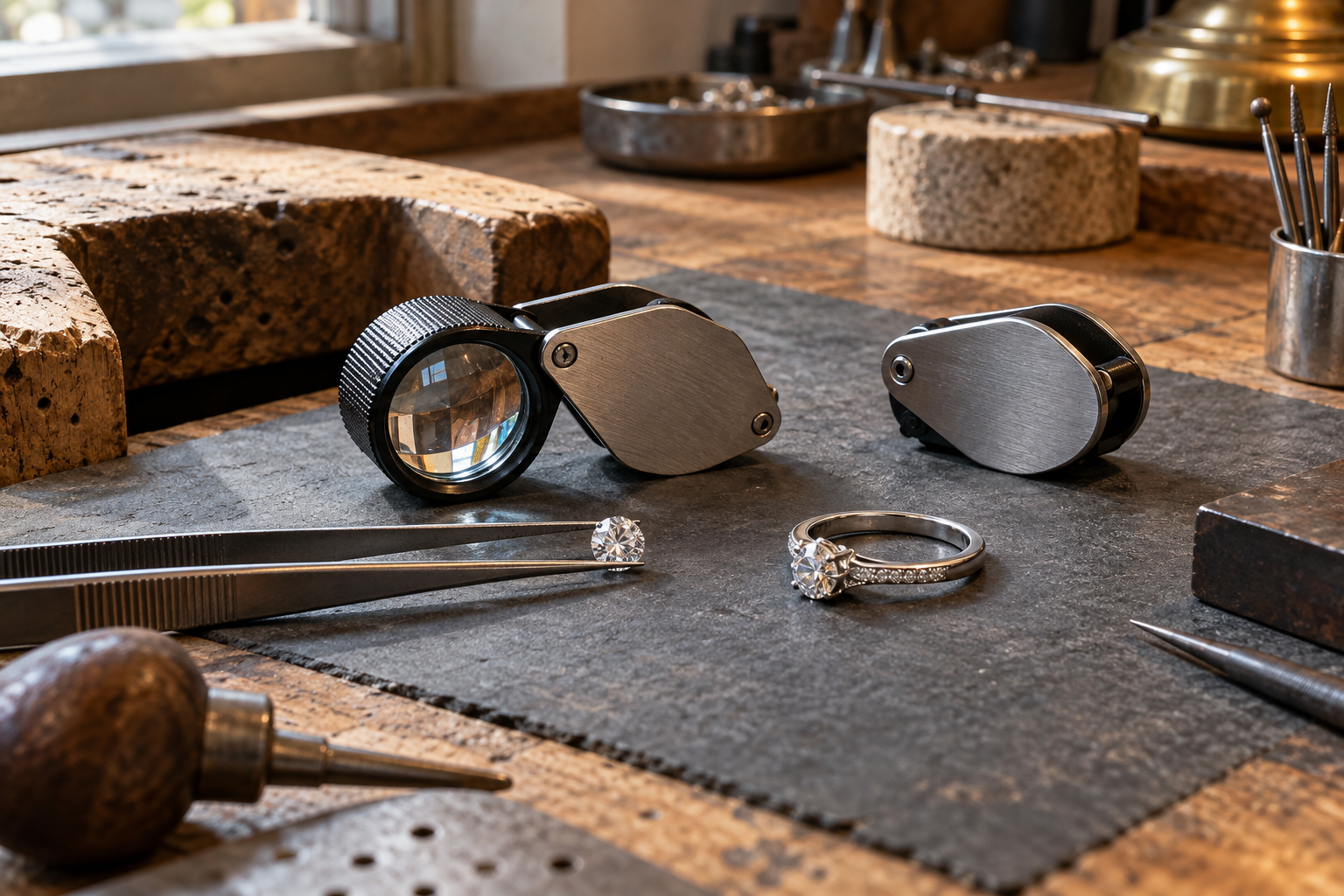
A jeweler’s loupe is a close-view tool for checking surfaces, joints, settings and stones. The right choice depends on whether you need a portable inspection view, extra light, a scale, or both hands free while working. For a first folding loupe, 10× is the most useful starting point: Gem-A describes it as the versatile standard because it preserves a workable field and depth of view.
Quick answer
Which jeweler's loupe should I buy first?
Start with a 10× folding triplet such as the Gem-A LOU0004B for inspecting stones and finished pieces. Choose the wider 23 mm Eschenbach 1182-10 when seeing more of a piece at once matters. Add a lighted, scaled or eye-worn loupe only when that feature solves a repeated task at your bench.
Match the viewing method to the job
Choose by what you need to see or do| Your task | Start with | Why it fits |
|---|
| Inspect gems and finished jewelry | Gem-A 10× triplet | Compact 10× folding view with corrected 18 mm lens |
|---|
| Scan a wider section of a piece | Eschenbach 1182-10 | 23 mm lens in a protected folding body |
|---|
| Inspect where bench lighting is awkward | Gem-A 10× LED | Integrated light with a 21 mm corrected lens |
|---|
| Compare a visible feature with a scale | Peak LED scale loupe | Focusing 10× view with a 0.1 mm metric reticle |
|---|
| Keep both hands on small work | Peak 2048 5× eye loupe | Light eye-held format with a longer working distance |
|---|
The first three are pocket inspection tools. The Peak scale loupe is a bench measuring aid; its reticle helps compare a feature against a scale, but it does not replace a caliper for dimensions that control fit. The Peak 2048 is an eye loupe for close work, where 5× and a 2-inch focal length leave more room to manipulate a part than its higher-power variants.
Five loupes for distinct jewelry tasks
Best first 10× loupe: Gem-A black triplet
The LOU0004B has a folding 10× triplet with an 18 mm achromatic and aplanatic lens. This is the straightforward pocket choice for examining facets, scratches, solder cleanup and setting edges. It comes with a travel case. The modest lens diameter asks you to position the work carefully; if you often need to scan a larger section without moving the loupe, consider the 23 mm Eschenbach below.
Best for first 10× inspection
Gem-A · LOU0004B
Gem-A 10x Triplet Loupe, black finish
A folding 10x triplet with an 18 mm achromatic and aplanatic lens and travel case.
Best for: First-line inspection of gemstones, setting edges and finished jewelry.
Specs, strengths and limitations
- Magnification
- 10x
- Lens
- 18 mm achromatic and aplanatic triplet
- Body
- Folding
- Included accessories
- Travel case
Strengths
- Compact folding format for carrying between bench and counter
- Corrected triplet optics for routine 10x inspection
- Lower price than the specialized scale loupe
Limitations
- 18 mm lens shows less of a piece than the 23 mm Eschenbach
- No integrated light or measuring reticle
Best wider 10× lens: Eschenbach 1182-10
Eschenbach’s 1182-10 uses a 23 mm aplanatic glass lens in a reinforced polyamide folding body. The larger lens makes it easier to keep a broader area in view while checking a ring shoulder, clasp or surface finish. Its enclosed body helps shield the lens from dust between uses. It has no built-in light or measuring scale, so pair it with a movable bench lamp when reflections hide detail.
Best for a wider inspection view
Eschenbach · 1182-10
Eschenbach 1182-10 Plastic Precision Folding Magnifier
A 10x folding magnifier with a 23 mm aplanatic glass lens in a reinforced polyamide body.
Best for: Inspecting a wider area of a ring, clasp or finished surface at 10x.
Specs, strengths and limitations
- Magnification
- 10x
- Lens
- 23 mm aplanatic glass
- Body
- Reinforced polyamide folding housing
Strengths
- 23 mm lens gives a wider viewing area than the Gem-A black triplet
- Folding body protects the lens between uses
- Glass lens and aplanatic correction
Limitations
- No integrated light for poorly lit settings
- No scale for measuring a feature
Best lighted pocket loupe: Gem-A 10× LED
The LOU0030 adds an LED to a 10× triplet with a 21 mm achromatic and aplanatic lens. It is useful for looking into a setting or examining a piece away from a well-lit bench. An integrated light can also create a strong reflection on a polished surface; rotate the piece or switch to an adjustable external lamp when you need to see texture rather than glare. Gem-A includes a travel case.
Best for awkward lighting
Gem-A · LOU0030
Gem-A 10x LED Loupe
A 10x LED triplet with a 21 mm achromatic and aplanatic lens and travel case.
Best for: Portable inspection when a movable bench lamp is hard to position.
Specs, strengths and limitations
- Magnification
- 10x
- Lens
- 21 mm achromatic and aplanatic triplet
- Illumination
- Integrated LED
- Included accessories
- Travel case
Strengths
- Integrated light helps when a bench lamp cannot reach the viewing angle
- 21 mm corrected lens is wider than the basic Gem-A triplet
- Folding format suits portable inspection
Limitations
- A fixed light angle can create glare on polished metal
- Light adds a power and maintenance requirement
Best for in-view measurements: Peak 10× LED scale loupe
Peak’s OPT-LSL10L-M combines 10× optics, adjustable focus and a 25 mm field of view with a metric reticle divided in 0.1 mm increments. Eight white LEDs illuminate the viewing area. This helps compare a scratch, hole or pattern against an in-view reference without switching tools. It is a larger bench instrument than a folding loupe, and its fixed metric scale is useful only when that unit and range suit the job.
Best for scale-assisted inspection
Peak Optics · OPT-LSL10L-M
Peak 10x LED Scale Loupe with Metric Reticle
A focusing 10x bench loupe with a 25 mm field of view, 0.1 mm metric reticle and eight white LEDs.
Best for: Comparing small visible features against a metric scale at the bench.
Specs, strengths and limitations
- Magnification
- 10x
- Field of view
- 25 mm
- Reticle
- Metric scale with 0.1 mm divisions
- Focus adjustment
- Adjustable
- Illumination
- 8 white LEDs
Strengths
- 0.1 mm metric reticle provides an in-view reference
- Adjustable focus and eight LEDs help with close bench inspection
- 25 mm field of view covers a useful section of flat work
Limitations
- Larger bench form is less pocketable than a folding loupe
- Fixed metric reticle may not suit every measurement task
- Four coin batteries add upkeep
Best eye loupe for close work: Peak 2048 5×
The OPT-P2048-A20D is the 5× model in Peak’s aluminum eye-loupe series. Peak specifies a 2-inch focal length, 10 g weight, glass lens, ventilation hole and holder. Its lower power and longer working distance are better suited to repeated close bench tasks than trying to manipulate a tool through a 20× pocket loupe. It is an eye-held aid, so check that the fit is comfortable for you; use a separate 10× folding loupe for deliberate inspection of tiny details.
Best for two-handed close work
Peak Optics · OPT-P2048-A20D
Peak 2048 5x Aluminum Eye Loupe
A 5x aluminum eye loupe with a glass lens, 2-inch focal length, ventilation hole and holder.
Best for: Two-handed close bench work that benefits from a lighter eye-held view.
Specs, strengths and limitations
- Magnification
- 5x
- Lens
- Glass, one element
- Focal length
- 2 in
- Body
- Aluminum with ventilation hole
- Weight
- 10 g
Strengths
- 5x power and 2-inch focal length leave more room to handle work
- 10 g aluminum body adds little weight at the eye
- Holder is specified with the model
Limitations
- Lower power cannot replace a 10x loupe for small inspection details
- Eye-held fit may take practice and may not suit every user
10× versus 20×: when higher power helps
Choose 10× for the first pass over a stone or finished piece. It is easier to find the area you want and keep it in focus. A 20× loupe is useful as a second look at one small feature, but higher power narrows the visible area and brings the work closer to the lens. If most of your day involves prolonged detail work, a stable bench magnifier or microscope may be more comfortable than holding a high-power loupe steady.
Do not judge a loupe by magnification alone. Lens diameter, correction, lighting and how steadily you can hold the work matter just as much. An achromatic lens reduces color fringing, while an aplanatic design aims to reduce distortion across the view. Compare the actual corrected view and working position, not only the number engraved on a housing.
Use a loupe without losing the detail
- Clean the lens and the piece. Dust on either surface can resemble a flaw.
- Hold a folding loupe close to your eye and bring the work toward it until the target is sharp.
- Brace the hand holding the loupe against the hand holding the work to reduce shake.
- Move the lamp or rotate the work to reveal different reflections on metal and facets.
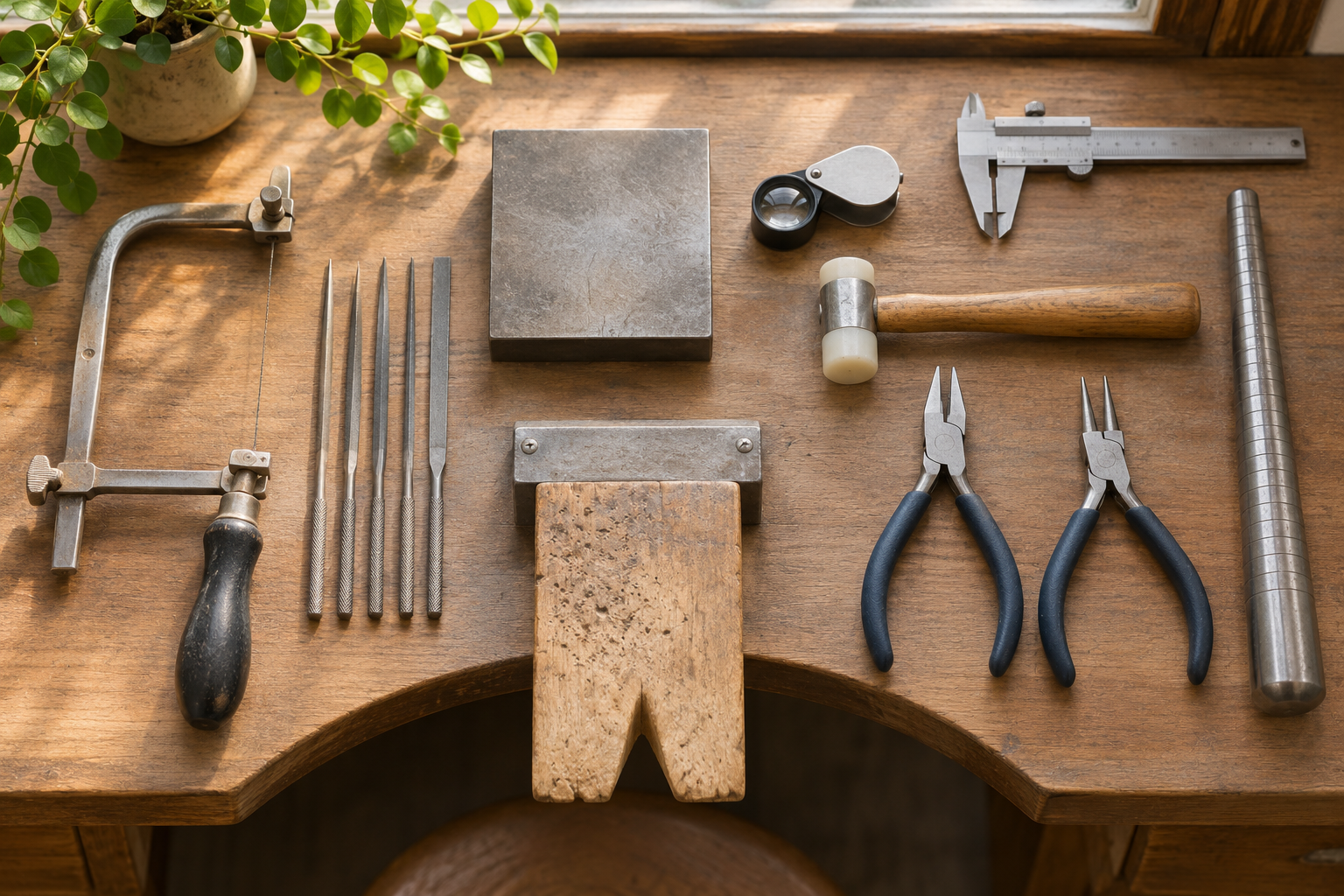
- For a dimension that must control a cut or fit, switch to a caliper rather than estimating through a plain lens.
If you are arranging a permanent inspection area, the jewelry bench setup guide covers lighting and work position. If you are inspecting pierced edges and cutouts, the jeweler’s saw guide covers the tools that made them.
What to check before ordering
- Exact model: Similar housings can contain different magnifications or scale reticles.
- Included accessories: Check the case, batteries, holder or reticle specified for the configuration you choose.
- Working position: Make sure the focal distance and grip suit how you hold the work.
- Shipping and support: Check terms and replacement support for your country.