A gold testing kit is useful for sorting jewelry, but the right one depends on what you need to learn. A touchstone and acids give a low-cost karat comparison. A pen-probe instrument makes repeated checks faster, provided you calibrate it and prepare the surface correctly. Neither method alone establishes the composition of an entire plated or filled piece.
Quick answer
Which gold testing kit should I choose?
Start with a touchstone kit if you check occasional pieces and can handle acids safely. The JSP eight-piece kit gives separate solutions for common US karats; Quicktest-3 uses three color-reaction solutions and also checks silver. For frequent gold checks, the KEE analog meter is a portable step up. The GemOro Analyzer offers a guided one-button workflow, while the PRO adds a digital percentage and range display.
Choose the method before the model
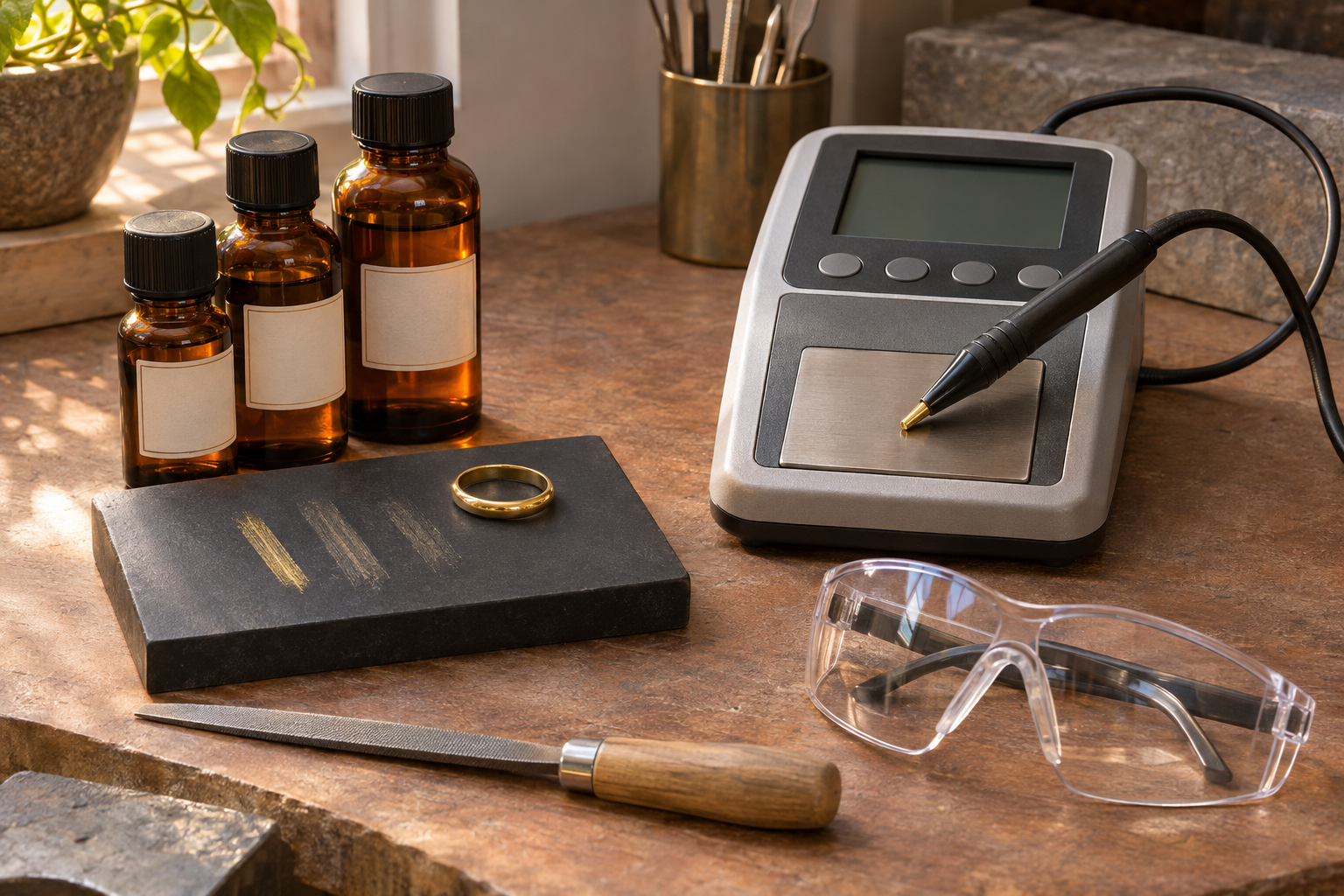
Acid kits make a streak on a testing stone and compare its reaction with a karat-specific solution or color chart. The result is an estimate tied to that streak. Electronic testers use a pen probe and a reference sample to interpret the metal’s response. They reduce chemical handling, but they still read a prepared contact area and need calibration and probe care.
Match the tester to your work| Your work | Start with | Why it fits |
|---|
| Occasional gold and silver checks | Quicktest-3 | Three solutions cover a broad gold range and silver |
|---|
| Common US karat comparisons | JSP eight-piece kit | Separate 10K, 14K, 18K and 22K bottles plus a stone |
|---|
| Portable repeated checks | KEE M-509GM | Analog probe meter powered by one AA battery |
|---|
| Simple electronic counter workflow | GemOro Analyzer | One-button operation and 6K–24K stated range |
|---|
| Detailed electronic readings | GemOro PRO | LCD shows karat, percentage and position within a range |
|---|
A stamped karat is a clue, not a calibration sample. The KEE manual calls for a known 18ct yellow-gold sample for ordinary work and a 22ct sample for accurate high-karat checks. GemOro specifies an 18K yellow-gold sample for its Analyzer and PRO; that sample is separate from the instruments. Budget for the reference metal before choosing a pen tester.
Best compact acid kit: Quicktest-3
Quicktest-3 uses one solution to separate non-gold from 9ct and higher gold, another for the 14ct–24ct range, and a third for silver. The wooden box also holds a file, magnet, copper sample and instructions. It is useful when you want one small kit for varied secondhand pieces. Reading the reaction color and speed takes practice; it is less direct than a set of individual karat bottles.
Best compact gold and silver kit
Quicktest · Q3
Quicktest-3 gold and silver tester
A three-solution color-reaction kit for checking 9ct through 24ct gold and silver.
Best for: A compact acid kit for lower-karat screening and silver checks.
Specs, strengths and limitations
- Test method
- Acid color reaction
- Gold range
- 9ct–24ct
- Metals tested
- Gold and silver
- Included equipment
- Three solutions, file, magnet, copper sample, instructions, wooden box
Strengths
- Covers gold and silver in one compact kit
- Includes a file and reference copper sample
Limitations
- Color reactions need practice to interpret
- Acids require protective handling and eventually need replacement
Best stepwise acid set: JSP eight-piece kit
The JSP set supplies separate 10K, 14K, 18K and 22K gold solutions, a silver solution, a black glass touchstone, a test plate and a storage box. That layout suits a bench where you repeatedly compare common stamped karats. It uses more bottles than Quicktest-3, and its stated bottle life after opening is six months. Check the local handling and shipping rules for acids before ordering.
Best for common karat comparisons
JSP · 56-0809
JSP 8-Piece Deluxe Test Acid Kit
A boxed touchstone set with separate solutions for 10K, 14K, 18K, 22K gold and silver.
Best for: Bench jewelers who prefer distinct karat-labeled solutions and a supplied testing stone.
Specs, strengths and limitations
- Test method
- Touchstone acid test
- Gold range
- 10K, 14K, 18K, 22K
- Metals tested
- Gold and silver
- Included equipment
- Five test acids, touchstone, test plate, storage box
Strengths
- Separate solutions make common karat comparisons straightforward
- Includes a touchstone and storage box
Limitations
- Does not include a platinum solution
- Five acid bottles require careful storage and replacement
Best portable analog meter: KEE M-509GM
The KEE tester uses a pen probe, a large analog meter and one AA battery. It checks gold and platinum without an acid streak, which can be convenient for a series of pieces. You still need a suitable known-gold sample for calibration and a clean test area. Use the manual’s separate high-karat calibration procedure if your work regularly reaches 20ct–24ct.
Best for portable repeated checks
KEE Gold · M-509GM
KEE Gold Tester M-509GM
An analog pen-probe tester for preliminary gold and platinum assessments.
Best for: Frequent checks where a portable meter and simple analog display suit the workflow.
Specs, strengths and limitations
- Test method
- Electronic pen probe
- Gold range
- 9ct–24ct with calibration samples
- Metals tested
- Gold and platinum
- Readout
- Analog meter
- Calibration
- 18ct yellow gold; 22ct for high-karat work
Strengths
- Portable single-AA design
- Large analog meter and replaceable probe
Limitations
- Requires suitable gold calibration samples
- Analog reading needs practice near a karat boundary
Best simple electronic workflow: GemOro AuRACLE Analyzer
The Analyzer covers GemOro’s stated 6K–24K gold range and platinum. Its one-button operation and guided display suit a counter where several people need a consistent setup sequence. It runs from a 9V battery or an AC adapter and includes a pen probe and file. An 18K yellow-gold calibration piece is needed separately. As with other surface-contact testers, follow the maker’s filing step when plating or filling is suspected.
Best guided electronic tester
GemOro · 2009
A one-button electronic tester for 6K–24K gold and platinum with a pen probe.
Best for: A bench or counter needing a guided electronic check without an acid setup.
Specs, strengths and limitations
- Test method
- Electronic pen probe
- Gold range
- 6K–24K
- Metals tested
- Gold and platinum
- Readout
- Guided display with karat indication
- Calibration
- 18K yellow gold sample
Strengths
- Simple one-button workflow
- Checks gold across a broad stated karat range
Limitations
- Needs a separate 18K calibration sample
- Surface plating can mislead unless the test area is filed
Best detailed digital display: GemOro AuRACLE PRO
The PRO adds an LCD karat and gold-percentage display, a graph showing where a result falls within a karat range, and standard and enhanced modes. Its stated range is 8K–24K plus platinum. Choose it when those extra readings help with frequent screening; the simpler Analyzer is easier to justify for occasional use. The PRO also needs an 18K yellow-gold calibration sample and a properly prepared test point.
Best for detailed digital readings
GemOro · 2012-CE
GemOro AuRACLE PRO
A digital pen-probe tester with a karat display, gold-percentage display and two test modes.
Best for: Frequent gold checks when a digital display and mode choice justify the higher cost.
Specs, strengths and limitations
- Test method
- Electronic pen probe
- Gold range
- 8K–24K
- Metals tested
- Gold and platinum
- Readout
- LCD karat, percentage and range graph
- Calibration
- 18K yellow gold sample
Strengths
- Shows karat, percentage and position within a karat range
- Standard and enhanced modes for different checks
Limitations
- Costs more than the simpler electronic picks
- Requires an 18K calibration sample and care with plated pieces
Understand plating and accuracy limits
A surface reading can look convincing even when the core is a different metal. Both acid and pen-probe instructions describe filing through a coating when plating is suspected. Filing makes a permanent mark, so choose a hidden point and obtain the owner’s consent first. Thin chains, solder joints, mixed-metal assemblies and hollow items also need careful choice of test point.
A result near a karat boundary is less certain than a clear separation. Repeat the test, use a known reference, and compare a second appropriate method if the result matters. For a costly purchase, insurance value or disputed item, ask a qualified assay service about a method suited to the whole piece. A home kit is a screening tool, not a certificate of bulk purity.
Set up and use a kit safely
- Read the exact kit manual and any safety sheet before opening bottles or powering a tester. Clear the bench of food and unrelated work.
- Inspect hallmarks, joins, wear spots and possible plating. Select a test area that represents the metal you need to assess.
- For acids, use the maker’s stone and reaction chart, protective eyewear and gloves, and suitable ventilation. Keep bottles capped when idle and follow the stated spill, storage and disposal instructions.
- For a meter, check probe condition and calibrate with the specified known-gold sample. Clean and dry the metal, then follow the maker’s contact and filing sequence.
- Record the location tested and the method. If readings disagree, stop short of assigning a firm karat and seek an appropriate second test.
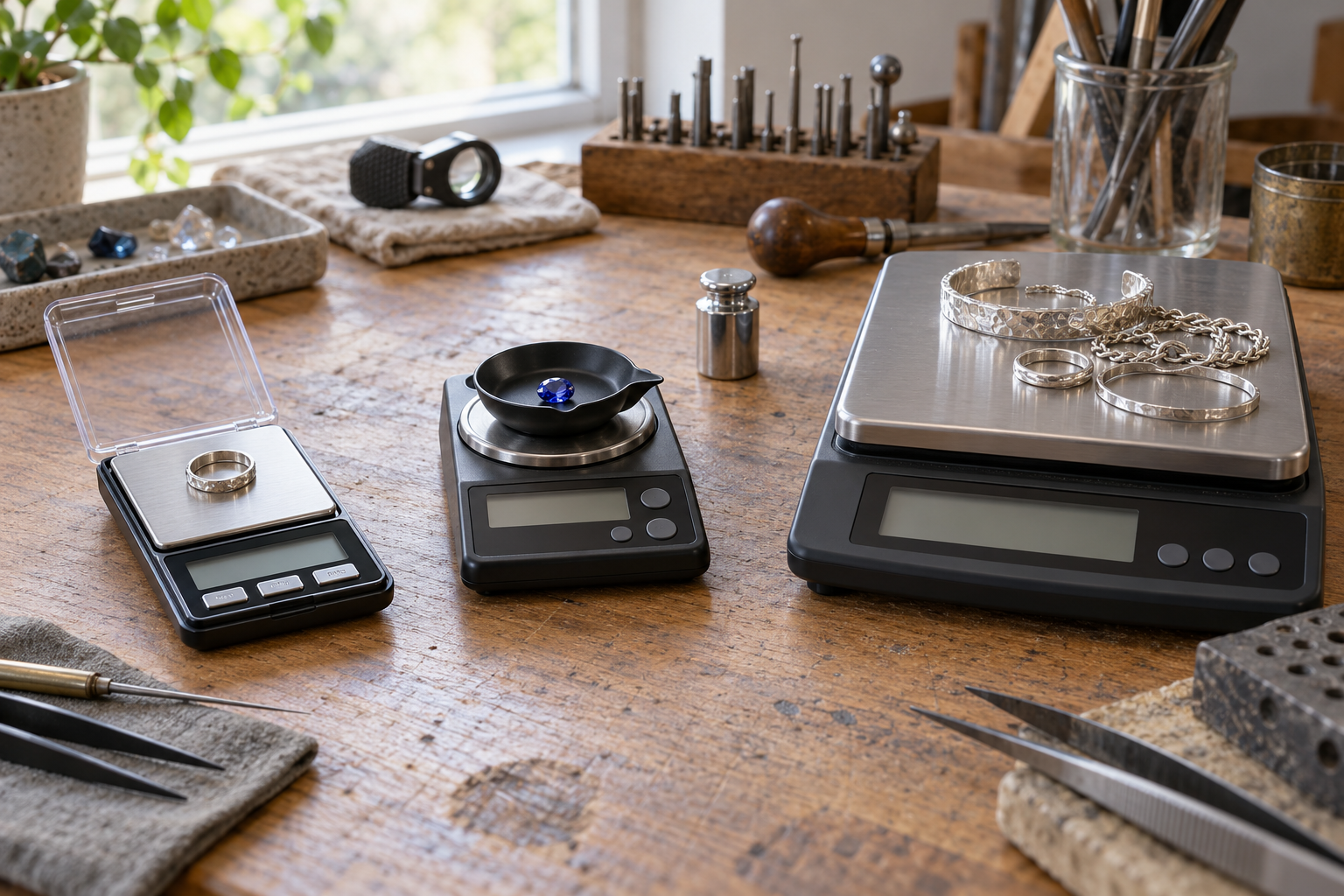
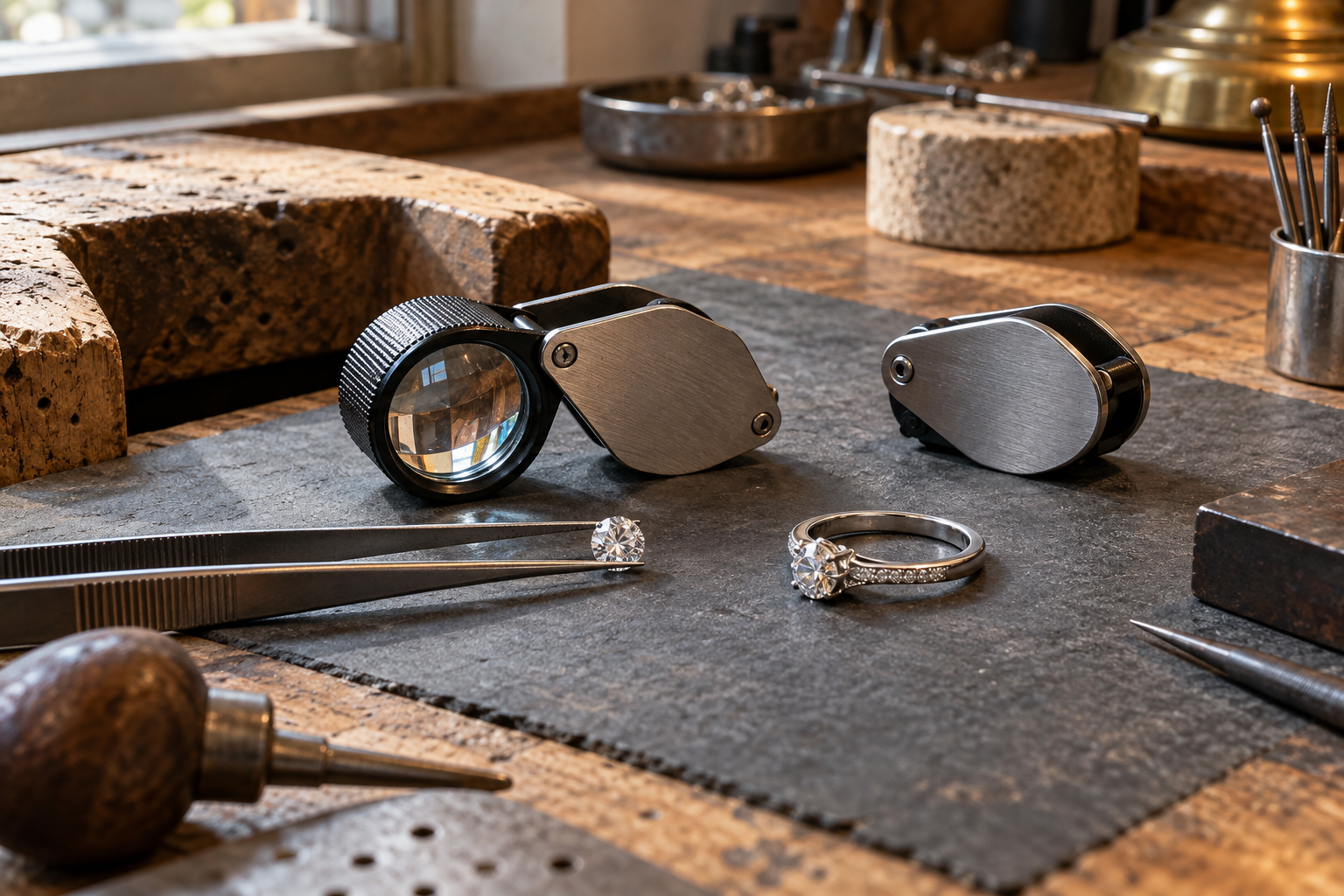
For weighing a piece during evaluation, see the jeweler’s scale guide. A 10× loupe helps inspect stamps, worn plating and solder seams before selecting a test point. The measuring hub covers related bench instruments.
What to check before ordering
Check the exact model number, karat range, included stone or probe, replacement solutions or probe, and whether a calibration sample is supplied. Confirm acid shipping rules and instrument support for your country. If you test a customer’s finished jewelry, agree on any filing mark before work begins.