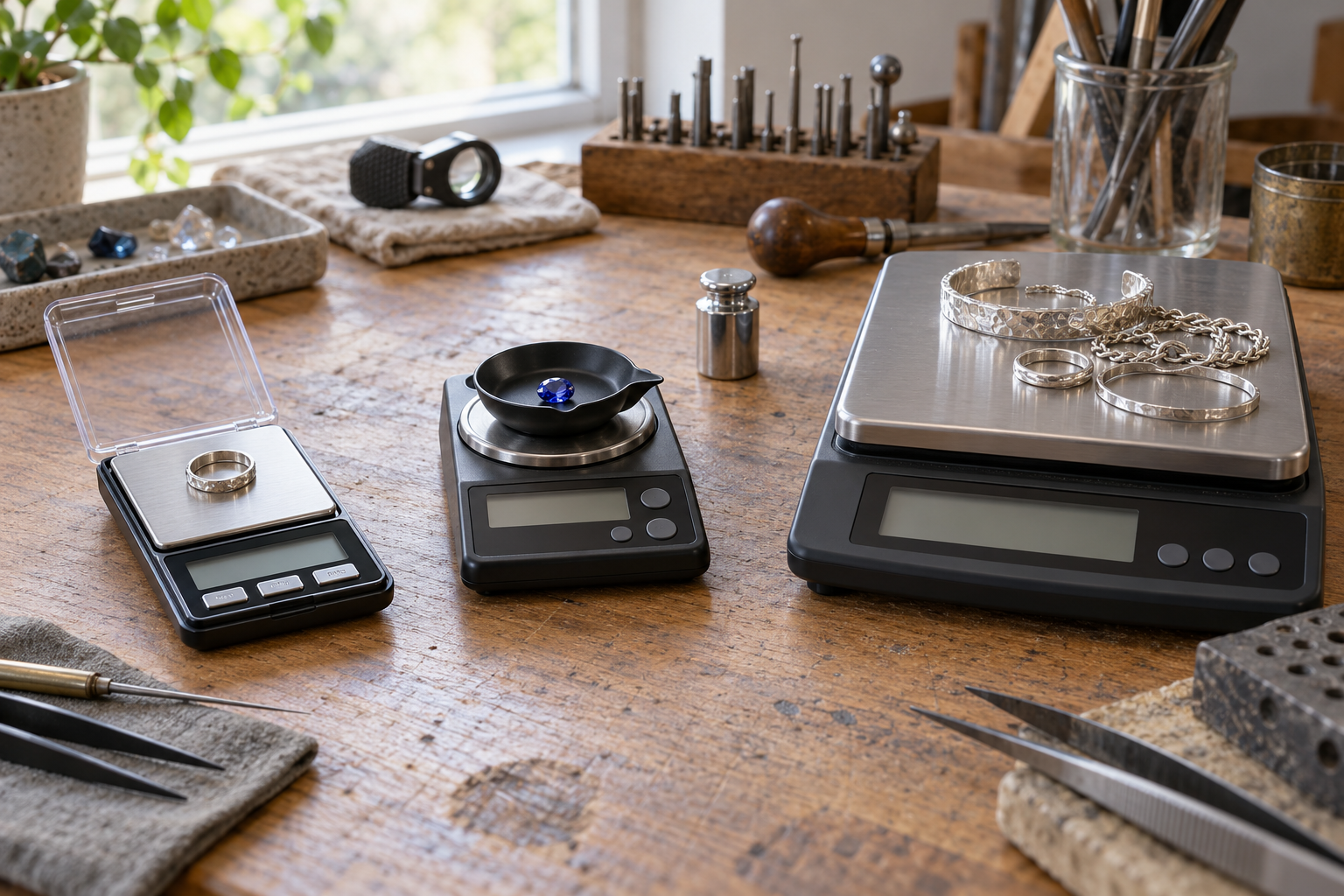
A scale for finished rings is not necessarily suitable for loose gemstones or a heavy container of silver findings. Start with the lightest item whose weight matters, then allow enough capacity for the heaviest piece and any tray you will tare. The five scales below cover distinct tasks rather than five versions of the same pocket tool.
Quick answer
Which jeweler's scale should I start with?
For routine small metal pieces, the Tanita 1479J2 balances a 200 g capacity with 0.01 g display steps and jewelry-specific units. Choose the less expensive AWS-600 when 0.1 g steps are enough and you need more capacity. Move to a dedicated carat scale for loose stones, a larger bench balance for batches, or an approved commercial model when the weight determines a sale price.
Choose capacity before the number of decimal places
A scale’s capacity is its maximum load, including any container. Its readability is the smallest change the display shows. More decimal places do not establish how accurate a reading is. A 20 g gemstone scale can show finer steps than a 600 g pocket scale, yet a finished bracelet and its tray may exceed the gem scale’s limit.
Match the scale to the weighing job| Your weighing task | Start with | Why it fits |
|---|
| Finished pieces and larger small batches | AWS-600 | 600 g capacity with 0.1 g display steps |
|---|
| Small metal pieces needing finer steps | Tanita 1479J2 | 200 g capacity with 0.01 g display steps and dwt/ozt modes |
|---|
| Loose gemstones | Tanita 1210N | 100 ct capacity, 0.01 ct steps and a draft shield |
|---|
| Larger containers or metal batches | Ohaus STX2202 | 2,200 g capacity while retaining 0.01 g display steps |
|---|
| Commercial gemstone weighing in the US | Ohaus SJX323N/E | Class II legal-for-trade configuration, subject to local approval |
|---|
For precious metal, grams are a straightforward working unit. Troy ounces and pennyweights are useful when you compare weights with records or supplier terms written in those units. Carats describe gemstone mass. Confirm the unit on the display before recording a reading; an unnoticed unit change can make a plausible number misleading.
Five scales for different jewelry tasks
Best low-cost scale for heavier small pieces: AWS-600
The AWS-600 is a folding pocket scale rated for 600 g with 0.1 g display steps. Its cover protects the platform in storage, and the maker specifies a 2.5 × 3 in platform and two AAA batteries. It is a sensible low-cost choice for weighing a completed bracelet, a group of findings or a small container of silver pieces. Its 0.1 g steps are a poor fit for tiny stones or fine adjustments to a light ring.
Best for affordable higher capacity
American Weigh Scales · AWS-600
A folding pocket scale with 600 g capacity and 0.1 g readability.
Best for: Finished pieces and batches when tenths of a gram suffice.
Specs, strengths and limitations
- Maximum capacity
- 600 g
- Display readability
- 0.1 g
- Platform
- 2.5 x 3 in
- Power
- Two AAA batteries
Strengths
- 600 g capacity suits heavier finished pieces
- Compact cover and low price
Limitations
- 0.1 g steps are coarse for small stones
- Small pan limits bulky pieces
Best everyday portable scale: Tanita 1479J2
Tanita’s 1479J2 covers 200 g in 0.01 g steps. It offers grams, carats, grains, ounces, troy ounces and pennyweights, which helps when metal paperwork uses a different unit from your bench notes. The compact body suits a crowded bench or a counter. Remember that the pan and 200 g limit leave less room for a broad piece or a tray than a larger balance.
Best for routine fine weighing
Tanita · 1479J2
A portable 200 g scale with 0.01 g increments and six weighing modes.
Best for: Routine weighing of small metal pieces and finished jewelry.
Specs, strengths and limitations
- Maximum capacity
- 200 g
- Display readability
- 0.01 g
- Weighing units
- g, oz, ct, gr, ozt, dwt
- Power
- Two CR2032 batteries
Strengths
- 0.01 g display suits finer metal weighing
- Modes include pennyweight and troy ounces
Limitations
- 200 g limit restricts containers
- Pocket pan is small for broad pieces
Best for loose gemstones: Tanita 1210N
The 1210N is a different tool: 100 ct maximum, 0.01 ct increments and a draft shield for small samples. Tanita includes a gem cup, AC adapter and 20 g test weight. Use it when comparing loose stones or logging individual gem weights. Its 20 g gram limit makes it the wrong primary scale for finished jewelry or metal batches.
Best for loose gemstones
Tanita · 1210N
Tanita 1210N Professional Diamond Scale
A gemstone scale with 100 ct capacity, 0.01 ct increments and a draft shield.
Best for: Loose gemstones where hundredths of a carat matter.
Specs, strengths and limitations
- Maximum capacity
- 20 g / 100 ct
- Display readability
- 0.002 g / 0.01 ct
- Weighing units
- g, ct, gr, ozt
- Calibration
- 20 g test weight included
- Power
- Four AAA batteries or AC adapter
Strengths
- 0.01 ct steps suit loose-stone sorting
- Draft shield and gem cup help with tiny samples
Limitations
- 20 g limit excludes most finished jewelry
- Costs more than general pocket scales
Best bench step-up for large batches: Ohaus STX2202
Ohaus specifies 2,200 g capacity and 0.01 g readability for the Scout STX2202. That combination gives room for a container of components or heavier finished work without dropping to 0.1 g display steps. Its larger pan and touchscreen suit a fixed weighing station. The cost and footprint are substantial, so choose it when your normal load repeatedly exceeds a pocket scale’s capacity.
Best for high-capacity bench weighing
Ohaus · STX2202
A bench balance with 2,200 g capacity and 0.01 g readability.
Best for: Large metal batches, containers and finished pieces.
Specs, strengths and limitations
- Maximum capacity
- 2,200 g
- Display readability
- 0.01 g
- Display
- Color touchscreen
Strengths
- 2,200 g capacity accepts large containers
- 0.01 g display retains fine steps
Limitations
- High cost and larger footprint
- No commercial approval specified
Best commercial gemstone scale: Ohaus SJX323N/E
The SJX323N/E is a Class II legal-for-trade model in Ohaus’s Scout jewelry line. Its specified capacity is 320 ct or 64 g; its display shows 0.01 ct or 0.001 g steps. The separate 0.1 ct verification interval matters when a reading is used in commerce. If a weight determines a US sale price, confirm the required certification, configuration and inspection with your state or local weights-and-measures authority before use. This narrow-capacity scale is for gemstone transactions, not large finished pieces.
Best for commercial gemstone weighing
Ohaus · SJX323N/E
Ohaus Scout SJX323N/E
A Class II legal-for-trade jewelry balance with 320 ct capacity and 0.01 ct displayed steps.
Best for: US commercial gemstone weighing subject to local approval.
Specs, strengths and limitations
- Maximum capacity
- 320 ct / 64 g
- Display readability
- 0.01 ct / 0.001 g
- Verification interval
- 0.1 ct / 0.01 g
- Commercial approval
- Class II legal for trade
Strengths
- Class II model intended for commercial jewelry weighing
- 0.01 ct displayed steps for gemstone work
Limitations
- 64 g capacity restricts finished metal pieces
- Commercial use requires local inspection and approval
Set up the scale for repeatable readings
- Put it on a firm, level surface away from vibration, fans and drafts. This matters most with the gemstone scale.
- Check the selected unit before each batch of measurements.
- Place an empty tray on the pan and tare it. Keep the tray plus sample below maximum capacity.
- Use the maker’s calibration procedure and the specified test weight. Do not assume a random coin is a calibration standard.
- Let the display settle, then record the unit along with the number. Recheck an unexpectedly different reading before adjusting metal or pricing work.
Display readability and measurement accuracy are separate specifications. If you need a tolerance for a transaction or a tightly controlled process, obtain the maker’s accuracy and repeatability data and check the instrument with suitable weights. A fine display by itself does not certify a scale for commercial use.
What to check before ordering
- Model number and capacity: Closely related versions can have different maximum loads and display steps.
- Included parts: Check whether a tray, test weight, batteries, AC adapter or draft shield comes with your configuration.
- Commercial use: Check the exact approval, verification interval and local inspection requirements before using weight to determine a US sale price.
- Shipping and support: Confirm replacement parts, calibration service and support for your country.
For dimensions rather than mass, see the jewelry measuring guide. For viewing a small stone or setting edge while you work, see the loupe guide.