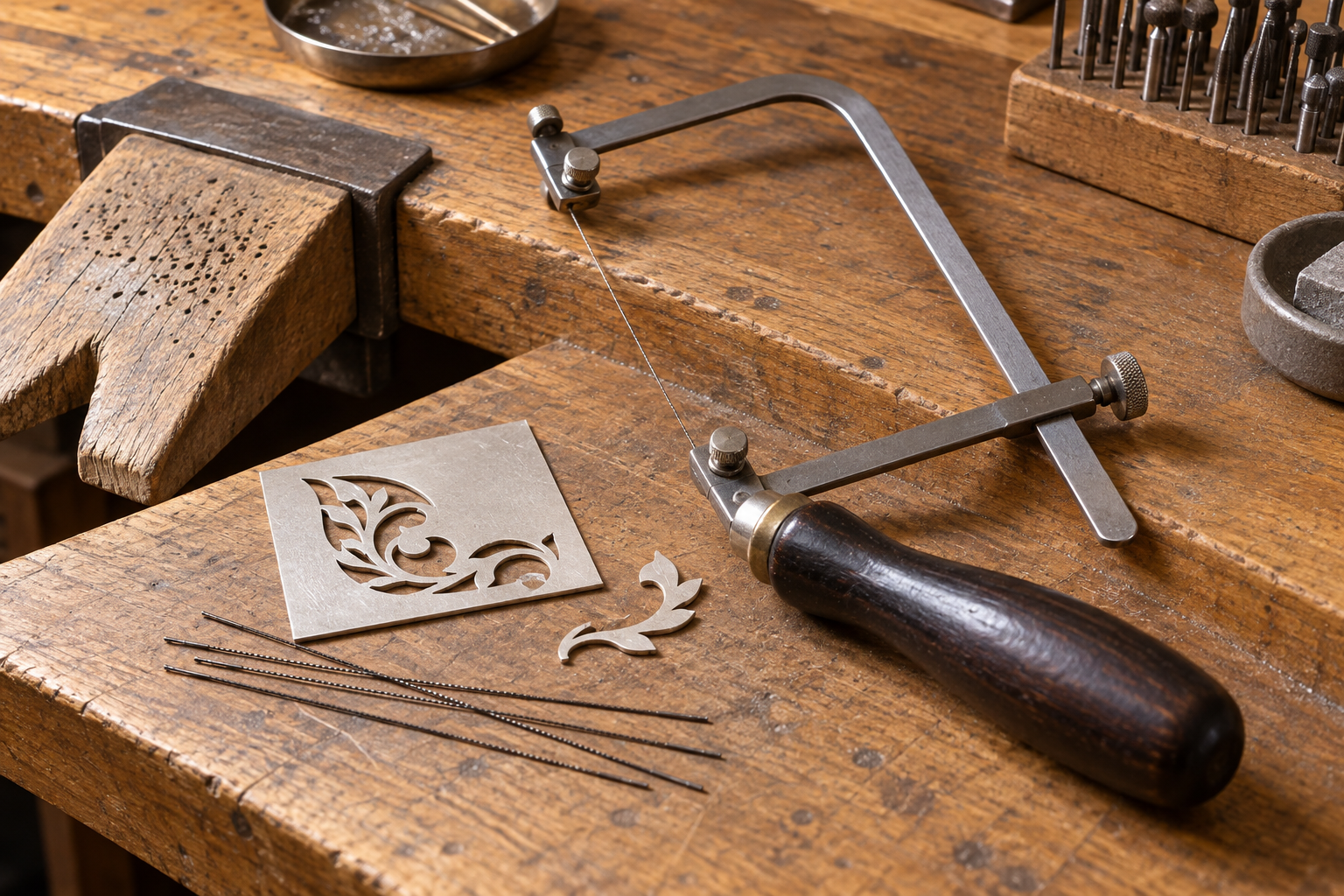
A jeweler’s saw frame holds a fine blade under tension for cutting outlines and piercing openings in sheet. Choose the frame by how far the cut sits from the sheet edge and how often you remove the blade for interior cuts. A deeper throat adds reach; a lever saves time when every new opening requires threading the blade through a drilled hole.
Quick answer
Which jeweler's saw frame should I start with?
For small pendants, earrings and practice cuts, start with a simple adjustable 3-inch frame such as the Contenti German Style Economy. Choose the Swiss-style frame if its rubber grip and guided blade locks suit your hands. Move to the GreenLion for wider sheet, the light Knew Concepts Mk.III for fine manual tension control, or the Mk.V swivel saw when you make many interior cuts.
Choose throat depth before features
Throat depth is the distance from the blade to the back of the frame. It needs to clear the material between your cut and the nearest sheet edge. A deeper frame can reach farther, but extra depth can add flex and make a small piece less nimble to turn. For ordinary small jewelry components, a 3-inch (about 75–76 mm) frame is a sensible starting point. Measure your largest planned cut before moving to a deeper frame. The frame selection guide explains why more depth is not automatically better.
Match a saw frame to your most frequent cut| Your work | Start with | The practical advantage |
|---|
| Small outlines and a first bench | Contenti German Style Economy 3 in | Low-cost sliding adjustment and serrated thumb-screw clamps |
|---|
| Small work with a firmer grip | Swiss-style 3 in | Rubber handle and guided blade-lock design |
|---|
| Wider sheet and longer reach | GreenLion 4¼ in | More throat clearance in a rigid steel frame |
|---|
| Fine cuts with a light frame | Knew Concepts Mk.III 3 in | Low weight and fine screw tension |
|---|
| Many interior cutouts | Knew Concepts Mk.V 3 in | Cam-lever changes and swiveling clamps |
|---|
Five saw frames for different bench jobs
Best first frame: Contenti German Style Economy adjustable 3-inch
The 400-342 is a conventional forged sliding frame with a 3-inch (75 mm) throat, serrated clamps and a hardwood handle. The upper thumb screw lets you shorten the blade span, useful when a blade breaks but still has enough length for both clamps to hold securely. Its simple clamp design also makes poor blade seating easy to spot and correct while learning. Choose it for small outlines and occasional piercing. If you spend whole sessions threading blades through interior holes, a lever-tension frame will save repeated adjustment.
Best for a first jewelry bench
Contenti · 400-342
Contenti German Style Economy 3-inch saw frame
An adjustable 3-inch forged frame with serrated blade clamps, thumb screws and a hardwood handle. Its sliding arm can grip a shortened blade.
Best for: A first saw for small jewelry parts when simple adjustment and low cost matter most.
Specs, strengths and limitations
- Throat depth
- 3 in (75 mm)
- Frame adjustment
- Sliding arm accepts shorter blades
- Blade tension
- Frame compression and upper thumb screw
- Blade clamps
- Serrated thumb-screw clamps
- Handle
- Hardwood
Strengths
- Low initial cost for an adjustable frame
- Sliding arm can reuse shorter blade sections
- Compact 3-inch throat is easy to steer around small parts
Limitations
- Basic clamps take more care to seat a fine blade
- No cam lever for repeated interior cuts
- Deeper sheet work may need more throat clearance
Best grip and guided clamps: Swiss-style adjustable 3-inch
This 3-inch (76 mm) spring-steel frame pairs a non-slip rubber grip with blade locks that guide the blade ends into holes. Side set screws can be arranged for either hand. The rubber grip and guided locks change how the frame sits in the hand and how the blade is seated, while the span remains adjustable. The tradeoff is a little more mass than a lightweight aluminum saw and no lever for rapid release.
Best for a firmer grip
Amadesa · 110058
Swiss-style adjustable 3-inch saw frame
A spring-steel adjustable frame with hole-style blade locks and a rubber grip. Set screws can be placed on either side.
Best for: Jewelers who want a firmer hand grip and a guided blade-clamp design.
Specs, strengths and limitations
- Throat depth
- 3 in (76 mm)
- Frame adjustment
- Adjustable
- Blade tension
- Frame adjustment
- Blade clamps
- Hole-style blade locks with side set screws
- Frame material
- Spring steel
Strengths
- Blade holes guide the ends into the clamps
- Rubber grip is easier to hold than a narrow wood handle
- Set screws can be arranged for either hand
Limitations
- 3-inch throat limits reach into wider sheet
- Set-screw changes are slower than a cam lever
- Frame is heavier than the lightweight Knew Concepts option
Best for wider sheet: GreenLion Studios Classic 4¼-inch
The GreenLion GR-OG uses an 11-gauge steel frame and a 4¼-inch (about 108 mm) throat. That extra clearance helps when the cut lies farther from the sheet edge. A tapered handle fills the palm, and the blade-clamp arrangement can be switched for right- or left-handed work. Choose its reach only when your sheet size needs it; the wider frame takes more room around a small workpiece.
Best for wider sheet
GreenLion Studios · GR-OG
A rigid 11-gauge steel frame with a 4¼-inch throat and tapered plastic handle. Its clamp arrangement can be set for right- or left-handed work.
Best for: Jewelers cutting wider sheet who still want a conventional, simple saw.
Specs, strengths and limitations
- Throat depth
- 4¼ in (108 mm)
- Blade clamps
- Thumbscrew clamps; reversible orientation
- Frame material
- 11-gauge steel
- Handle
- Tapered plastic
Strengths
- Wider throat reaches farther into sheet than the 3-inch picks
- Steel frame is designed for stiffness
- Clamp orientation supports right- or left-handed use
Limitations
- Larger frame takes more clearance at a compact bench
- Tapered plastic grip differs from a traditional wood handle
- No lever for rapid blade release
Best light precision frame: Knew Concepts Mk.III screw-tension 3-inch
Knew Concepts lists the 125.003 Mk.III at 115 g with blade. A knurled top screw makes small tension adjustments without bending a traditional sliding frame. It keeps the compact 3-inch throat for close work. This is the lighter, simpler way into a rigid precision frame if you mostly cut outlines or make only a few interior openings. It uses a full-length 5⅛-inch blade and lacks the quick release of a cam lever.
Best for light, controlled sawing
Knew Concepts · 125.003
A light 3-inch aluminum frame with a knurled screw for fine blade-tension adjustment.
Best for: Detailed small-part sawing when a light frame and precise manual tension matter more than rapid changes.
Specs, strengths and limitations
- Throat depth
- 3 in (76 mm)
- Blade tension
- Knurled screw adjustment
- Frame material
- Aluminum
- Weight
- 115 g with blade
- Blade length
- 5⅛ in (130 mm)
Strengths
- 115-gram weight reduces tool mass in detailed work
- Screw gives fine control over blade tension
- Rigid aluminum frame supports a taut blade
Limitations
- Each interior cut needs manual tension release and reset
- Fixed blade length will not grip short blade pieces
- Costs more than the basic adjustable frames
Best for repeated piercing: Knew Concepts Mk.V swivel 3-inch
The Mk.V combines a cam lever with a fine tension adjustment. Flip the lever to release tension, pass the blade through a drilled opening, secure it, and restore tension with the lever. Its clamps swivel 45 degrees either side of straight ahead, moving the frame away from an awkward sheet edge without changing the blade path. The 3-inch throat and 5⅛-inch blade requirement still apply. Its price makes most sense when you repeat this sequence many times per piece.
Best for repeated interior piercing
Knew Concepts · 123.003CS
Knew Concepts Mk.V 3-inch cam-lever swivel saw
A 3-inch hardened-aluminum frame with cam-lever tension and blade clamps that swivel 45 degrees left or right.
Best for: Frequent interior piercing and cuts where the frame needs to swing away from the work.
Specs, strengths and limitations
- Throat depth
- 3 in (76 mm)
- Blade tension
- Cam lever with fine adjustment
- Blade clamps
- Swivel clamps with blade seating holes
- Frame material
- Hardened aluminum
- Weight
- 151 g
Strengths
- Lever releases and restores tension during repeated piercing
- Swivel moves the frame clear of awkward sheet edges
- Lightweight hardened-aluminum construction
Limitations
- Highest cost in this group
- Requires full-length 5⅛-inch blades
- Swivel adjustment adds a step when straight cutting is enough
Set the blade up before judging the frame
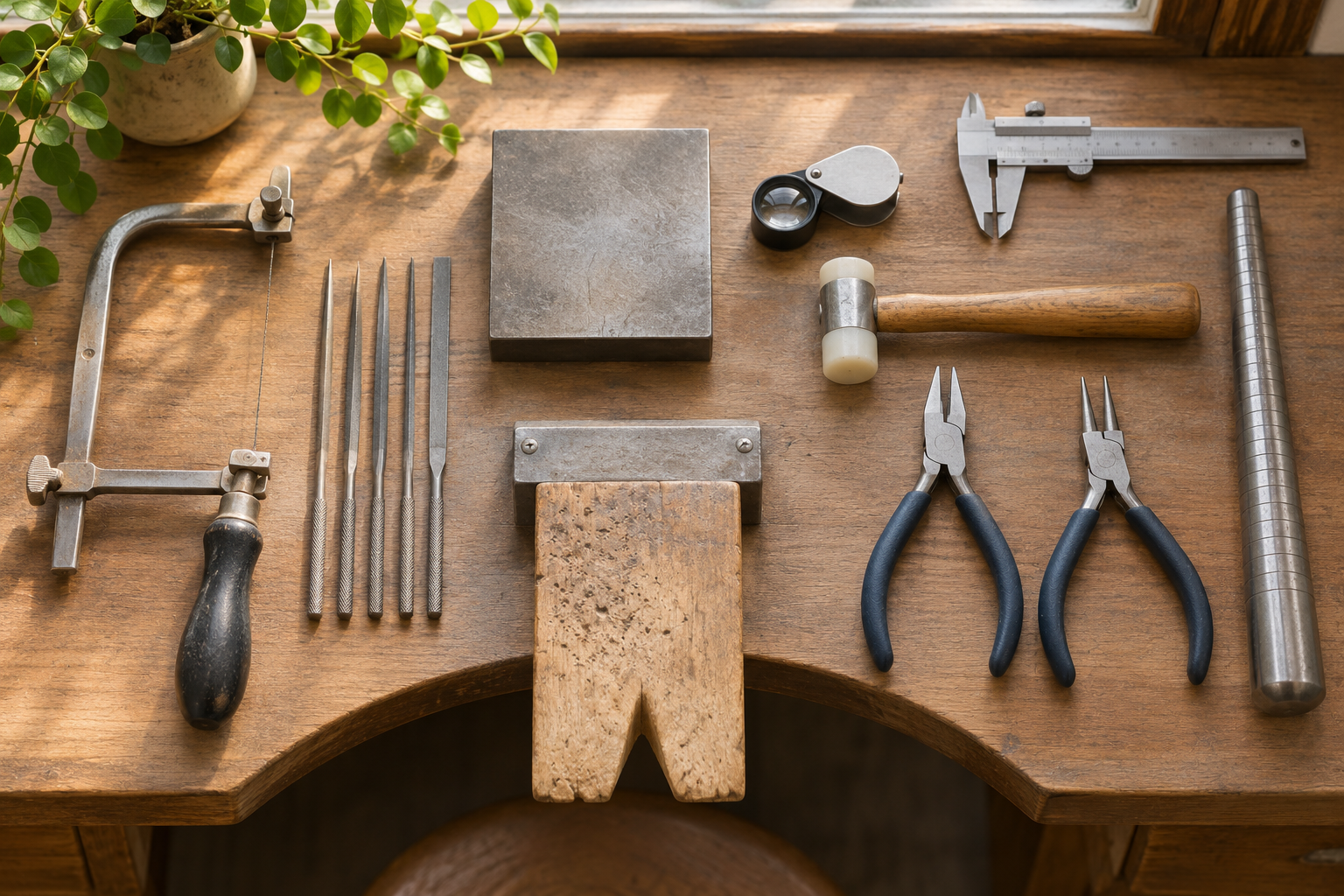
Secure the upper blade end fully in its clamp, thread it through the work if piercing, then secure the lower end. Set tension until the blade gives a clear high note when lightly plucked; the Knew Concepts instructions describe this as a useful check. The teeth should face forward and down so the blade cuts on the downstroke. Support the sheet on a bench pin and keep fingers clear of the blade path. Wear eye protection because fine blades can break.
Blade size is a separate choice from frame depth. Fine sizes suit detailed cuts in thinner sheet, while coarser sizes suit thicker material. The blade size chart gives teeth-per-inch and metal-gauge guidance. Keep spare blades near the bench: tension, feed pressure and tight turns all affect breakage. If you are assembling a first workstation, the jewelry bench setup guide covers the working surface and tool placement.
What to check before ordering
- Depth: Measure from your deepest planned cut to the nearest sheet edge, then allow room to steer the frame.
- Blade changes: For many pierced openings, compare a cam lever with a screw or sliding-frame adjustment.
- Grip and orientation: A handle that stays steady in your hand matters more than a large frame you rarely need.
- Exact configuration: Check the model number, included blades, replacement clamps, shipping and support for your country.