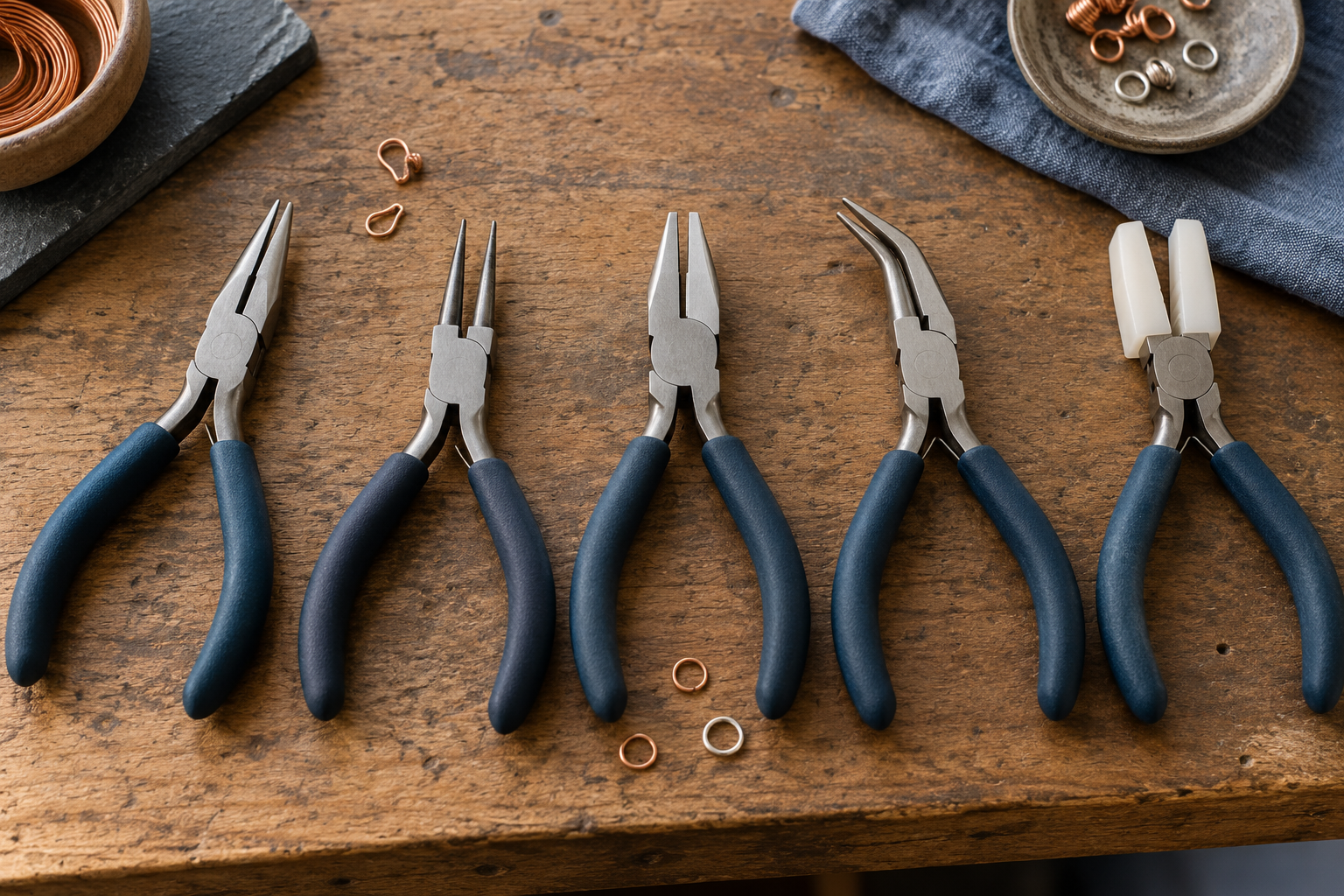
The best jewelry making pliers are a small set of jaw shapes that solve different jobs. Smooth chain nose jaws grip findings, round jaws form loops, and wide flat jaws make straight bends. Add bent nose or nylon jaws when access or surface marks become a recurring problem. Check jaw alignment and surface finish before judging comfort or handle color.
Quick answer
Which pliers should I buy first for jewelry making?
Begin with smooth chain nose, round nose and flat nose pliers. The Xuron 485, 488 and 485FN cover those jobs without giving you three versions of the same tip. Add a soft-wire flush cutter separately. Choose the 450BN for fine work at an awkward angle or the Beadsmith PL360 when you often straighten coated or polished wire.
Match the jaw to the work
Five plier shapes and the jobs they solve| Your frequent task | Jaw to choose | Why it helps |
|---|
| Hold a finding or bend wire in a small space | Smooth chain nose | Tapered flat inside faces grip without serrations |
|---|
| Form eye pin loops and curved wire | Round nose | Tapered round jaws provide different loop diameters |
|---|
| Hold more wire or make a crisp angle | Wide flat nose | Broader contact reduces slipping |
|---|
| Reach behind a bead or see a small link | Bent nose | Angled tips move the hand out of the sight line |
|---|
| Straighten finished or coated wire | Nylon jaw parallel | Soft, aligned faces reduce metal-to-metal marking |
|---|
For a first bench, buy the first three shapes and a separate cutter. Two smooth gripping pliers help open a jump ring by twisting its ends sideways, then closing it in the reverse direction. Do not pull the ends apart across the ring’s diameter; that distorts its shape. The Xuron jewelry tools guide distinguishes the jaw profiles and their intended work.
Five pliers for different bench jobs
Best first gripping plier: Xuron 485 chain nose
The 485’s smooth, long inside jaws grip a small finding or a section of wire without serrations pressing into it. Xuron lists a 5-inch overall length and a 0.86-inch blade. Its narrow profile reaches farther into a crowded assembly than a wide flat nose. Start here for routine holds, small bends and the first half of a jump-ring pair. Use a flat nose in the other hand when the ring or wire needs a broader opposing grip.
Best for first gripping tasks
Xuron · 485
Long, smooth chain nose jaws grip and bend wire in close spaces. The rounded outside edges help form curves without a sharp outside corner.
Best for: A first general-purpose gripping plier for wire work and small findings.
Specs, strengths and limitations
- Jaw type
- Long chain nose
- Jaw surface
- Smooth
- Jaw length
- 0.86 in (22 mm)
- Overall length
- 5 in (127 mm)
- Return spring
- Built-in return spring
Strengths
- Smooth inside jaws suit soft wire and findings
- Narrow profile reaches into small assemblies
- Spring and cushioned grips reduce repeated opening effort
Limitations
- Long narrow jaws provide less broad contact than a flat nose
- Cannot make the consistent round loops of a round nose plier
Best for loops: Xuron 488 round nose
The 488 has fine round tips that gradually become elliptical farther back along the jaws. Place wire at the same point on the taper each time to repeat a loop size; moving farther back changes the curve. Xuron recommends it for small, soft wire. Use chain nose pliers to grip and adjust a finished loop, since a round jaw has less flat contact with the metal.
Best for repeatable wire loops
Xuron · 488
Fine round tips transition toward an elliptical shape farther back on the jaws. Use the tapered section to form loops and curves in small, soft wire.
Best for: Making eye pin loops and controlled curves in soft jewelry wire.
Specs, strengths and limitations
- Jaw type
- Round nose, transitioning to elliptical
- Jaw surface
- Smooth
- Jaw length
- 0.78 in (20 mm)
- Overall length
- 5 in (127 mm)
- Return spring
- Return spring
Strengths
- Fine tips form small loops
- Jaw taper allows more than one loop diameter
- Light return spring aids repeated loop making
Limitations
- Round jaws do not hold a flat component as securely as chain or flat nose jaws
- Maker recommends small, soft wire rather than heavy forming
Best for wider holds: Xuron 485FN flat nose
The 485FN’s smooth, wide faces hold more of a wire length than a chain nose, making it easier to form a straight bend or steady a soft sheet component. It also pairs well with the 485 when opening jump rings. Keep the wide tip away from a tiny recess where a slim chain nose can reach more cleanly. Bare metal jaws can still mark a polished surface if you squeeze hard or drag the piece through them.
Best for broad grips and straight bends
Xuron · 485FN
Wide, smooth flat jaws give more contact area than a chain nose for holding, flattening and making straight bends in wire or soft sheet.
Best for: Firm, even gripping and straight bends in wider wire or small sheet parts.
Specs, strengths and limitations
- Jaw type
- Wide flat nose
- Jaw surface
- Smooth
- Return spring
- Return spring
Strengths
- Broad flat faces hold more wire at once
- Straight jaws help make crisp angular bends
- Cushioned grips and return spring suit repeat work
Limitations
- Wide tips are less nimble in tight settings
- Bare steel jaws can mark a polished or coated surface under pressure
Best for a clear sight line: Xuron 450BN bent nose
The 450BN angles its fine tips at 45 degrees. This places your hand to one side while you pick up a small part or finish a wrapped loop. It is a useful fourth plier when straight jaws block your view or force an awkward wrist angle. Its fine tips are for controlled small work; use the wide 485FN when you need a stronger hold across a larger area.
Best for tight, angled work
Xuron · 450BN
Fine jaws bend 45 degrees near the tip, improving the view of a small finding while gripping or wrapping wire in a tight space.
Best for: Reaching small findings and wrapped loops without hiding the work behind your hand.
Specs, strengths and limitations
- Jaw type
- Bent chain nose
- Jaw surface
- Smooth
- Return spring
- Return spring
Strengths
- 45-degree bend improves sight lines around small parts
- Fine tips reach confined work
- Angled head can keep the wrist in a more neutral position
Limitations
- Fine angled tips are less suited to broad, forceful bends
- Duplicates some general gripping tasks if a straight chain nose already fits the work
Best for protecting wire: The Beadsmith PL360 nylon jaw parallel pliers
PL360 combines broad nylon faces with a parallel closing action. Draw a section of coated or soft wire through the jaws in controlled passes to straighten it before shaping. The maker’s wire guide describes this use. Nylon reduces direct steel contact, but a dirty or worn face can still leave a mark; wipe the jaws and try a short offcut first. The bulky head will not replace a slim chain nose for tiny findings.
Best for delicate wire surfaces
The Beadsmith · PL360
Parallel action keeps the nylon jaw faces aligned as they close. The soft contact helps straighten coated or polished wire with less risk of tool marks.
Best for: Straightening soft or coated wire while protecting its surface.
Specs, strengths and limitations
- Jaw type
- Parallel flat nose with nylon faces
- Jaw surface
- Nylon
- Overall length
- 5.5 in (140 mm)
- Joint
- Compound parallel joint
- Return spring
- Return spring
Strengths
- Nylon faces help prevent tool marks on soft wire
- Parallel action spreads pressure across the jaws
- Spring supports repeated opening
Limitations
- Bulkier than a slim chain nose for tight findings
- Nylon faces wear and need periodic replacement
Check the joint and jaws before choosing a set
The useful test is whether the tips meet evenly when closed. Look along the jaws for gaps and side play, then feel for a smooth joint without sticking. Choose smooth inside faces for soft wire and finished findings; serrations grip aggressively but can emboss the metal. A return spring can make repeated opening less tiring, while handle size and grip shape should let you close the jaws without squeezing your fingertips into the joint.
Box joints and parallel joints address different needs. A box joint supports precise jaw alignment, while a parallel mechanism keeps broad faces more evenly opposed during closure. Neither feature compensates for rough jaw edges. If you work with polished wire, test the jaw face on scrap before using it on a visible surface.
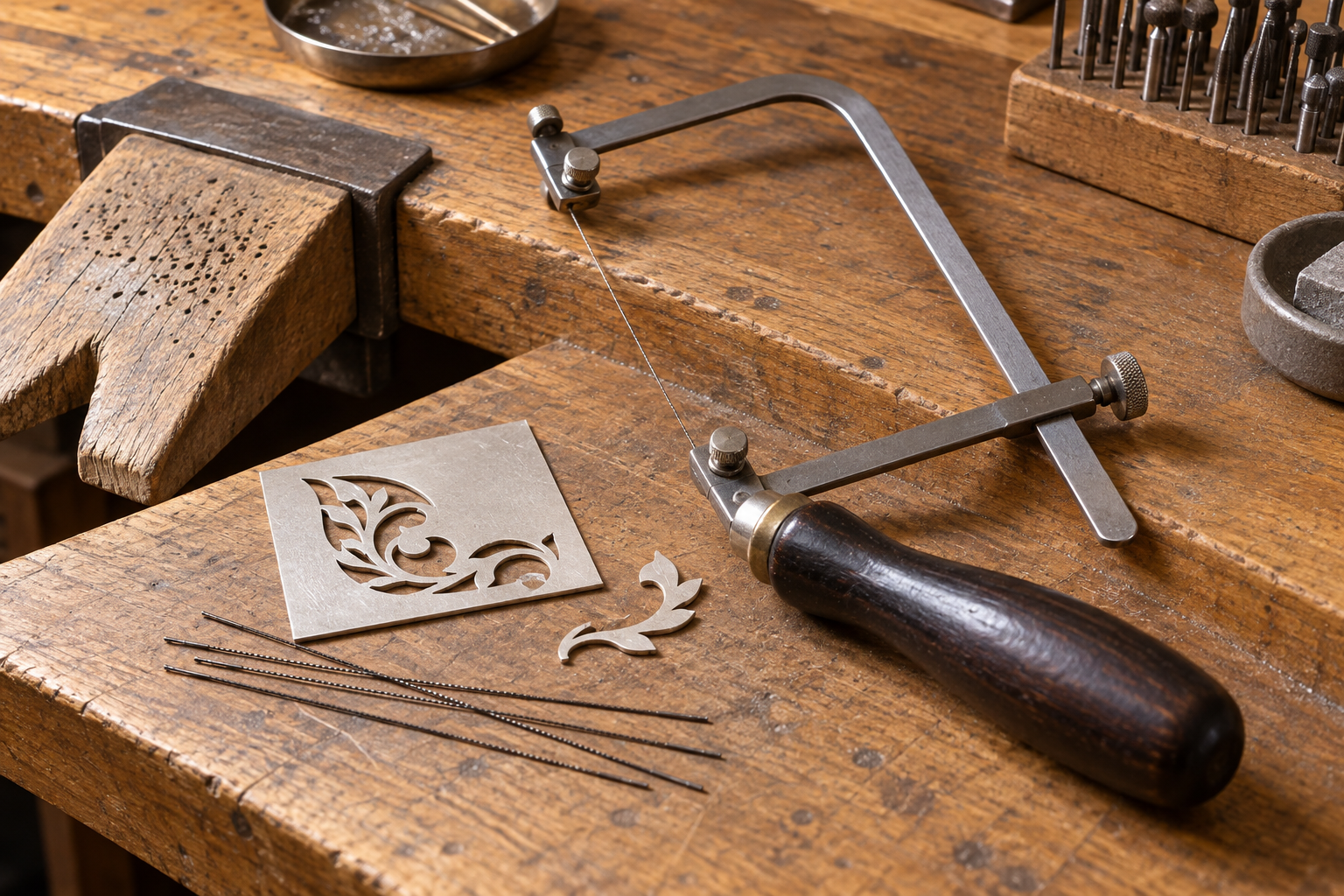
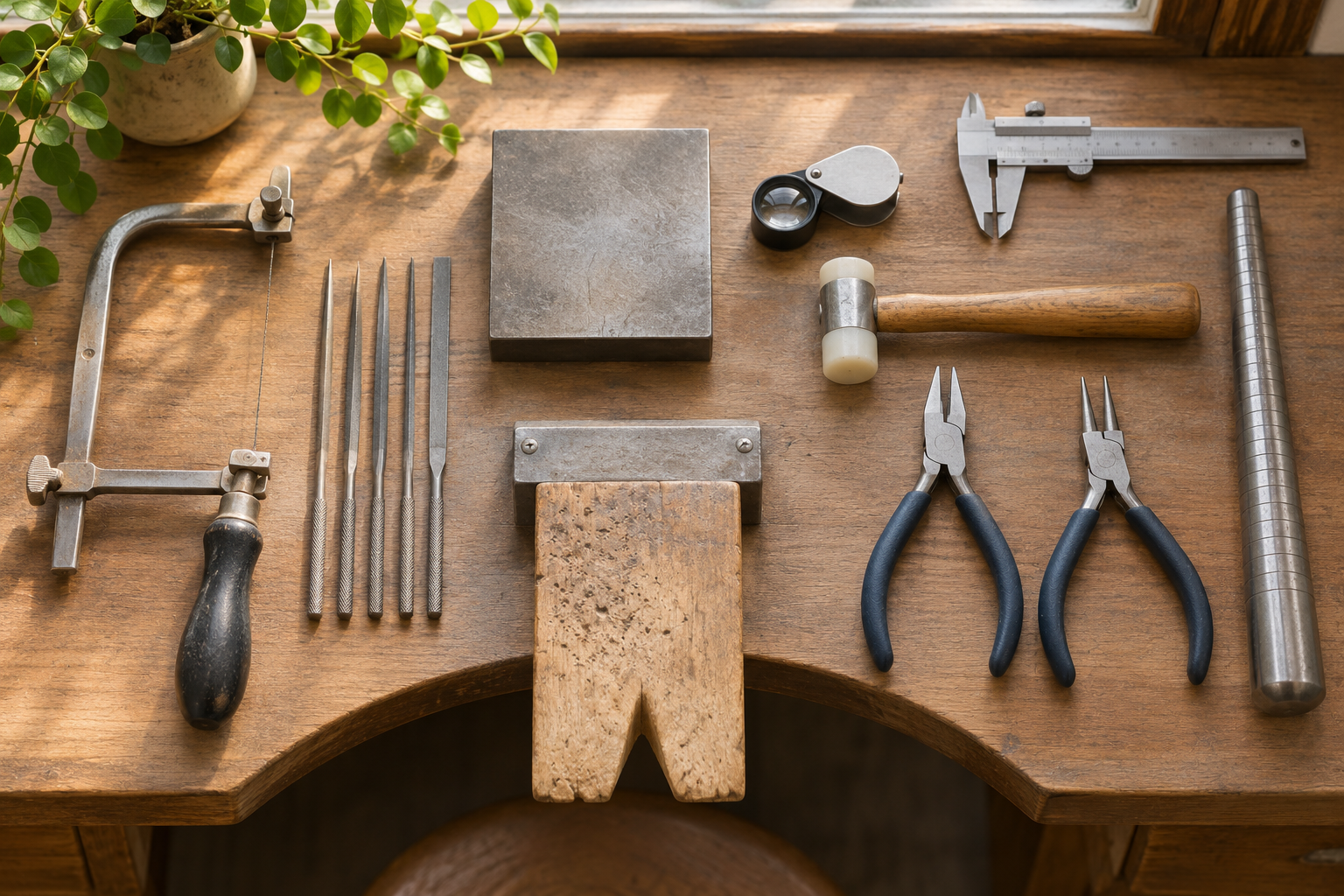
For a kit, check the actual jaw shapes, not just the tool count. Chain nose, round nose and flat nose are a useful core; a cutter is a separate tool with a different job. Cut only the wire types and gauges the cutter maker specifies. If your work centers on sawing and fabrication, the jeweler’s saw guide and bench setup guide help place these hand tools alongside the rest of the bench.
What to check before ordering
- Jaw shape and finish: Confirm the model number and whether the inside faces are smooth or serrated.
- Fit: Compare handle length, spring action and jaw reach with the size of your hand and the pieces you make.
- Contents: Check whether a set includes the three core jaw shapes and a cutter, or only several gripping pliers.
- Support: Check replacement jaw parts where relevant, plus shipping and tool support for your country.