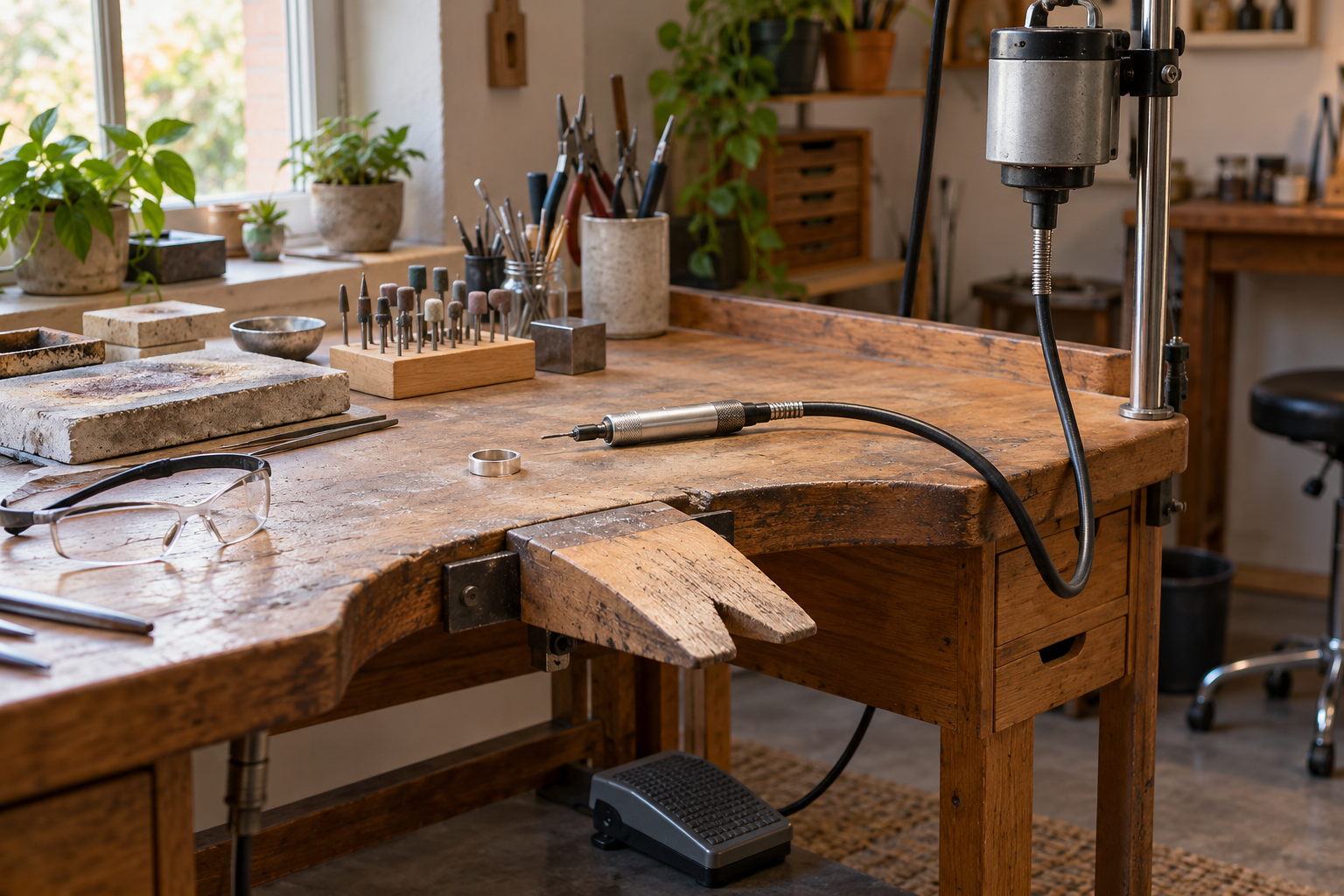
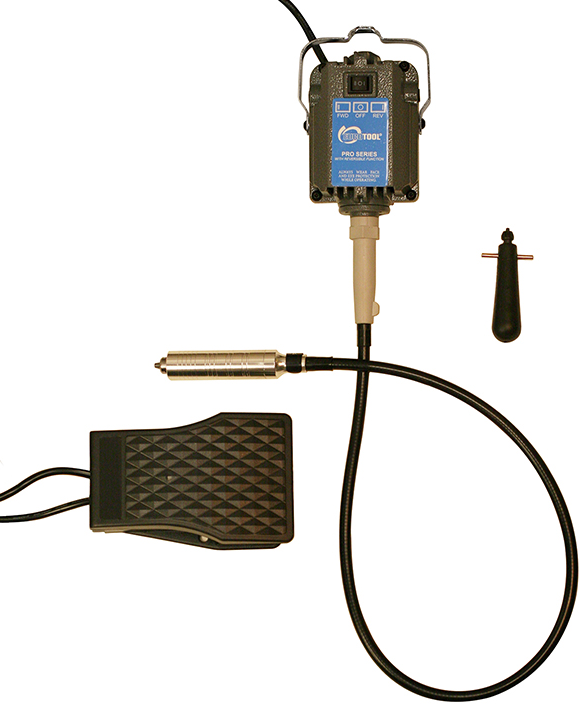
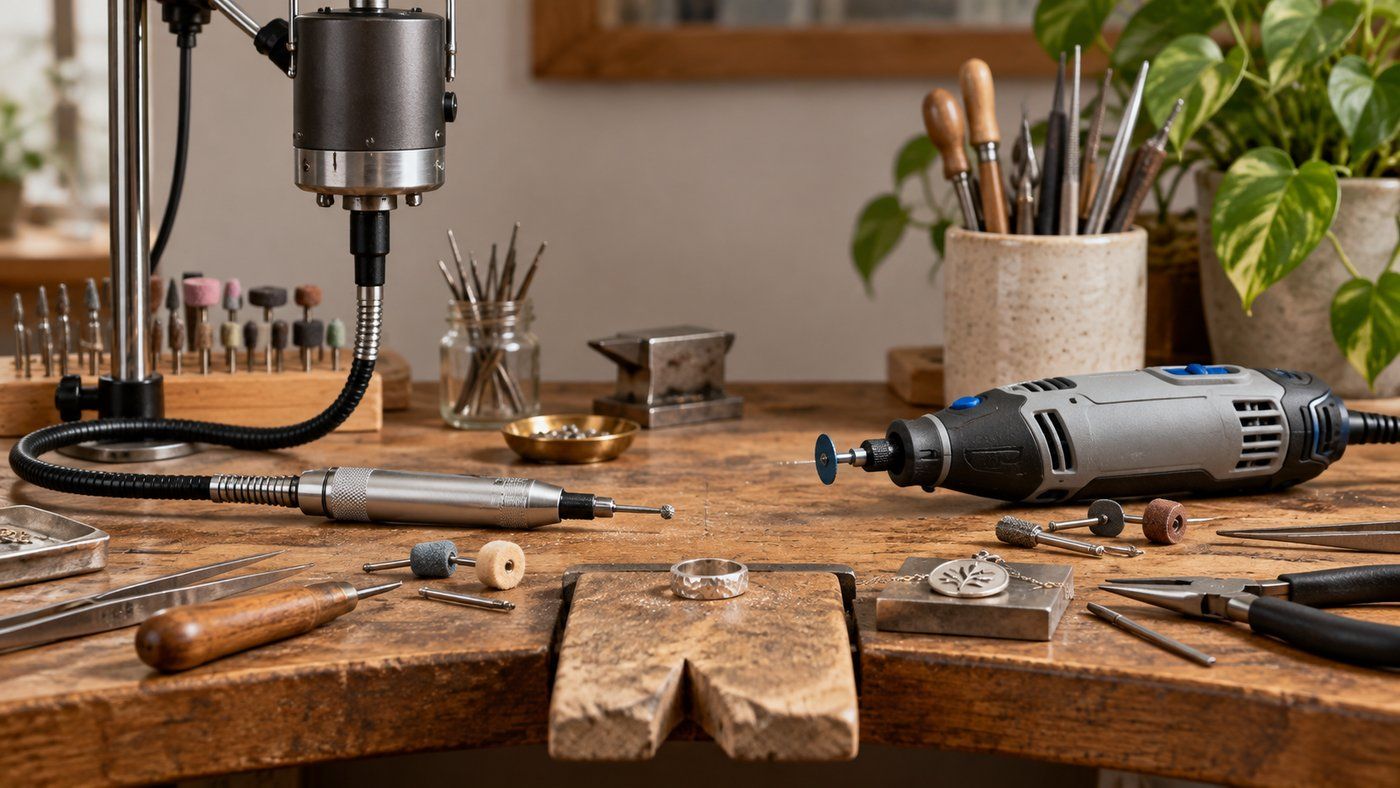
The best budget flex shaft is the one whose handpiece holds your tools, pedal lets you control the cut, and motor fits your bench. A large wattage number matters little if a bur slips in the chuck or the pedal starts too abruptly for a setting job. These five choices cover genuinely different starting points: an attachment for a motor you already own, two inexpensive complete sets, a quick-change system and a reversible bench machine.
Quick answer
Which budget flex shaft should I buy for jewelry?
Choose the SE 979FSG for occasional work when the lowest-cost complete hanging setup is the goal. Choose the VEVOR 780W when a wider chuck and heavier grinding matter more than a slim grip. If you already own a compatible rotary tool, the Dremel 225-02 costs less to add, but it does not give you a foot-controlled motor. For repeated 3/32-inch bur changes, consider the Prodigy quick-change system; choose the Eurotool HDP-180.00 for a reversible motor and documented handpiece options.
Match the system to your work
Five budget flex-shaft routes for different jewelry benches
Your situation
Best fit
Main limitation
Own a compatible rotary tool; need a lighter grip
Dremel 225-02 attachment
Uses the host tool; no foot speed control
Want the lowest-cost complete hanging set
SE 979FSG
Less documented parts and service support
Use larger abrasives or mixed shank sizes
VEVOR 780W
Bulkier handpiece for close work
Change 3/32-inch burs throughout a session
Prodigy quick-change system
Other shank sizes need another handpiece
Need reverse and a broader handpiece path
Eurotool HDP-180.00
Higher entry cost than the basic sets
If you have no motor yet, compare complete systems: motor, flexible shaft, speed control and handpiece. The Dremel attachment is a useful fifth route only for someone who already has a compatible tool. It cannot operate by itself. A hanger or rigid support may still be a separate expense with any hanging motor.
Check the handpiece before the motor rating
A three-jaw chuck is forgiving when your jewelry kit mixes 3/32-inch burs, larger drills and mandrels. The SE’s specified 5/32-inch capacity and VEVOR’s 0.3–6.5 mm range give different room for those shanks. A quick-change handpiece saves time only if its fixed size matches the tools you actually use; the Prodigy handpiece is for 3/32-inch shanks. Eurotool supplies a standard chuck-style handpiece and documents an optional quick-change one.
For small seat-cutting and finishing, keep the work supported and choose the bur’s recommended speed. Maximum rpm alone does not describe low-speed pedal feel, vibration or torque under load. Those are reasons to start with light pressure and a scrap-metal trial when a new machine reaches your bench.
Plan the whole bench layout
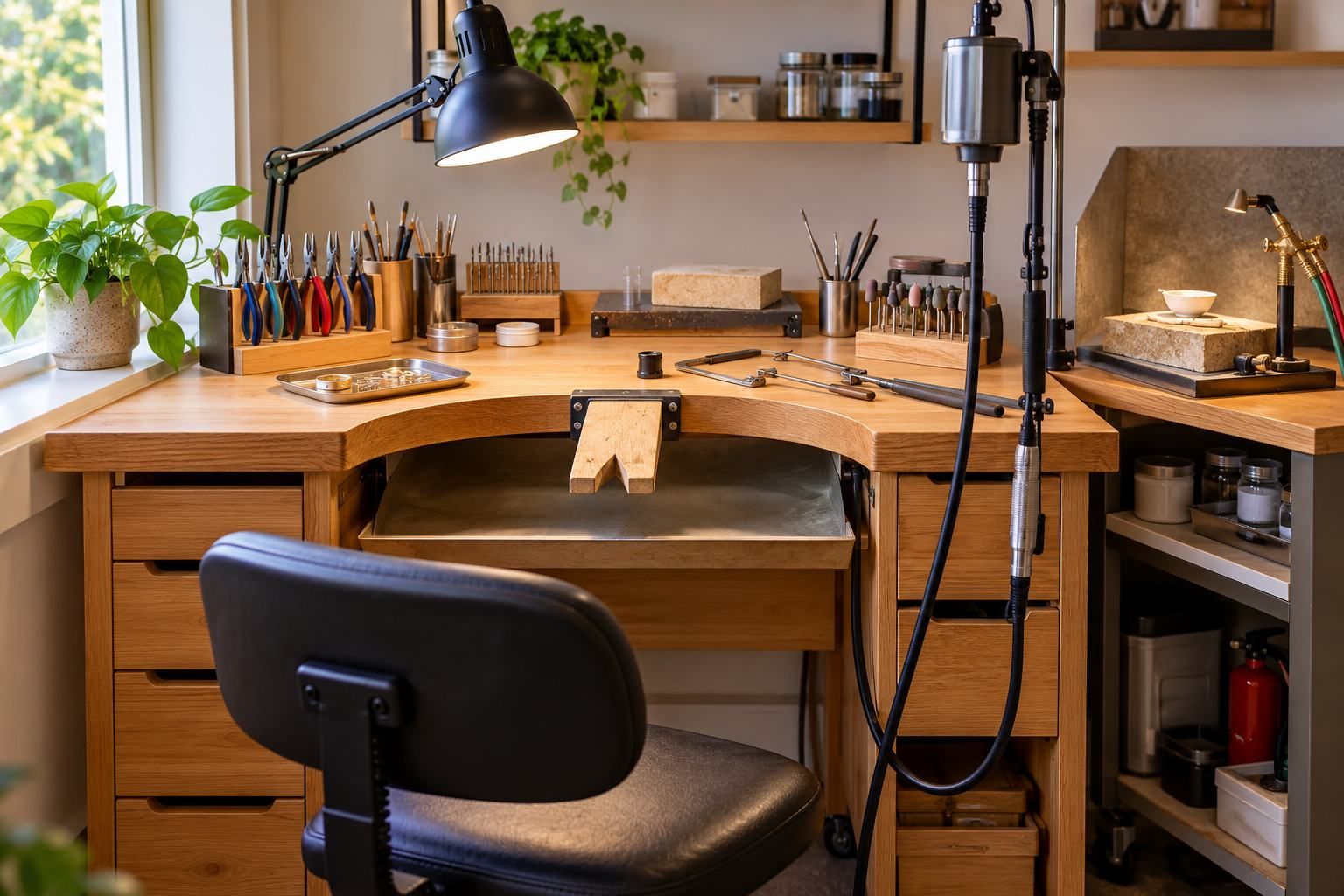
Put the hanger above the working area so the cable hangs in a gentle curve and does not pull the handpiece sideways. Leave floor space where your foot can reach the pedal without twisting your seated position. A tabletop rotary tool with the Dremel attachment also needs a safe resting or hanging position for the motor. See the bench setup guide before fixing a hanger to the furniture.
Five recommendations
Best add-on for an existing tool
Dremel · 225-02
Dremel 225-02 flex shaft attachment
Price tier: $Budget
Add the 225-02 when a compatible Dremel already covers occasional drilling, sanding or polishing but feels bulky near small work. Its 36-inch cable moves the grip away from the motor. Check compatibility with your exact rotary-tool model before buying, and remember that speed still comes from the host tool rather than a foot pedal.
Best for: Jewelers who already own a compatible rotary tool and want a lighter grip for occasional detail work.
Specs, strengths and limitations
Handpiece
Small grip; accepts up to 1/8 in shanks
Shaft length
36 in
Foot pedal
No; speed set on host tool
Warranty
1 year for product defects
Strengths
Lowest added cost if you already own a compatible rotary tool
Smaller grip reaches tight areas more comfortably than the full motor body
36-inch cable reaches from a mounted host tool to the bench
Limitations
Requires a compatible Dremel motor; it cannot run alone
The 979FSG supplies a hanging motor, variable foot control, chuck handpiece and case. The 5/32-inch chuck fits more shank sizes than a fixed 3/32-inch quick-change grip. Treat its included abrasives as practice supplies; choose your own burs and polishing tools for the metal and operation. It is a sensible occasional-use entry point when a serviceable professional system is beyond the current budget.
Best for: Beginners who need a complete occasional-use kit at the lowest sensible entry price and accept less certain long-term parts support.
Specs, strengths and limitations
Maximum speed
22,000 rpm
Motor power
Listed as 1/4 hp, 110 V / 60 Hz
Speed control
Variable foot control
Handpiece
Three-jaw chuck, up to 5/32 in (4 mm)
Shaft length
42 in (retailer specification)
Strengths
Low-cost complete set with motor, control and handpiece
Three-jaw chuck accepts common jewelry-tool shank sizes
Carrying case and starter accessories are included
Replacement motor brushes are included in some documented packages
Limitations
Published accessory counts vary between versions and sellers
Warranty and replacement-parts support are not clearly documented
Included consumables should be treated as starter items
Less suitable for sustained daily studio use than serviceable specialist systems
The VEVOR’s specified 0.3–6.5 mm chuck range is useful if you move between small jewelry burs and larger mounted abrasives. Its 100 cm shaft and foot control make it a complete bench setup, but the larger handpiece is less comfortable close to a tiny setting. Choose it for the chuck range and work pattern, not because the 780 W figure can be compared directly with another maker’s horsepower rating.
Best for: Budget buyers who prioritize a wide chuck range and heavier grinding capacity over a jewelry-specialist handpiece system and long-term service network.
Specs, strengths and limitations
Maximum speed
23,000 rpm
Motor power
780 W, 110 V
Speed control
Stepless foot control, 500–23,000 rpm
Handpiece
Three-jaw chuck, 0.3–6.5 mm (about 1/4 in)
Shaft length
100 cm (about 39.4 in)
Strengths
Widest chuck capacity in this shortlist
Low 500 rpm starting specification and 23,000 rpm maximum
Complete set with foot control and starter accessories
Higher claimed output than the other budget kits
Limitations
Accessory counts differ across package descriptions
Claimed wattage is not directly comparable with Foredom horsepower ratings
Large handpiece is less suited to delicate close-grip work
Long-term parts and service support is less established than Foredom's
Prodigy flex shaft system with quick-change handpiece
Price tier: $$Mid-range
The Prodigy system pairs an electronic foot control with a lever-operated handpiece for 3/32-inch tools. That saves repeated chuck-key work when a session moves through several setting burs. If your drills or mandrels use other shank sizes, budget for the compatible key-type handpiece as well; the supplied grip is intentionally size-specific.
Best for: Jewelers using mostly 3/32-inch burs who value rapid tool changes during repeated bench work.
The HDP-180.00 adds a reversible 1/6 hp motor, variable foot control and standard chuck-style handpiece. Eurotool documents compatible brushes and an optional quick-change grip, giving you a clearer route to adapt the system later. It costs more up front than the basic sets, so its value is strongest when reverse or future handpiece changes already matter to your work.
Best for: Jewelers who want reverse operation and a path to specialist handpieces without moving to a premium system.
Specs, strengths and limitations
Maximum speed
18,000 rpm
Motor power
1/6 hp, 110 V / 60 Hz
Forward / reverse
Yes
Speed control
Variable foot control
Handpiece
Standard chuck style; compatible quick-change option
Strengths
Reversible motor helps with left-handed work and changing cutting direction
Foot control and chuck handpiece are included
Maker documents compatible brushes and optional quick-change handpiece
Limitations
Costs more than the basic starter sets
110 V version needs the correct power supply outside North America
Check the power supply. The SE, Prodigy and Eurotool configurations here specify 110 V; VEVOR configurations can differ by region. Read the exact motor and control nameplates. A plug adapter alone does not convert voltage, and pedal compatibility must match the motor.
Check what is in the box. A working hanging setup needs a motor, shaft, speed control and handpiece. Confirm the hanger, chuck key, grease and consumables separately. Do not judge a kit by accessory count: the tools that touch your jewelry need to fit your chosen technique.
Check service parts. Motor brushes, inner shafts, sheaths and handpieces are wearing or replaceable parts. Eurotool documents compatible brushes and handpieces; the cheaper generic systems have less clearly documented support. That matters more as the machine moves from occasional projects to daily work.
Protect the work and yourself. Clamp tiny parts when fingers would be close to a rotating bur. Wear eye protection, tie back hair, avoid loose clothing and control polishing dust. Let the cutter work with light pressure rather than forcing the handpiece.
If you use a flex shaft during nearly every bench session, the broader flex-shaft guide explains when a serviceable Foredom SR becomes worth the extra cost. If you are still deciding whether a hanging setup earns space at all, compare a flex shaft with a handheld rotary tool first.
Frequently asked questions
What is the cheapest useful flex shaft for jewelry?
If you already own a compatible Dremel, its 225-02 attachment is the least expensive way to move the motor weight out of your hand, but it has no foot control of its own. For a complete hanging system with a pedal, start by comparing the SE 979FSG and VEVOR 780W against the work you do.
Is a cheap flex shaft good enough for stone setting?
It can turn suitable burs, but controllable low speed and a handpiece that holds your bur shanks matter more than the claimed motor power. If you change 3/32-inch burs repeatedly, a quick-change handpiece can be worth more than a higher maximum speed.
Should I buy a quick-change or chuck handpiece first?
Choose a chuck if your drills, mandrels and burs use mixed shank sizes. Choose a quick-change handpiece when nearly everything you use has a 3/32-inch shank and frequent swaps slow your work.
Can I use a 110 V flex shaft outside the United States?
Only with an appropriate power arrangement for the exact motor and pedal. Check the nameplate, plug and local electrical requirements; a simple plug adapter does not change supply voltage.
Tools in this guide
Dremel
Dremel 225-02 flex shaft attachment
$Jewelers who already own a compatible rotary tool and want a lighter grip for occasional detail work.
$Budget buyers who prioritize a wide chuck range and heavier grinding capacity over a jewelry-specialist handpiece system and long-term service network.
We have not personally used every product in this guide. Recommendations are based on specifications, manufacturer documentation, specialist references and owner experiences.
Specifications come from manufacturer documentation where it is available.
Specialist references, supplier catalogs and owner experiences are used to understand real-world strengths and weaknesses.
We do not claim physical testing, and we do not publish scores or star ratings.
Flex shaft vs Dremel for jewelry making: compare control, hand comfort, speed, drilling, polishing, stone setting and cost to decide which rotary tool fits your bench.
Set up a jewelry bench at home with the right bench height, bench pin position, lighting, seating, tool layout, metal recovery, soldering zone and safety.
Choose a Foredom flex shaft by motor, handpiece, foot control and kit contents, with clear picks for general jewelry work, quick bur changes, heavy grinding and stone setting.