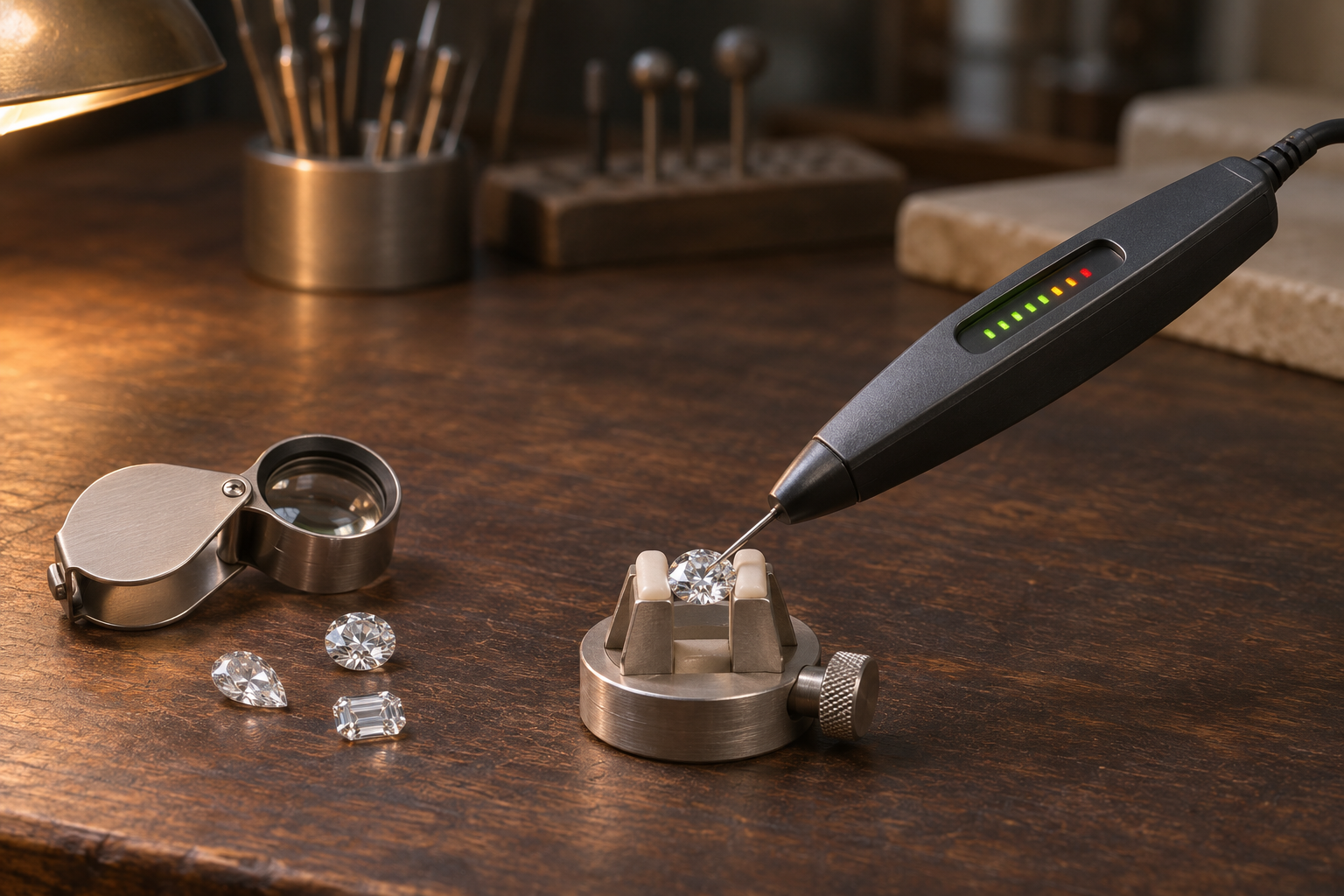
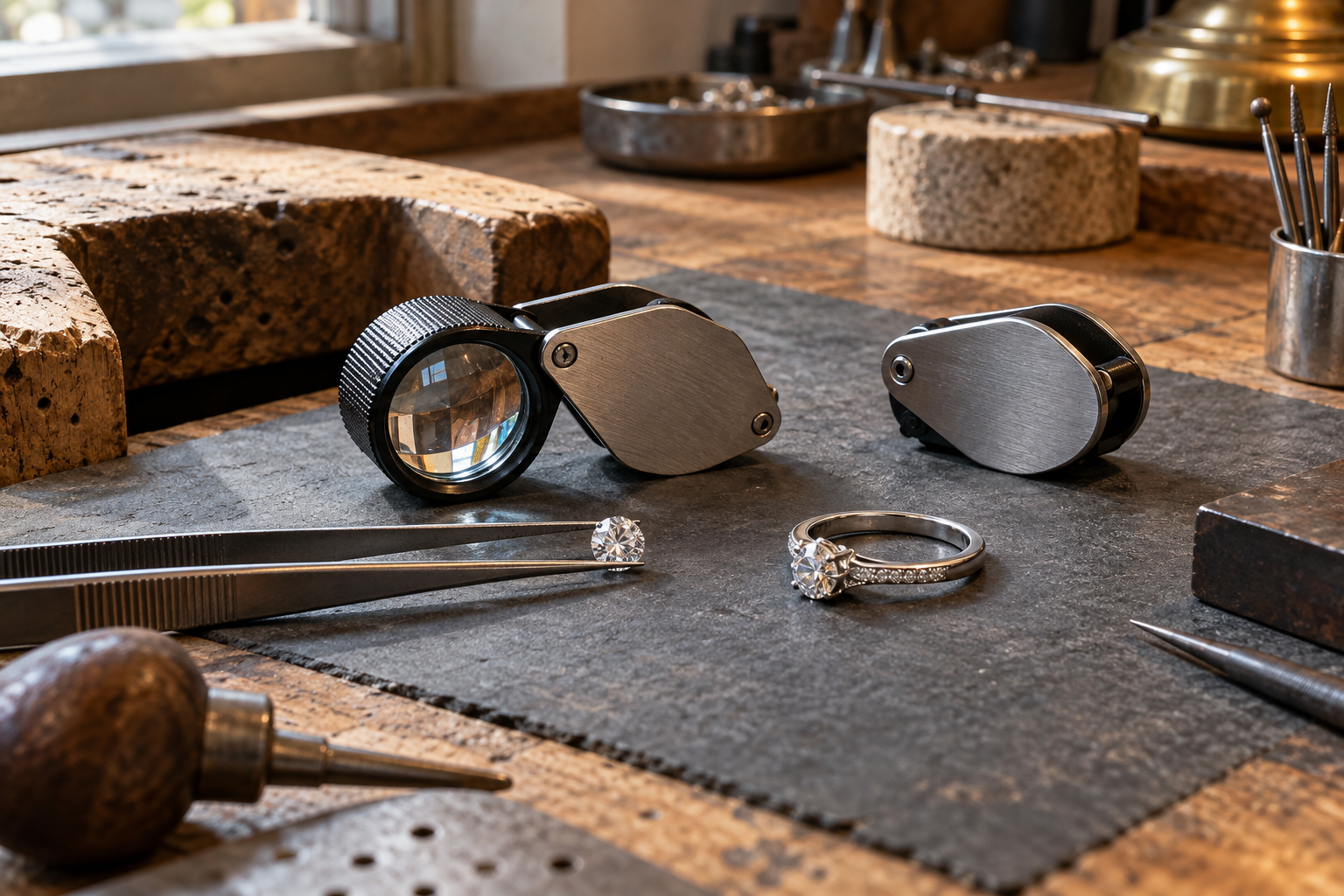
A diamond tester is useful only if its result answers the question you have. A thermal pen helps separate diamond-like stones from many simulants. An electrical check helps separate moissanite. Neither establishes whether a diamond grew in the ground or a laboratory. Choose the instrument by that sequence, the size of stones you handle, and the consequences of a wrong call.
Quick answer
Which diamond tester should I buy?
For an initial check, the Diamond Mate A is a straightforward thermal pen, but add a Moissanite Tester II for stones that register as diamond. The Multi Tester III combines those checks in one tool. SAM is the step up for very small stones and lower-conductivity moissanite. If you routinely sort confirmed colorless diamonds for possible laboratory-grown origin, the Synthetic Diamond Screener II adds a bounded screening step, not a final origin decision.
Decide what you need to distinguish
Thermal conductivity separates many low-conductivity simulants from stones with diamond-like heat transfer, but moissanite can also produce a diamond indication. An electrical test supplies the next distinction. A combined tester performs both measurements in one housing; a separate electrical probe can extend a thermal pen you already own. Both methods depend on clean probe contact and a suitable testing environment.
Origin is a different question. Natural and laboratory-grown diamonds share enough properties that an ordinary pen cannot separate them. A dedicated screener can identify a narrower group for further examination, subject to its color, size and setting limits. GIA notes that a referral result may represent either natural or laboratory-grown diamond; send a consequential result to a qualified laboratory.
Choose a test sequence for your bench| Your work | Start with | What it adds |
|---|
| Occasional unknown colorless stones | Diamond Mate A | A simple thermal first check; follow a positive result with moissanite testing |
|---|
| You already own a thermal pen | Moissanite Tester II | A dedicated electrical follow-up for a diamond indication |
|---|
| Routine counter checks with one pen | Multi Tester III | Thermal and electrical checks in one instrument |
|---|
| Very small stones and difficult moissanite | SAM | Finer probe and broader stated moissanite response |
|---|
| Origin screening after diamond identification | Synthetic Diamond Screener II | Flags suitable colorless stones that need further examination |
|---|
Five testers for distinct jobs
Best thermal first check: Presidium Diamond Mate A
The PDMT-A uses a 0.6 mm retractable thermal probe and an audible warning if the tip touches a metal setting. Presidium states a 0.02 ct lower stone size. Three AAA alkaline batteries make it portable and avoid the charging setup of the separate PDMT-C version. Choose it if you need an initial check and can follow a diamond indication with another method. A positive thermal result is not a moissanite or origin decision.
Best thermal first check
Presidium · PDMT-A
A handheld thermal-conductivity tester with a 0.6 mm retractable probe and metal-contact alert.
Best for: An initial check of colorless stones when a separate moissanite check is available.
Specs, strengths and limitations
- Test method
- Thermal conductivity
- Primary use
- Diamond versus common low-conductivity simulants
- Smallest stated stone
- 0.02 ct
- Probe
- 0.6 mm retractable tip
- Power
- 3 AAA alkaline batteries
Strengths
- Simple first-pass thermal test
- Fine retractable tip reaches small stones
- Metal-contact alert helps avoid a setting reading
Limitations
- Cannot separate diamond from moissanite
- Does not establish natural or laboratory-grown origin
Best follow-up to a thermal pen: Presidium Moissanite Tester II
The PMT II measures electrical conductivity to check colorless moissanite against diamond. The maker specifically positions it after a positive thermal test, so it makes sense for a bench that already has a suitable first-step pen. Its stated minimum is 0.05 ct moissanite, and it uses three AAA batteries. Do not use it as the only instrument for an unidentified stone: it does not first sort out cubic zirconia and other lower-conductivity simulants.
Best moissanite follow-up
Presidium · PMT II
Presidium Moissanite Tester II
A dedicated electrical-conductivity probe for checking a colorless stone that first gave a diamond indication on a thermal tester.
Best for: A jeweler who already has a thermal tester and needs a separate moissanite check.
Specs, strengths and limitations
- Test method
- Electrical conductivity
- Primary use
- Diamond versus colorless moissanite after a thermal test
- Smallest stated stone
- 0.05 ct moissanite
- Probe
- Dedicated electrical probe
- Power
- 3 AAA alkaline batteries
Strengths
- Adds a focused moissanite check to an existing thermal workflow
- Compact handheld format
- Clear LED readout
Limitations
- Requires a separate thermal tester for unknown stones
- Not intended to identify other simulants or diamond origin
Best single handheld tester: Presidium Multi Tester III
The PMuT III combines thermal and electrical checks, with a 0.6 mm retractable tip, metal-contact warning and a display visible from either side. Presidium gives a 0.02 ct minimum for colorless stones. It saves switching tools during routine checks, but technique still matters: the maker’s FAQ says a loose moissanite on a metal tray needs a complete electrical loop, and suggests testing more than one point when readings disagree. It cannot determine diamond origin.
Best single handheld tester
Presidium · PMuT III
A single handheld instrument combining thermal and electrical checks for colorless diamond, moissanite and common simulants.
Best for: Routine counter checks when carrying one probe is more useful than a two-instrument sequence.
Specs, strengths and limitations
- Test method
- Thermal and electrical conductivity
- Primary use
- Colorless diamond, moissanite and common simulants
- Smallest stated stone
- 0.02 ct
- Probe
- 0.6 mm retractable tip
- Power
- 3 AAA alkaline batteries or optional maker adapter
Strengths
- Combines the first two checks in one instrument
- Fine tip and 180-degree LED display
- Metal-contact warning
Limitations
- Higher cost than a thermal-only pen
- Technique and electrical contact matter for moissanite readings
- Cannot determine diamond origin
Best for tiny stones: Presidium SAM
SAM uses a 0.45 mm retractable probe; Presidium states it can test colorless stones from 0.01 ct and distinguish a wider range of moissanites, including lower-conductivity types. That makes its higher cost easier to justify when melee and difficult moissanite checks are regular work. Follow the maker’s stated 23–27°C operating temperature range. SAM still does not determine natural versus laboratory-grown origin.
Best for tiny stones
Presidium · SAM
A fine-tip thermoelectrical tester designed to separate colorless diamonds from a wider range of moissanites, including lower-conductivity stones.
Best for: Frequent small-stone checks where standard combined testers leave uncertain moissanite results.
Specs, strengths and limitations
- Test method
- Higher-resolution thermal and electrical conductivity
- Primary use
- Colorless diamond versus wider moissanite range and common simulants
- Smallest stated stone
- 0.01 ct
- Probe
- 0.45 mm retractable tip
- Power
- 3 AAA alkaline batteries or optional maker USB adapter
Strengths
- 0.45 mm tip supports very small stones
- Designed for lower-conductivity moissanite
- Compact battery-powered probe
Limitations
- Costs more than the Multi Tester III
- Shorter stated continuous battery life than the Multi Tester III
- Cannot establish natural or laboratory-grown origin
Best additional origin screen: Presidium Synthetic Diamond Screener II
The SDS II uses deep-UV absorption for a screening result after you have established that the stone is a diamond. Its maker limits use to colorless D–J stones with a suitable flat surface and size; mounted jewelry needs an open back. It does not identify cubic zirconia or moissanite, and a Type IIa-like or other uncertain result calls for further examination rather than an origin verdict. This desktop tool belongs in a repeated sorting workflow, not as a first tester for an unknown ring.
Best additional origin screen
Presidium · SDS II
A desktop deep-UV screening instrument for confirmed colorless diamonds, with a referral result that needs further examination.
Best for: A studio sorting confirmed colorless diamonds and referring stones that need origin testing.
Specs, strengths and limitations
- Test method
- Deep-UV absorption screening
- Primary use
- Type Ia-like versus Type IIa-like result for confirmed diamonds
- Smallest stated stone
- 0.02 ct, subject to size and contact rules
- Probe
- Enclosed desktop testing chamber
- Power
- 4 AAA alkaline batteries or USB power
Strengths
- Adds a diamond-type screening step after stone identification
- Handles suitable loose stones and open-back settings
- Enclosed chamber and clear indicator lights
Limitations
- Cannot identify an unknown stone or replace an origin report
- More expensive and less portable than handheld probes
- Restricted to the maker's color, size, surface and setting conditions
How to get a more useful reading
- Inspect the stone with a loupe and choose an accessible, clean facet. Note whether the stone is loose or mounted.
- Read the exact manual for power, warm-up, calibration and temperature. Let the stone and instrument settle to the specified conditions.
- Keep the probe on the stone rather than the metal setting. Support loose stones as directed so an electrical test can complete its circuit.
- Repeat a doubtful result at another appropriate point. A tiny stone, dirty facet, damaged tip or incomplete contact can make a single reading misleading.
- Record the method and result. If the value of a stone or an origin claim matters, use a gemological laboratory for the necessary follow-up.
For a broader bench kit, see the measuring tools hub. Our gold testing guide covers the separate question of metal composition.
What to check before ordering
Check the exact model suffix, smallest stone size, whether your settings expose a usable facet, the supplied batteries or adapter, replacement probe availability, and support for your country. A small-stone claim applies only when the probe can contact the stone without touching its mounting. For the SDS II, confirm that your stones meet its color, shape and open-back conditions before budgeting for it.