Buying guide · Rotary Tools
Best Flex Shafts for Jewelry Making
Compare five verified flex-shaft configurations for jewelry making, from budget starter kits to serviceable Foredom and Grobet bench systems.
Rotary ToolsComparison
Compare Foredom SR and TX flex-shaft motors by torque, speed, reverse, voltage, controls and handpiece setup to choose the right system for jewelry work.
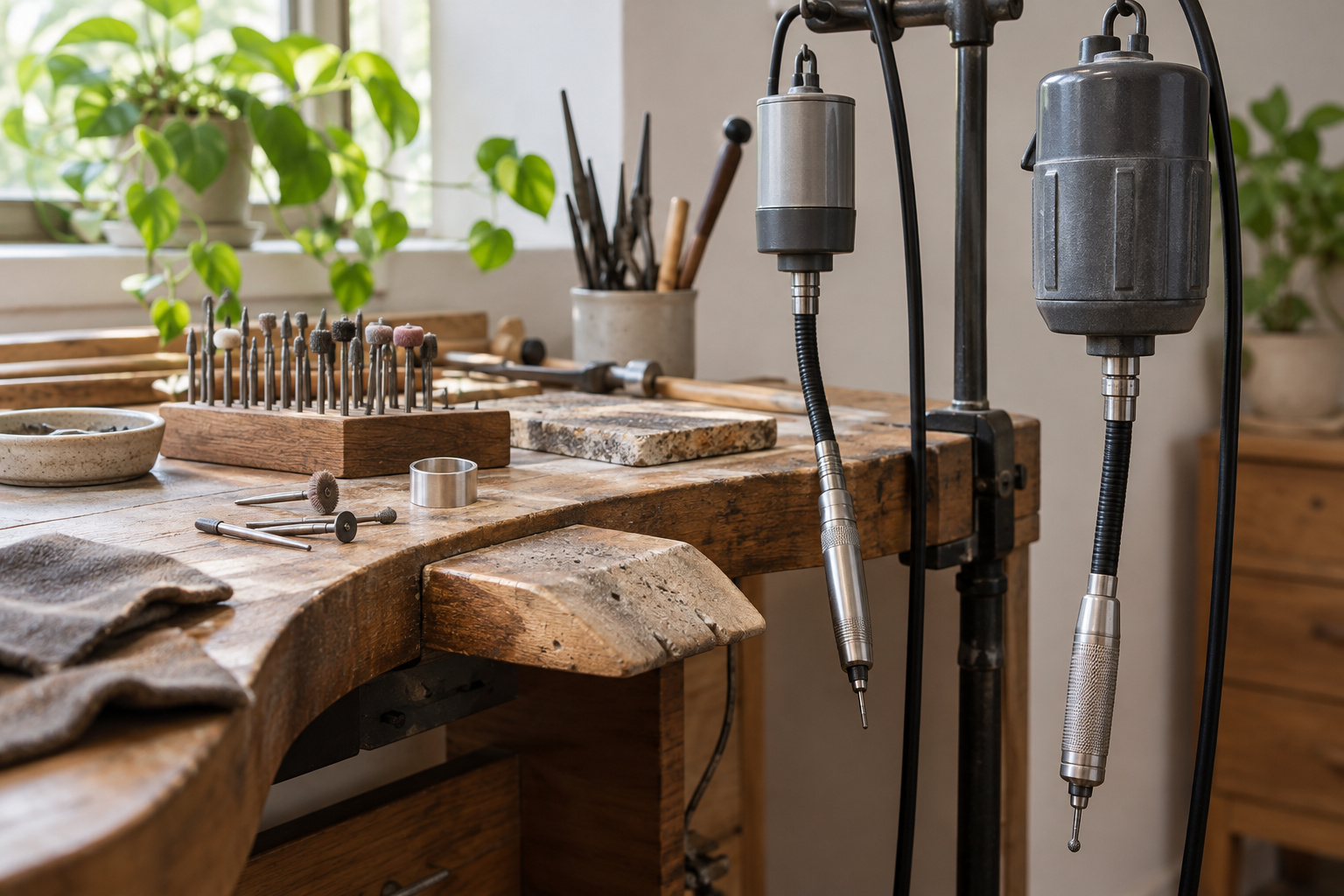
The Foredom SR is the more useful default for most jewelry benches. Its reversible motor and broad voltage choices suit everyday drilling, bur work, sanding and detail polishing. The TX earns its place when you regularly keep a larger cutter under heavy load and need the motor to hold speed through that work.
Quick answer
Choose the SR for a first professional flex shaft or a bench that moves among small drills, setting burs, abrasives and polishing tools. Choose the TX when prolonged, forceful grinding or material removal is a normal part of your work. The TX has more torque under load, but it runs forward only and its current motor range is 115 V; the SR offers forward and reverse and 115 V or 230 V versions.
| Consideration | SR | TX |
|---|---|---|
| Motor rating | 1/6 hp | 1/3 hp |
| Maximum speed | 18,000 rpm | 15,000 rpm |
| Rotation | Forward and reverse | Forward only |
| Current voltage choices | 115 V and 230 V | 115 V |
| Best fit | General jewelry work and varied techniques | Sustained heavy cutting and grinding |
| Control | Use an SR-compatible control matched to voltage | Use TXR, SXR or EMX control |
Foredom rates these motors for continuous duty or maximum efficiency, so the horsepower figures are most useful within Foredom’s own range. The TX’s rating is twice the SR’s, but that does not mean a small setting bur cuts twice as fast. Cutter design, pressure, handpiece and workpiece support still govern the operation.
The SR’s 18,000 rpm ceiling and forward/reverse switch give it a broad working range. Reverse can make an abrasive or polishing operation more comfortable when you change the side from which you approach a piece. It also lets you choose a rotation direction that throws debris away from a delicate edge. Use only accessories that their maker permits in that direction, and tighten chucks and mandrels as instructed.
For a jeweler switching repeatedly between drilling, burs, rubber abrasives and small buffs, handpiece choice usually changes the workflow more than extra motor power. A chuck-style H.30 accepts varied shank sizes; a compatible quick-change handpiece is faster when most burs share its specified shank size. Choose the handpiece around your actual drills and burs, then check the shaft connection before buying.
The SR also has current 230 V versions. That matters if your workshop uses 230 V mains: select a matching motor and control rather than relying on a plug adapter. A kit’s suffix and plug type should agree with the local supply.
Foredom positions the TX for demanding work that keeps a cutter under load. Think of repeated heavy grinding, carving into hard material or removing substantial metal from castings. In those jobs, stronger torque helps the tool resist slowing as pressure rises. Use the right abrasive and controlled pressure; extra motor torque is not permission to force a bur into a small workpiece.
The TX’s 15,000 rpm maximum is lower than the SR’s 18,000 rpm. Its practical advantage is cutting strength under load, not speed at the top of the dial. If your work mainly uses small jewelry burs and short passes, the stronger motor may add little to the result.
The TX runs forward only and Foredom’s current TX range is 115 V only. For a 230 V workshop, that is a major setup constraint. Check the motor nameplate and local power supply before committing to a system.
Both motor series can be configured with Foredom’s common 39-inch key-tip shaft, which supports a broad range of compatible handpieces. A key-tip SR and key-tip TX can therefore feel similar at the working end when they carry the same handpiece. Do not assume that every Foredom handpiece fits every shaft: heavy-duty square-drive versions use a different connection and a narrower handpiece group.
| Your work | Start with | Check before ordering |
|---|---|---|
| Mixed drilling, setting burs and finishing | SR with a versatile key-tip handpiece | Accessory shank sizes and whether the kit includes the handpiece |
| Many identical 3/32-inch burs in one session | SR with a compatible quick-change handpiece | Whether your drills and mandrels also fit that handpiece |
| Long heavy-grinding sessions | TX with a handpiece suited to the cutter | 115 V power, matched control and the actual shaft connection |
| 230 V workshop | A 230 V SR configuration | Matching motor, control and plug type |
Foredom distinguishes motor combinations, sets and kits. A motor combination includes the motor, shaft and speed control but may require a separate handpiece. Read the exact model number and component list so the setup you receive can actually run the burs you use.
The TX is a permanent-magnet motor with specific control requirements. Its manual permits TXR or SXR foot controls or an EMX dial control and warns that other controls or direct connection to an outlet can damage the motor. The SR uses controls matched to its own motor and voltage. Treat the pedal as an electrical component of the system, not a universal accessory.
Before connecting either machine, check the motor and control nameplates, voltage, grounding and condition of the cords. Hang the motor securely, keep the shaft in a broad curve, and follow the manual’s lubrication and maintenance instructions. Wear eye protection, secure small work and keep loose hair or clothing away from the rotating shaft.
Buy the SR if your work is mostly normal jewelry fabrication and you have no recurring heavy-load task. Put the budget and attention into a handpiece that fits your burs, a matching control and a sound hanging setup. Choose the TX only when sustained material removal already justifies its torque and your workshop supports its 115 V supply.
For complete system choices, see the flex-shaft guide. If you are still deciding whether a hanging motor belongs at your bench, start with flex shaft versus handheld rotary tool.
The TX is better suited to sustained heavy cutting or grinding. For routine drilling, setting burs, sanding and small-scale polishing, the SR offers more useful flexibility through reverse rotation and 115 V or 230 V versions.
No. Foredom specifies a 15,000 rpm maximum for the TX and 18,000 rpm for the SR. The TX's advantage is stronger torque under load, not a higher top speed.
No. Foredom's TX manual specifies TXR or SXR foot controls or an EMX dial control for the TX motor. Use a control approved for the exact motor and voltage.
Both series can use compatible Foredom key-tip handpieces when fitted with standard key-tip shafting. Match the shaft connection and accessory shank size; a square-drive shaft needs a square-drive handpiece.
It depends on the configuration. Foredom sells motor-and-control combinations as well as sets and kits. Check the exact model number and included motor, shaft, control and handpiece before ordering.
We have not personally used every product in this guide. Recommendations are based on specifications, manufacturer documentation, specialist references and owner experiences.
Full details: how we review and research tools and oureditorial policy.
Buying guide · Rotary Tools
Compare five verified flex-shaft configurations for jewelry making, from budget starter kits to serviceable Foredom and Grobet bench systems.
Buying guide · Rotary Tools
Choose a budget flex shaft for jewelry by handpiece fit, foot control, motor direction and service parts, with five distinct ways to spend less.
Comparison · Rotary Tools
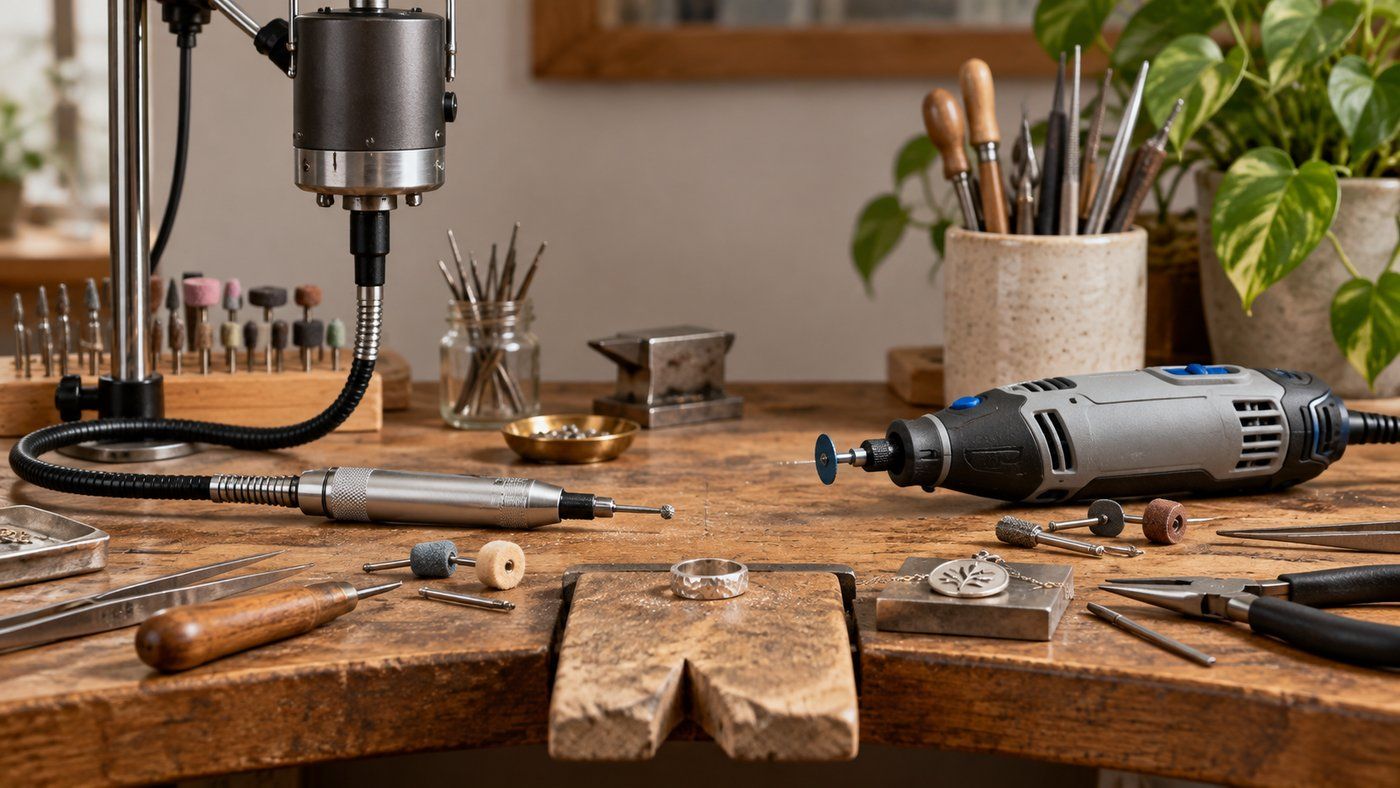
Flex shaft vs Dremel for jewelry making: compare control, hand comfort, speed, drilling, polishing, stone setting and cost to decide which rotary tool fits your bench.
Buying guide · Rotary Tools
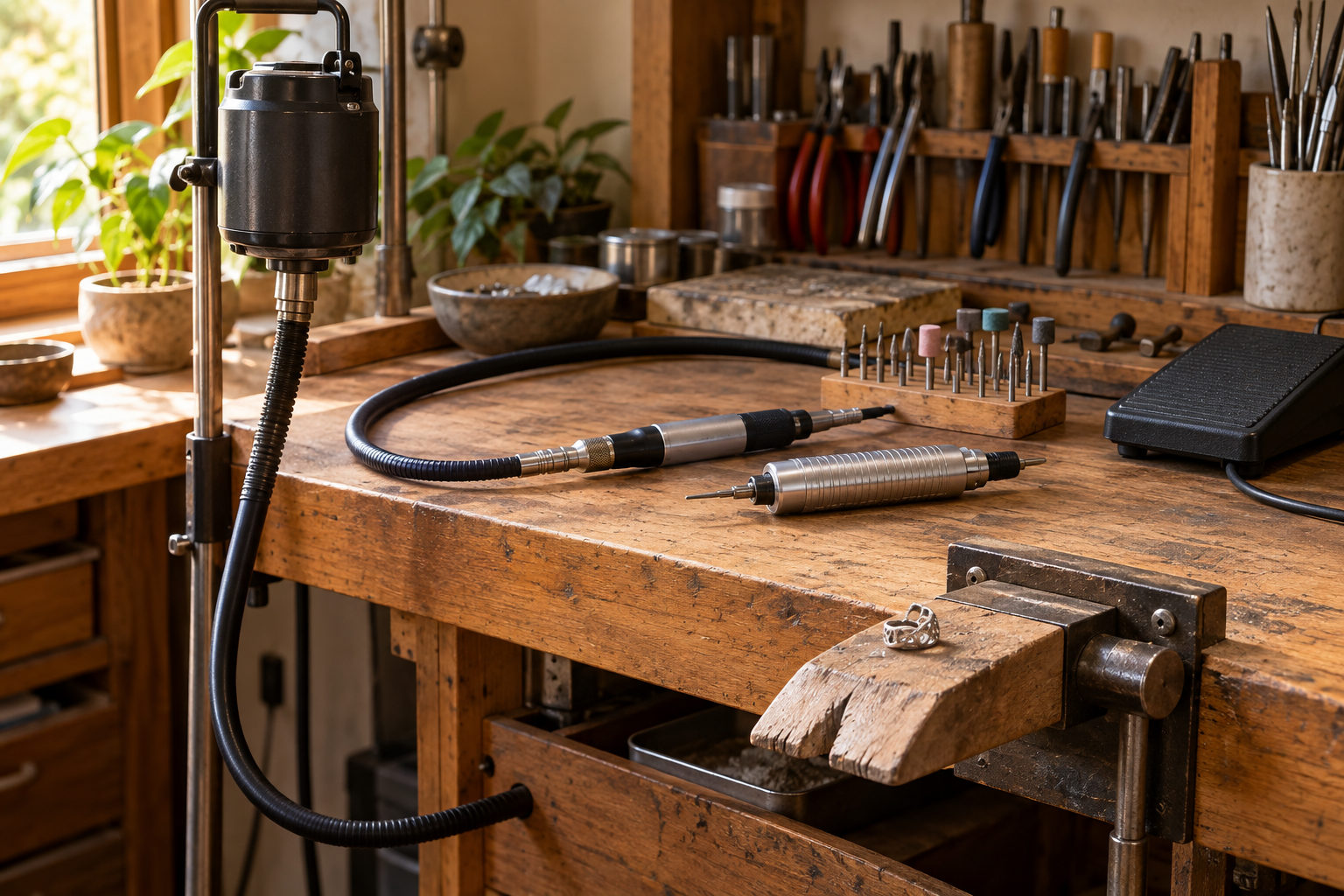
Choose a Foredom flex shaft by motor, handpiece, foot control and kit contents, with clear picks for general jewelry work, quick bur changes, heavy grinding and stone setting.