A modest rolling mill can be useful when its roller layout, bench space and intended work agree.
The best budget rolling mill is the one that saves you a second purchase. Start with the stock you actually want to
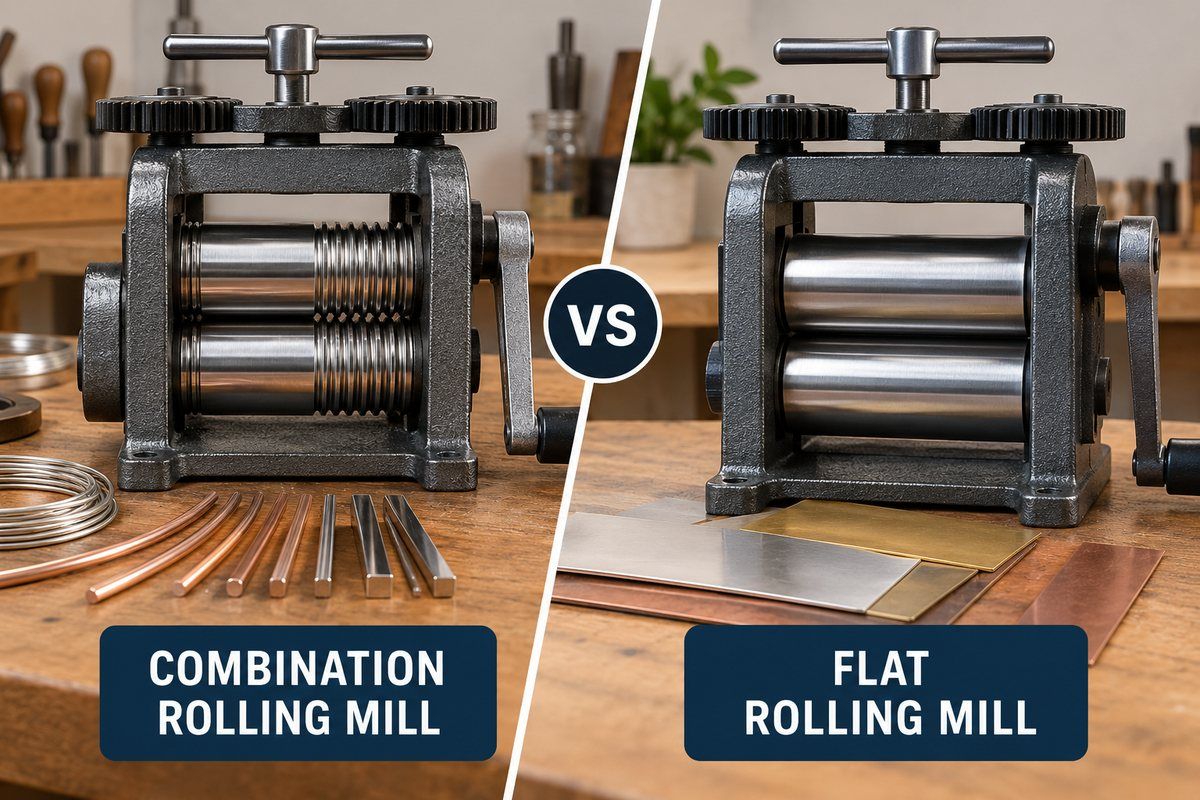
make: a compact combination mill is useful for rings, small sheet and wire; a dedicated flat mill is worth saving for
only when wider sheet or roll printing is already part of your work.
Quick answer
What is the best budget rolling mill for jewelry making?
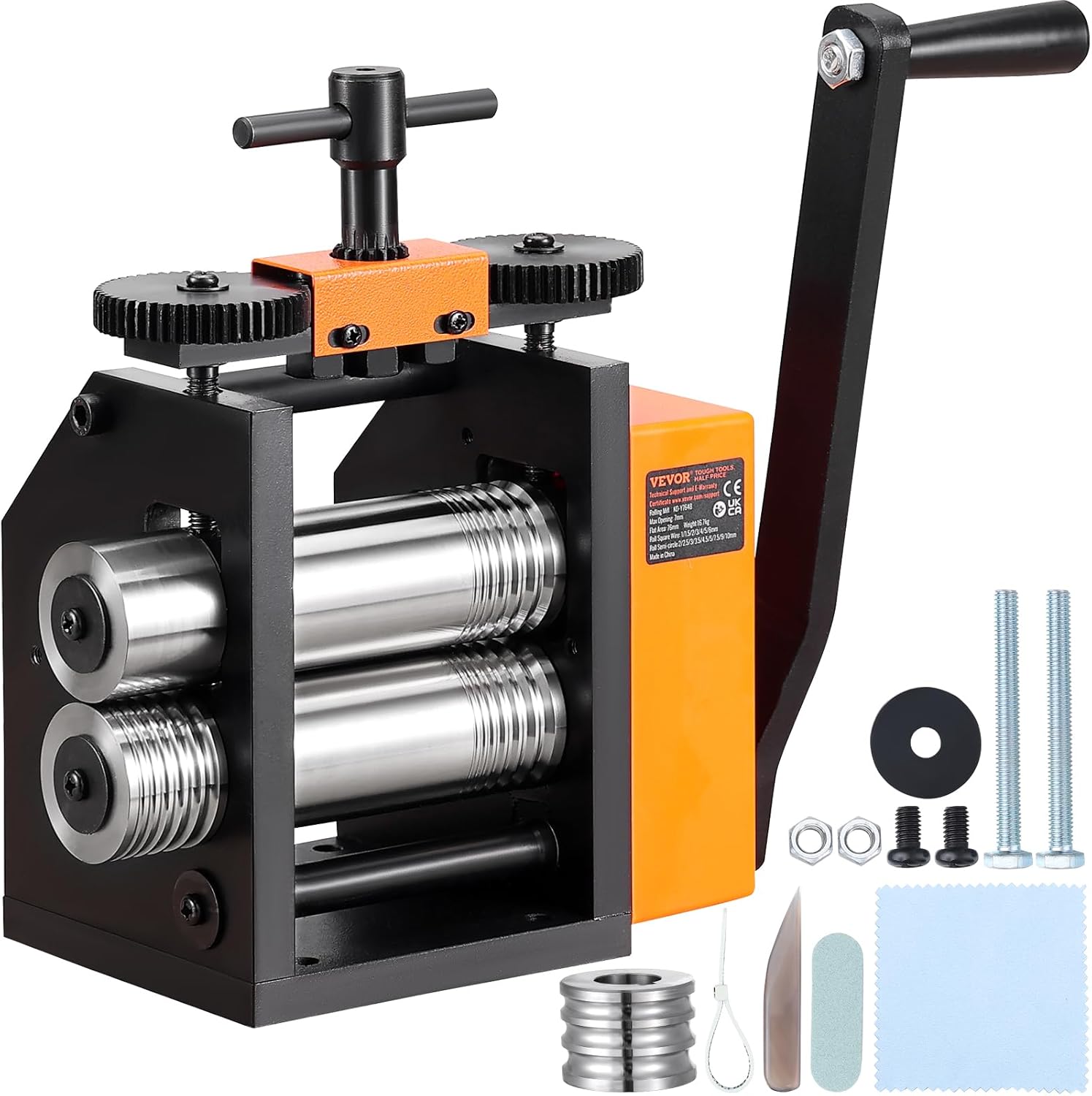
The VEVOR KD-Y7648 76 mm 3-in-1 is the sensible lowest-cost route for small jewelry work because it combines a
76 mm flat section with square and half-round wire grooves. Choose the Lakimi LK-RM06 instead when a 4:1 gearbox
matters more than flat-sheet capacity. Neither is the economical choice for wide cuffs or frequent production: in
that case, wait and save for a dedicated flat mill with the width you need.
Decide where the budget stops
“Budget” should describe the right first commitment, not simply the lowest sticker price. A rolling mill needs a rigid
mounting surface, space for the handle arc and room to feed metal from both sides. Saving a little on the machine is
not useful if it cannot be bolted down or its narrow flat section cannot take the blanks you plan to make.
Choose a budget level by the work you need to do
Your regular work
Most sensible route
Why
Rings, small findings and short wire
Compact combination mill
Flat, square and half-round sections cover varied small work in one footprint.
Wire profiles matter more than sheet width
4:1 combination mill
More reduction lowers handle effort, while grooves trade away flat capacity.
Narrow cuffs and roll printing
90 mm dedicated flat mill
A full smooth roller is more useful than grooves you will not use.
Wide sheet every week
Save for a 110–130 mm flat mill
A compact mill will become the expensive temporary answer.
Before choosing, measure the widest blank or texture material you expect to pass through the rollers. Total roller
width and usable flat width are not always the same thing; wire grooves take up space on a combination roller. Our
rolling-mill size guide explains that measurement in more detail.
Five routes, from a compact first mill to a better long-term purchase
Best lowest-cost combination mill: VEVOR KD-Y7648
VEVOR’s KD-Y7648 is a compact manual combination machine for the jeweler who needs a mill now but is working on a
small bench. The maker specifies a 76 mm maximum rolling width, an adjustable 0.1–7 mm opening, seven square-wire
sizes and nine half-round sizes. That mix makes it more versatile than a similarly sized flat-only machine, but its
lower reduction gearing needs more force than the 4:1 option below.
Pick this for narrow sheet, ring stock and a mix of square and half-round wire. Inspect the roller faces before
rolling valuable metal, mount the mill rigidly, and use annealed test stock first. Its 76 mm width is a firm limit
for wider cuffs and large texture plates.
Best for: Budget-conscious beginners making rings and small components who can work within a 76 mm sheet width.
Specs, strengths and limitations
Roller width
76 mm
Flat rolling area
76 mm flat roller
Wire grooves
7 square sizes; 9 half-round sizes
Gear ratio
2:1 reduction
Maximum opening
7 mm
Strengths
Flat, square-wire and half-round capability in a compact footprint
0.1–7 mm adjustable opening handles thicker ingots than the other compact mills here
Lower entry price than the geared specialist mills in this guide
Limitations
76 mm width limits wider sheet and texture work
2:1 gearing provides less leverage than a 4:1 or 5:1 mill
Inspect roller finish and alignment immediately after delivery
Best budget choice for lower handle effort: Lakimi LK-RM06
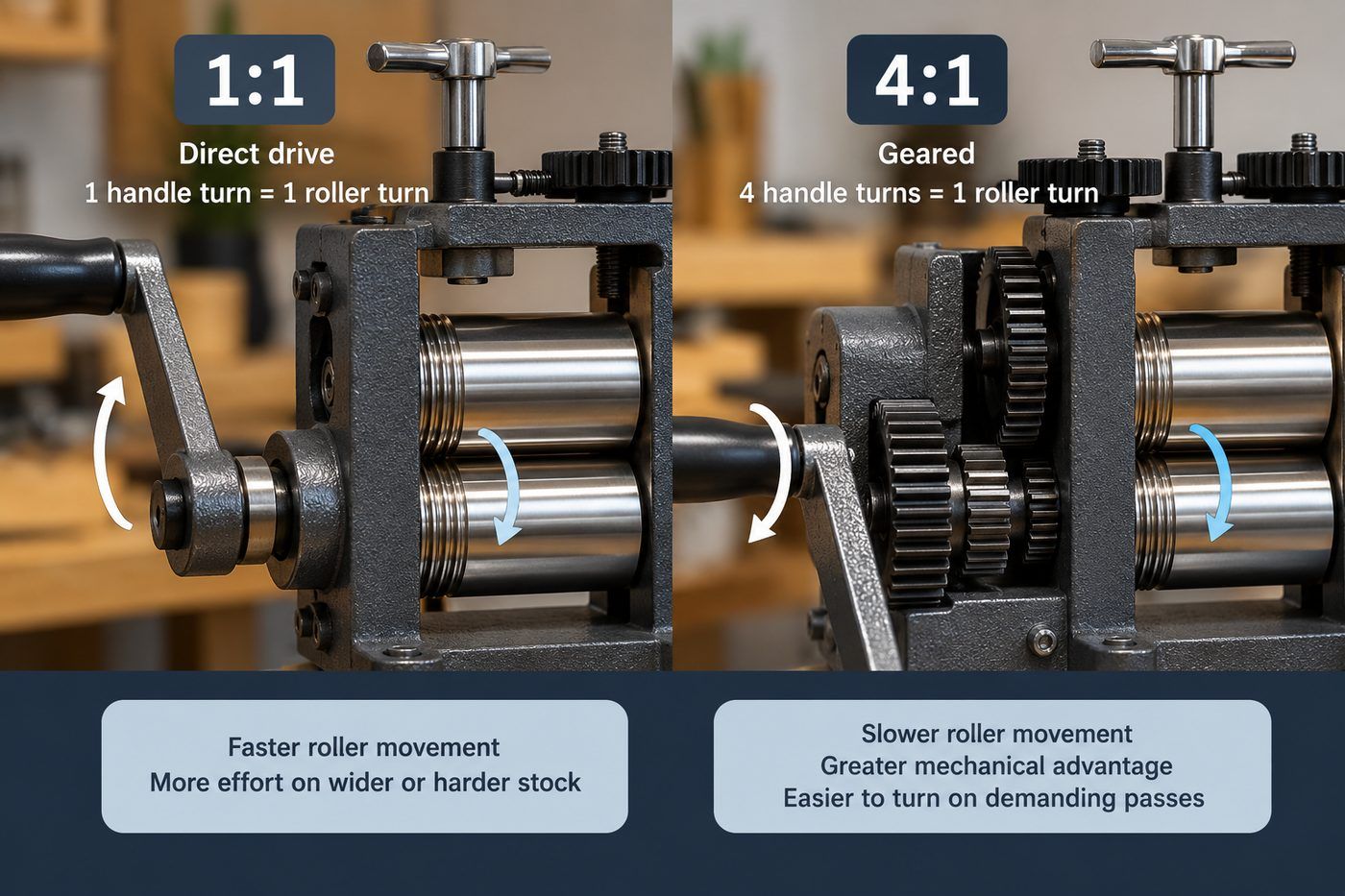
The Lakimi LK-RM06 is for a compact-bench jeweler who values leverage over flat-sheet width. Its 4:1 reduction gearing
means four handle turns for roughly one driven-roll turn, lowering the effort per pass. The cost of that configuration
is a 40 mm flat section within a 90 mm roller: the rest of the working face is devoted to square and half-round grooves.
Choose this when you make wire profiles regularly and your flat stock stays narrow. Do not read the 90 mm headline
width as 90 mm of smooth sheet capacity; measure your usual blanks against the 40 mm flat section.
Best for: Home jewelers who want easier 4:1 cranking and can accept a narrow flat area in exchange for wire grooves.
Specs, strengths and limitations
Roller width
90 mm
Flat rolling area
40 mm
Wire grooves
Square and half-round grooves
Gear ratio
4:1 reduction
Maximum opening
4 mm
Strengths
4:1 gearing requires less force than the compact 2:1 VEVOR
Combination layout supports sheet, square wire and half-round profiles
Compact 16 kg machine suits a small home bench
Limitations
Only 40 mm of the 90 mm roller is available for flat sheet
Maximum opening is 4 mm rather than the 7 mm stated for the VEVOR
Shorter manufacturer track record than PEPETOOLS or Durston
Best budget stretch for flat sheet: PEPETOOLS 18700A
The PEPETOOLS 18700A is the first meaningful step beyond a basic combination mill for a sheet-first jeweler. Its full
90 mm working width is flat, and its 4:1 reduction gearbox is designed for slower, lower-effort passes. The maker lists
a 5 mm maximum opening, so this is a better fit for sheet and roll printing than thick starting stock or built-in wire
profiles.
This is the sensible step-up when grooves would sit unused and every millimetre of smooth roller matters. It costs
more than the compact combination mills and has no wire grooves, so buy it for a clear sheet-work plan rather than
for maximum versatility.
Best for: Jewelers who prioritize clean sheet and roll printing over built-in wire grooves.
Specs, strengths and limitations
Roller width
90 mm
Flat rolling area
90 mm
Wire grooves
None
Gear ratio
4:1 reduction
Maximum opening
5 mm
Strengths
Full roller width is available for sheet and textures
4:1 reduction gearing lowers handle effort
Manufacturer publishes detailed model specifications and parts support
Limitations
No built-in square-wire grooves
Only 90 mm of sheet capacity
Costs noticeably more than the compact combination mills
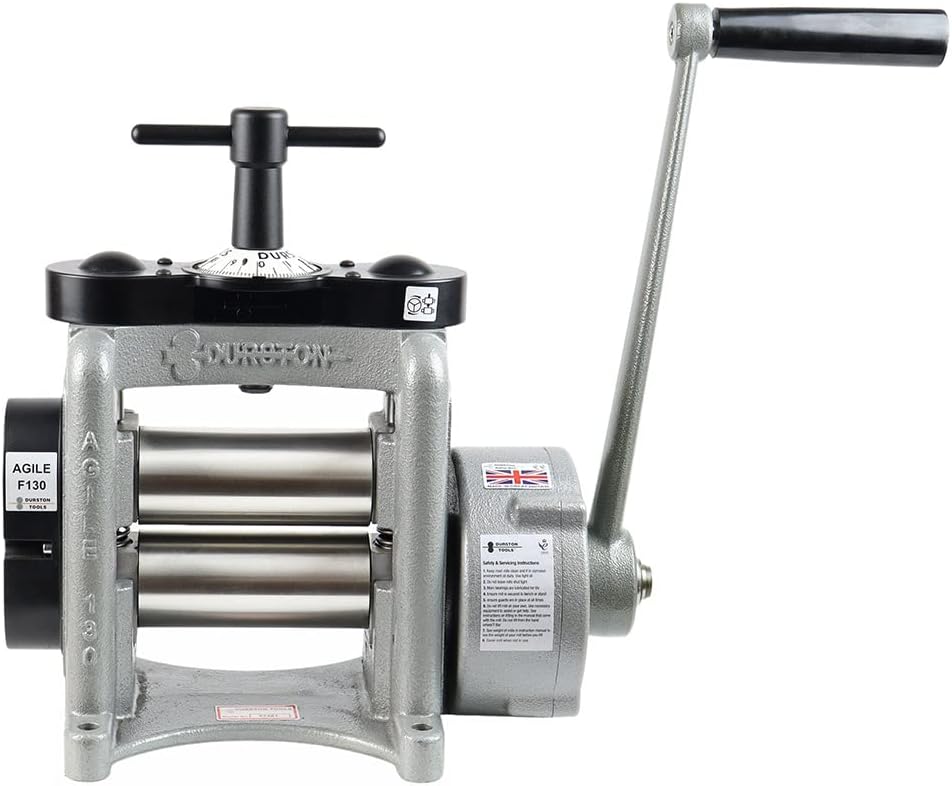
Best save-for flat-mill upgrade: Durston Agile F110
The Durston Agile F110 is not an entry-price choice, but it can be the lower-cost choice over time for a jeweler who
already knows that 90 mm is too narrow. The maker lists 110 mm by 50 mm flat rolls, a 5.5 mm opening, 4:1 gearing and
a 26 kg machine weight. Its dedicated flat layout trades wire grooves for more useful sheet width.
Product image unavailable
Best save-for choice for a permanent flat-mill bench
Durston · Agile F110 (1020)
Durston Agile F110 Flat Rolling Mill
Price tier: $$$$Professional
Choose the F110 if wider sheet is a settled need and you can give a 26 kg mill a permanent, rigid mounting point.
It does not replace a combination mill for square or half-round wire, and it is too substantial for a temporary
table setup.
Best for: A home jeweler with a permanent bench who wants more dedicated flat-sheet capacity than a compact 90 mm mill.
Specs, strengths and limitations
Roller width
110 mm
Flat rolling area
110 mm
Wire grooves
None
Gear ratio
4:1 reduction
Maximum opening
5.5 mm
Strengths
Full 110 mm roller width is dedicated to flat sheet
4:1 reduction gearing reduces handle effort for controlled passes
Manufacturer publishes model-specific dimensions and technical documentation
Limitations
No built-in wire grooves or side extensions
At 26 kg, it needs a permanent rigid mounting plan
Shipping, pricing and parts support vary by country; confirm them with the maker
Best wait-and-save route for wider sheet: Durston Agile F130
The Agile F130 is the right comparison point when your work has outgrown compact rollers entirely. Its 130 mm flat
rolls, 5:1 gearing and roughly 39 kg working weight suit repeated sheet work, but its footprint and bench requirements
make it a planned studio machine. For occasional narrow work, the extra capacity is unnecessary.
Consider this only when the work demands a 130 mm flat area often enough to justify its weight, cost and permanent
space. Its 5:1 gearing gives useful leverage, but it has no built-in wire grooves.
Best for: Frequent studio work, wider sheet and roll printing where maximum flat width matters more than wire grooves.
Specs, strengths and limitations
Roller width
130 mm
Flat rolling area
130 mm
Wire grooves
None
Gear ratio
5:1 reduction
Maximum opening
6 mm
Strengths
Wide 130 mm flat working area
5:1 gearing provides substantial leverage
Manufacturer documentation and replacement parts are readily traceable
Limitations
No built-in square-wire grooves
Heavy machine that needs a rigid permanent mounting point
Price and footprint put it beyond most first-mill budgets
The VEVOR gives the broadest capability per bench footprint. The Lakimi exchanges some sheet width for more leverage.
The PEPETOOLS directs the same idea toward clean, smooth sheet. The Durston models cost more, but their dedicated flat
layouts become sensible when a small combination roller would force you to work around its grooves on every project.
Setup checks that protect a modest mill
Map the mounting point. Include the handle’s full sweep and the feed path, not only the base dimensions.
Check the roller faces. Rust, pits, grit and scratches can transfer to every subsequent piece of metal.
Make light test passes. Use clean, annealed scrap and reduce gradually; do not force a large reduction in one pass.
Check both sides of the gap. A test strip helps reveal whether the rollers are staying parallel under light load.
Keep hard contaminants away. Abrasive material, hardened steel and dirty scrap can permanently mark polished rolls.
Wait if you mostly fabricate from purchased sheet and wire, or if you do not yet have a bench that can resist the crank
force without moving. A jeweler’s saw, bench pin, calipers and a reliable soldering setup can improve more projects
until you have a recurring reason to resize stock, roll texture or recycle clean scrap.
The lowest-cost useful choice is therefore the VEVOR for varied small work; the LK-RM06 if wire profiles and lower
handle force are the priority; and a dedicated flat mill only when the work proves that its extra smooth width will be
used. Start with the narrowest configuration that genuinely fits the work, then leave room in the budget for a stable
bench and careful setup.
Frequently asked questions
What is a good budget rolling mill for jewelry?
A compact combination mill is the practical low-cost choice when you need narrow sheet, square wire and half-round wire from one machine. Compare its usable flat width and gearing before its total roller width.
Is a 76 mm rolling mill large enough for jewelry?
It is large enough for rings, small components, narrow sheet and short texture work. It is not the right size for regular cuff blanks or wider pattern plates.
Is a budget rolling mill worth buying?
It is worth buying when you will repeatedly alter sheet or wire, make texture, or turn clean scrap into stock. It can wait when purchased sheet and wire already cover most of your projects.
Should I choose lower reduction gearing or 4:1 gearing?
Choose 4:1 when lower handle effort matters more than speed. A lower-reduction mill takes fewer turns but asks more from the operator as work gets wider or harder.
We have not personally used every product in this guide. Recommendations are based on specifications, manufacturer documentation, specialist references and owner experiences.
Specifications come from manufacturer documentation where it is available.
Specialist references, supplier catalogs and owner experiences are used to understand real-world strengths and weaknesses.
We do not claim physical testing, and we do not publish scores or star ratings.
Choose the right jewelry rolling mill by roller width, configuration, gearing and bench space, with a research-based look at budget and professional options.
How to choose rolling mill size for jewelry making — usable flat width vs roller width, 80 vs 110 vs 130 mm mills, cuffs, texture plates and bench space.
Combination vs flat rolling mills compared for jewelry making — including usable sheet width, wire grooves, versatility and which type is better for your bench.
Learn what 1:1, 2:1 and 4:1 rolling mill gear ratios mean, how reduction gearing changes torque and handle effort, and whether a geared rolling mill is worth it.