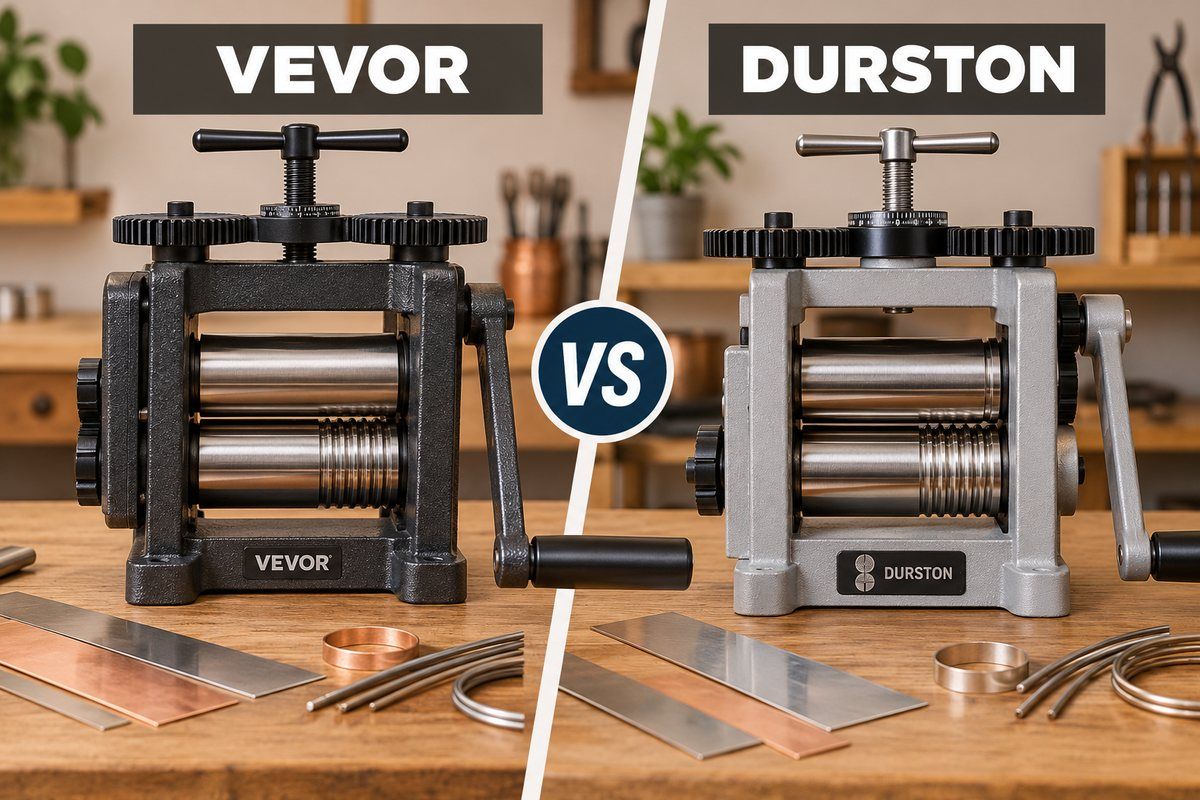
VEVOR and Durston occupy very different positions in the jewelry rolling mill market. A VEVOR combination mill can cost a fraction of an established Durston, yet when you compare the specifications on paper, the gap may initially look surprisingly small.
That makes the obvious question:
What are you actually paying for with a Durston?
The answer is less about a single specification and more about manufacturing consistency, roller construction, alignment, long-term durability, documentation and support.
A budget VEVOR can still be a perfectly useful tool for the right workshop. If you make jewelry occasionally, are learning how rolling mills work or simply cannot justify spending four figures on one machine, starting with a lower-cost mill can be reasonable.
If the rolling mill will become one of the central tools on your bench, however, paying more for predictable operation and long-term service becomes easier to justify.
Quick answer
Should I buy a VEVOR or a Durston rolling mill?
Buy a VEVOR if keeping the initial cost low matters most and you are comfortable inspecting, cleaning and potentially adjusting the mill yourself. Buy a Durston if you expect to use the mill regularly and place greater value on manufacturing consistency, established support and long-term ownership. Do not choose on brand alone: compare the actual flat rolling width, groove sizes, maximum opening and gear ratio of the models you are considering.
VEVOR vs Durston at a glance
The two mills below are the VEVOR and Durston models we recommend in our rolling mill buying guide: a compact 76 mm VEVOR combination mill and the wide 130 mm Durston Agile F130 flat mill. They sit at opposite ends of the price range and show how differently the two brands are positioned.
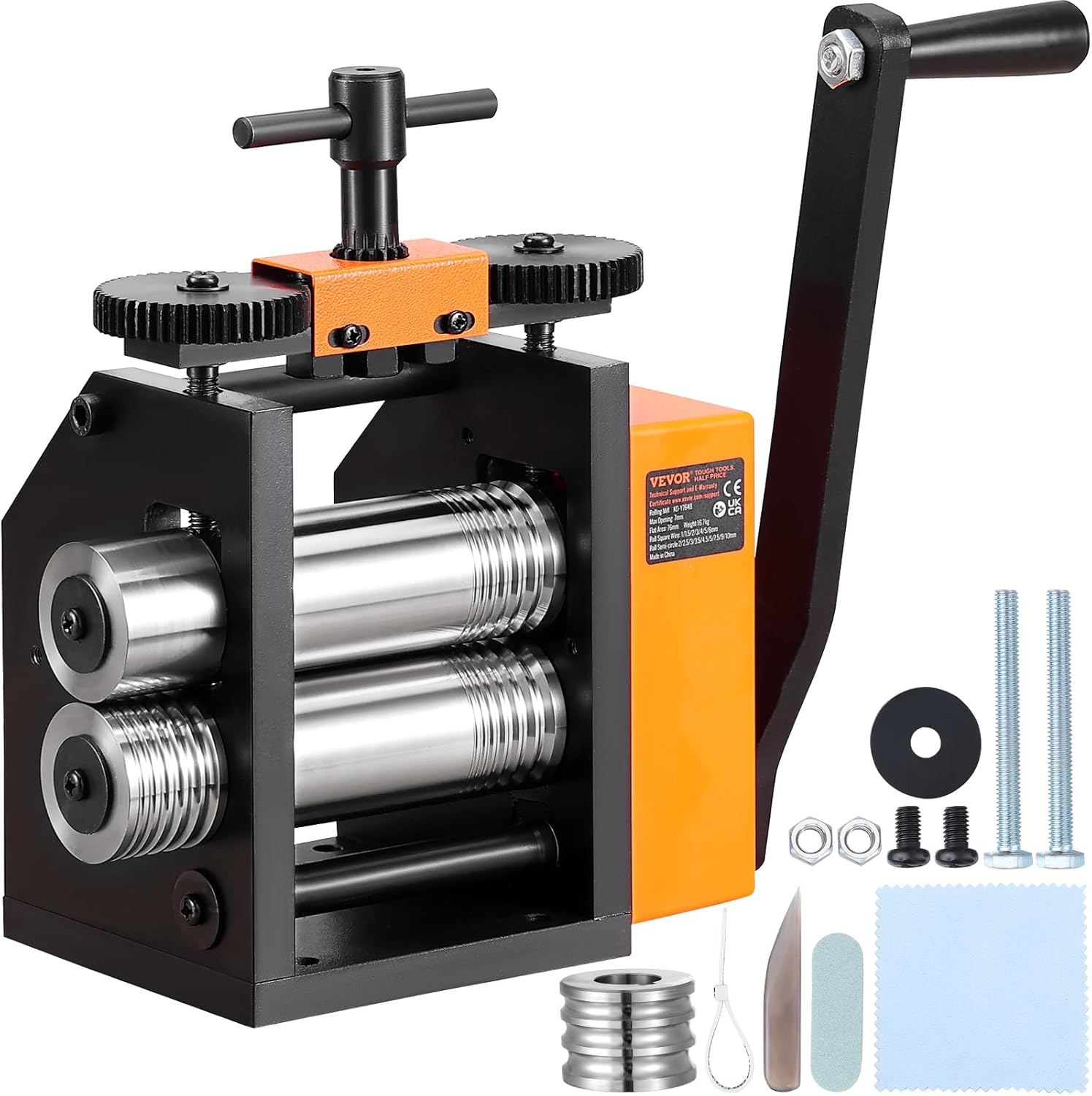
Budget VEVOR pick
VEVOR · KD-Y7648
A compact manual mill with separate flat, square-wire and half-round rolling sections. The exact 76 mm KD-Y7648 listing is matched to Amazon.com ASIN B0CQYM6JBG.
Best for: Budget-conscious beginners making rings and small components who can work within a 76 mm sheet width.
Specs, strengths and limitations
- Roller width
- 76 mm
- Flat rolling area
- 76 mm flat roller
- Wire grooves
- 7 square sizes; 9 half-round sizes
- Gear ratio
- 2:1 reduction
- Maximum opening
- 7 mm
Strengths
- Exact Amazon.com listing and model identity were matched
- Flat, square-wire and half-round capability in a compact footprint
- Lower entry price than the geared specialist mills in this guide
Limitations
- 76 mm width limits wider sheet and texture work
- 2:1 gearing provides less leverage than a 4:1 or 5:1 mill
- Inspect roller finish and alignment immediately after delivery
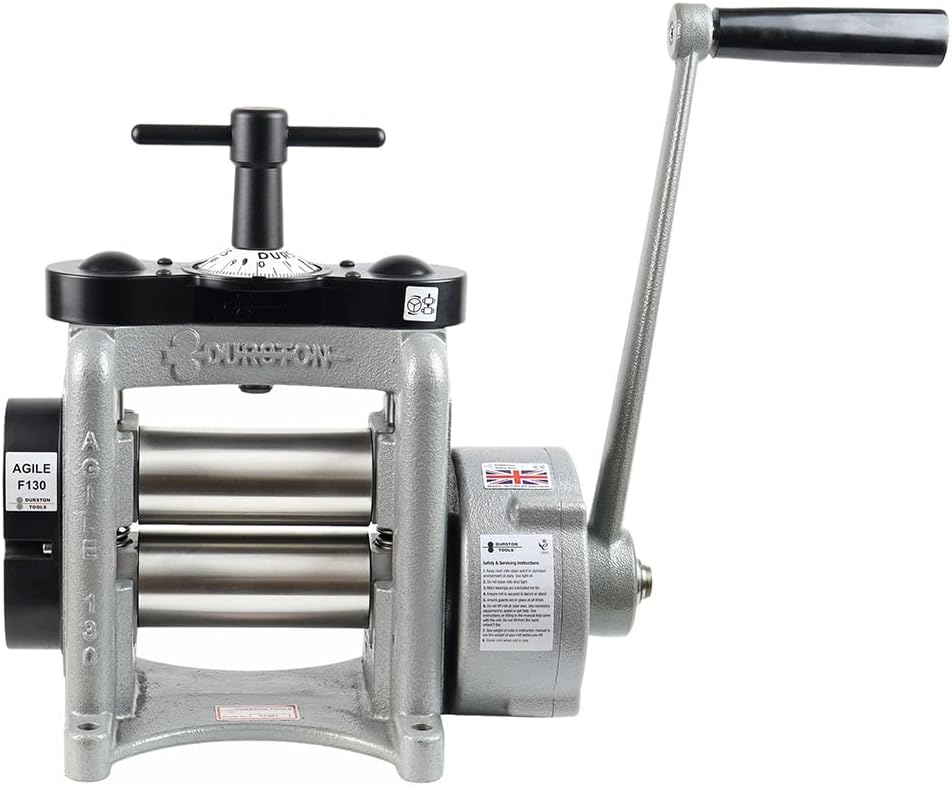
Premium Durston pick
Durston · Agile F130 (1030)
A heavy 130 mm manual flat mill with 5:1 reduction gearing. The exact Agile F130 model is listed on Amazon, with offer visibility depending on the shopper's delivery location.
Best for: Frequent studio work, wider sheet and roll printing where maximum flat width matters more than wire grooves.
Specs, strengths and limitations
- Roller width
- 130 mm
- Flat rolling area
- 130 mm
- Wire grooves
- None
- Gear ratio
- 5:1 reduction
- Maximum opening
- 6 mm
Strengths
- Wide 130 mm flat working area
- 5:1 gearing provides substantial leverage
- Manufacturer documentation and replacement parts are readily traceable
Limitations
- No built-in square-wire grooves
- Heavy machine that needs a rigid permanent mounting point
- Amazon offer visibility and delivery eligibility vary by location
These two machines differ in size and configuration as well as brand, so they do not isolate what the Durston premium buys. For that, it helps to compare models with matching headline specifications.
At first glance, those specifications can make the cheaper mill look like an obvious bargain.
For example, a current VEVOR 110 mm combination rolling mill and the Durston Agile C110 both use 110 mm rolls and 4:1 reduction gearing.
That does not make them equivalent machines.
The comparison is useful precisely because it shows why buying a rolling mill based only on its advertised roller width and gear ratio can be misleading.
The closest comparison: VEVOR 110 mm vs Durston Agile C110
The exact models sold by both companies change over time, so always verify the listing before buying. But their 110 mm combination mills provide a useful illustration.
110 mm combination mill specification comparison| Specification | What it means |
|---|
| Overall roller width | Both examples use approximately 110 mm-wide main rolls. |
|---|
| Reduction gearing | Both examples are specified with 4:1 reduction gearing. |
|---|
| Flat rolling area | VEVOR lists about 57 mm on its 110 mm combination model; the Durston Agile C110 lists 50 mm. |
|---|
| Maximum opening | VEVOR specifies up to 5 mm; Durston specifies a maximum sheet thickness of 5.5 mm. |
|---|
| Wire capability | Both provide grooves, but groove sizes and profiles differ. Compare them with the wire sizes you actually intend to make. |
|---|
| Construction details | Durston publishes additional information about supported bearing blocks, self-lubricating bearings and hardened rolls. |
|---|
This is why usable specifications should come before brand reputation.
A more expensive combination mill does not automatically give you a wider flat section. A cheaper mill does not automatically lack reduction gearing.
What changes as you spend more is often harder to express in one number.
A premium rolling mill is fundamentally a precision machine.
The rolls need to remain parallel. Their surfaces need to be smooth. The adjustment mechanism needs to move predictably. The bearings and frame need to hold everything in alignment while significant force is being applied.
Small differences in these areas can affect the experience much more than another 10 mm of advertised roller width.
1. Manufacturing consistency
The biggest advantage of an established professional mill is arguably predictability.
With any new rolling mill, you should inspect the rolls and alignment before using valuable metal. With a budget machine, that inspection matters even more.
You are looking for:
- pits or scratches on the roller faces;
- visible machining marks;
- rust or corrosion;
- rollers that do not close evenly;
- excessive movement in the bearings;
- gears that bind through part of their rotation;
- an adjustment mechanism that moves unevenly.
A low purchase price is less attractive if you immediately need to diagnose an alignment problem or return a 20 kg machine.
That does not mean every inexpensive mill has problems. It means your individual machine matters more than the logo printed on it.
2. Roller finish matters more than many beginners expect
Anything on a flat roller can potentially appear on the metal passing through it.
A scratch becomes particularly frustrating when you are rolling sterling silver or gold sheet because fixing the resulting mark means removing material afterward.
Before using a new mill, close the rolls enough to inspect them under strong side lighting.
Look across the surface rather than directly down at it. Side lighting makes small scratches, pits and machining marks easier to see.
Then clean the protective coating according to the manufacturer’s instructions.
Do not test an unfamiliar mill first with your most expensive metal.
Start with scrap copper or another inexpensive material and inspect the resulting sheet.
If a defect appears repeatedly in the same position, examine the corresponding part of the roller.
3. Roller alignment
A rolling mill should reduce metal evenly across the usable width.
If the rolls are not parallel, one side can reduce the metal more than the other. Sheet may begin to curve, twist or develop an uneven thickness.
This becomes more important as:
- the sheet gets wider;
- reductions become heavier;
- dimensional consistency matters more;
- you begin rolling expensive precious metal.
Alignment is therefore one of the first things worth testing on any budget rolling mill.
You can start with annealed scrap sheet of reasonably uniform thickness. Measure it before and after rolling at multiple positions across its width.
Do not expect laboratory precision from a jewelry bench test. You are looking for obvious inconsistency.
4. Bearings, frame rigidity and adjustment
Rolling metal creates substantial separating force between the rolls.
The rest of the mill exists partly to keep those rolls where they are supposed to be while that force is applied.
Frame rigidity, bearing support, gears and adjustment hardware therefore matter even though they are much less interesting to put in a product listing than “110 mm rollers.”
Durston specifically describes the Agile C110 as using supported bearing blocks and self-lubricating bearings.
Those construction details are part of the reason professional mills are difficult to compare with inexpensive alternatives using specification sheets alone.
A cheap mill can still reduce metal.
The bigger question is how consistently it continues doing that after years of adjustment and loading.
5. Gearing: surprisingly, this may not be the deciding factor
It is easy to assume the expensive mill must have dramatically better gearing.
That is not always true.
Both of the 110 mm examples discussed here use a 4:1 reduction ratio.
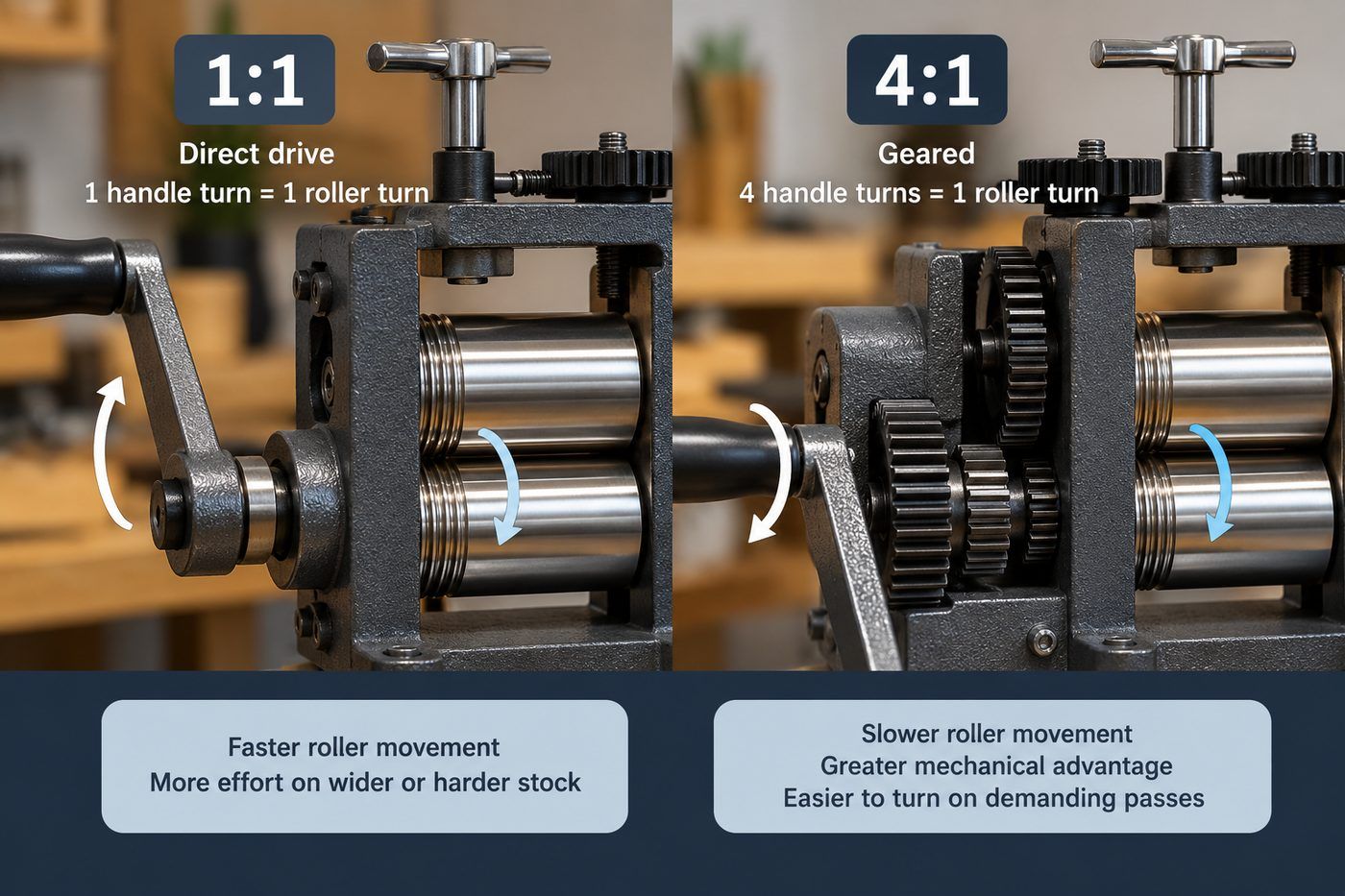
A 4:1 gearbox means you turn the handle approximately four times for one rotation of the rolls. You trade speed for mechanical advantage, making it easier to pass metal through the mill.
For a deeper explanation, see our guide to rolling mill gear ratios.
The lesson for this comparison is simple:
Do not pay hundreds of dollars more just because one listing says “geared.” Check the actual ratio.
6. Support, documentation and replacement parts
This is one of the less visible parts of a rolling mill purchase.
You may own the machine for 10, 20 or more years.
During that time you may need:
- installation information;
- lubrication guidance;
- mounting dimensions;
- replacement components;
- help diagnosing a problem;
- parts for an older model.
Durston maintains a large range of rolling mills and publishes product sheets, instructions and diagrams for its machines.
That established support network has value if the tool becomes important to your work.
VEVOR’s appeal is different. You are primarily buying a lot of machine for comparatively little initial expenditure.
For some buyers that is a better trade.
Is a VEVOR rolling mill actually bad?
No.
Calling all inexpensive rolling mills “bad” is too simplistic.
A correctly aligned budget mill with clean rollers can still perform the fundamental jobs people buy rolling mills for:
- reducing sheet;
- reducing wire;
- preparing stock from small ingots;
- creating more consistent thickness;
- imprinting texture;
- producing square or shaped wire where suitable grooves are provided.
There are also owners who use inexpensive mills successfully for years.
The better question is:
How much inconvenience and uncertainty are you willing to accept to save money?
If you are comfortable maintaining tools, diagnosing mechanical problems and returning an unacceptable machine, the equation may strongly favor VEVOR.
If you want to unpack the mill, mount it and get on with jewelry making, the premium option becomes more attractive.
Where a VEVOR makes the most sense
A VEVOR rolling mill is easiest to justify for someone building a jewelry bench on a limited budget.
It can also make sense when the mill will not be used every day.
When a VEVOR rolling mill makes sense| Situation | Why VEVOR may fit |
|---|
| You are learning metalsmithing | You can learn rolling technique without putting a large amount of money into your first mill. |
|---|
| You are unsure how much you will use a mill | A budget machine reduces the cost of finding out whether rolling becomes part of your normal workflow. |
|---|
| Your workshop budget is limited | Money saved on the mill can fund other important tools such as a flex shaft, torch, bench or dust extraction. |
|---|
| You are mechanically confident | Cleaning, checking alignment and making minor adjustments are less intimidating. |
|---|
| You mainly texture or roll narrow stock | You may not benefit as much from the advantages of a larger professional mill. |
|---|
There is also a legitimate strategy of buying an inexpensive mill first and upgrading later.
By the time you upgrade, you will know whether your real limitation is flat width, gearing, wire grooves, roller diameter or something else.
That is much better information than trying to predict your future workshop needs before you have used a rolling mill.
Where a Durston makes more sense
The case for Durston becomes stronger as the rolling mill becomes more important to your work.
When paying more for Durston becomes easier to justify| Situation | Why Durston may fit |
|---|
| You roll metal every week | Small improvements in operation and consistency are multiplied across years of regular use. |
|---|
| You work with expensive gold or silver | Roller condition and consistent reduction become more consequential when mistakes involve costly stock. |
|---|
| You fabricate much of your own stock | The mill is a core production tool rather than an occasional accessory. |
|---|
| You want to keep the mill long term | Parts availability, documentation and manufacturer support become increasingly valuable with age. |
|---|
| You dislike troubleshooting machinery | Paying more for an established tool can reduce the amount of uncertainty you are accepting at purchase. |
|---|
The important point is that Durston is not automatically the correct choice just because you can afford one.
If you roll a small piece of copper twice a month, you may never extract enough value from a premium mill to make the additional expenditure meaningful.
Does a Durston produce better jewelry?
Not automatically.
A rolling mill does not replace good metal preparation or rolling technique.
You still need to:
- anneal when appropriate;
- avoid taking excessively aggressive reductions;
- feed sheet squarely;
- keep the rolls clean;
- protect the rolls from moisture;
- avoid rolling inappropriate hardened material;
- maintain the machine correctly.
A skilled maker using a modest mill can produce excellent work.
Likewise, an expensive Durston can be damaged through poor maintenance.
Premium machinery should therefore be thought of as providing a better platform for the process, not replacing the process itself.
Premium does not mean maintenance-free
One mistake buyers sometimes make is assuming expensive rolls cannot rust or become damaged.
They can.
Polished steel rolls need protection regardless of the brand name on the frame.
Follow the manufacturer’s storage and maintenance guidance, particularly in workshops exposed to humidity or large temperature changes.
Keep wet pickle tools, drinks and other sources of moisture away from the mill.
Also inspect the rolls before extended periods of storage.
Paying more for a rolling mill does not remove the basic responsibility of looking after precision steel surfaces.
What should you inspect when a VEVOR arrives?
Do this before rolling precious metal and preferably before the return period expires.
Check the roller surfaces
Rotate the rolls through a complete revolution under bright lighting.
Look for scratches, pits, dents, corrosion and obvious machining defects.
Check that the rolls close evenly
Bring the rolls together gently.
Do not force them against each other.
Look across the width and make sure one end does not obviously close before the other.
Rotate the mechanism
Turn the handle through several complete rotations.
You are checking for unusual binding, excessive play or obvious gear problems.
Check the adjustment
Open and close the rolls through their normal working range.
The mechanism should move in a controlled and repeatable way.
Use clean copper or scrap before silver or gold.
Make a light pass and inspect both the metal and roller surfaces.
Mount the mill properly
A rolling mill generates substantial leverage.
A machine moving around on the bench makes accurate rolling difficult and can become unsafe.
Use the provided mounting holes and a sufficiently rigid bench or stand.
Should beginners buy the cheapest rolling mill possible?
Usually, no.
There is a difference between buying inexpensive equipment intentionally and simply selecting the cheapest listing available.
Look for the specifications that determine whether the machine can actually perform your work:
- usable flat rolling width;
- roll diameter;
- maximum opening;
- reduction gear ratio;
- square groove range;
- half-round or extension rolls if required;
- mounting arrangement;
- machine weight and dimensions.
A $150 mill that cannot roll the width of sheet you normally use is not cheaper than a $250 mill that can.
See what size rolling mill you actually need before choosing between manufacturers.
Don’t confuse total roller width with flat rolling width
This is especially important when comparing combination mills.
A mill advertised as having 110 mm rolls does not necessarily provide 110 mm of flat rolling space.
Part of the roll may be occupied by:
- square wire grooves;
- half-round grooves;
- other profiles.
For example, the 110 mm combination mills discussed earlier provide substantially less than 110 mm of uninterrupted flat surface.
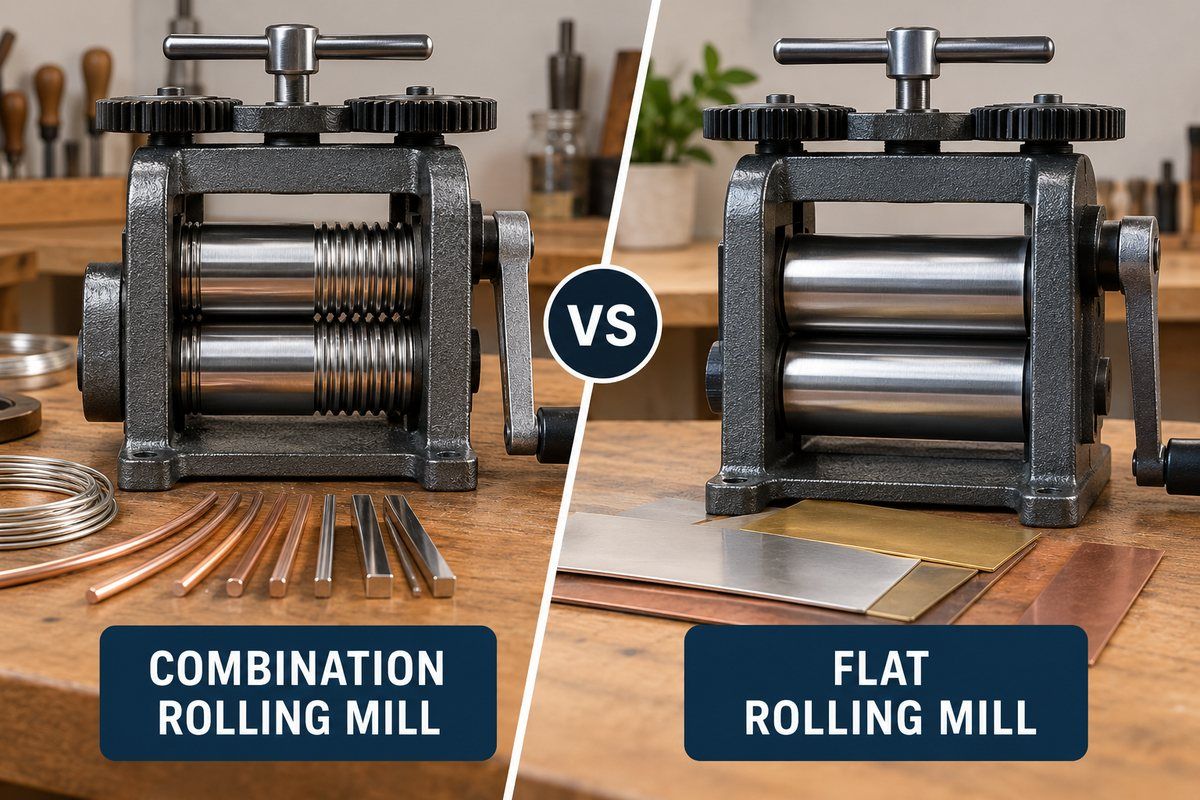
If your main goal is making wider sheet, a dedicated flat mill may therefore be a better choice than either combination mill.
Read combination vs flat rolling mills before assuming a combination machine is automatically more versatile for your particular work.
What about texture rolling?
Both inexpensive and premium mills can be used to transfer suitable textures to annealed metal.
However, texture rolling places its own demands on the machine.
You need sufficient opening for the metal and texture material together, enough force to produce the impression and rollers you are willing to expose to the process.
Avoid putting unknown hard materials through a mill simply because they physically fit between the rolls.
The roller surfaces are one of the most important parts of your machine. Damage them and every subsequent piece of sheet may remind you of the mistake.
What about rolling ingots?
If you plan to cast ingots and convert them into sheet or wire regularly, the argument for a more substantial rolling mill becomes stronger.
Rolling a small annealed strip and breaking down a thick ingot are very different workloads.
Consider:
- maximum roll opening;
- roll diameter;
- gearbox reduction;
- frame rigidity;
- width of the stock;
- amount of reduction required.
You may also need to forge an ingot thinner before it will fit safely through the mill.
For repeated stock production, buying enough rolling mill rather than the absolute minimum is usually the more useful way to think about the decision.
VEVOR vs Durston for a home jewelry studio
For many home studios, the choice comes down to capital cost versus confidence.
A VEVOR lets you put a capable mechanical tool on the bench without committing a large proportion of your workshop budget.
That can be the rational choice when you still need ten other tools.
A Durston makes more sense once you know rolling is central to how you work.
Think of the premium less as buying additional features and more as paying for the parts of a machine that are difficult to see in an Amazon-style specification list.
The upgrade path can be sensible
There is nothing inherently wrong with this path:
budget mill → learn → identify limitations → upgrade
In fact, it can prevent an expensive purchasing mistake.
After a year with a rolling mill you may discover that you care far more about a wide flat area than wire grooves.
Or perhaps you rarely roll sheet but constantly reduce wire.
Maybe 110 mm is plenty.
Maybe it is frustratingly narrow.
You cannot learn those things from a specifications table as easily as you can from using the tool.
A basic mill can therefore serve two purposes: it makes jewelry and teaches you what you want from your eventual long-term mill.
The case for buying once
The alternative is equally reasonable.
If you already know that fabrication will be a major part of your work, buying the tool you expect to keep can avoid:
- paying shipping twice;
- selling a heavy used mill;
- learning around limitations you already know will matter;
- replacing the machine after only a few years.
Rolling mills are also unusually durable workshop tools when maintained correctly.
That means the purchase price can be spread across many years of use.
This is where the Durston argument is strongest.
VEVOR vs Durston: which gives better value?
There is no universal winner because value depends on usage.
For an occasional hobbyist, paying several times more for improvements that are barely noticed may be poor value.
For someone rolling metal several times a week, those same improvements can affect thousands of passes through the machine.
A useful way to make the decision is to ask:
If both machines successfully perform the work I need today, how much am I willing to pay for greater confidence in consistency, support and long-term ownership?
That is closer to the real VEVOR-versus-Durston decision than asking which logo makes the better rolling mill.
Our buying framework
VEVOR or Durston?| Your priority | Start here |
|---|
| Lowest possible initial cost | VEVOR |
|---|
| Learning whether you even need a rolling mill | VEVOR |
|---|
| Occasional hobby use | VEVOR may be sufficient |
|---|
| Comfortable inspecting and adjusting machinery | VEVOR becomes easier to justify |
|---|
| Regular fabrication work | Durston becomes easier to justify |
|---|
| Working frequently with expensive precious metal | Prioritise roller condition and consistency; Durston may justify its premium |
|---|
| Long-term professional workshop purchase | Durston |
|---|
| Need wider sheet | Ignore brand initially and compare usable flat width |
|---|
| Need particular wire profiles | Compare exact groove sizes before choosing either brand |
|---|
Before buying either one
Do not order a mill until you can answer these questions:
How wide is the sheet I actually need to roll?
A combination mill’s total roll width can substantially overstate its usable flat area.
What wire sizes do I need?
Check the actual grooves rather than assuming “combination” means every wire size is covered.
Do I need reduction gearing?
For most home jewelry workshops, a geared mill is much more pleasant to use for heavier reductions.
How thick is my starting stock?
Maximum opening becomes particularly important if you make your own ingots.
Where will I mount it?
Rolling mills need a rigid mounting surface and adequate handle clearance.
How often will I use it?
Frequency of use is one of the strongest arguments for or against spending substantially more.
Bottom line
A VEVOR rolling mill is not automatically a false economy, and a Durston is not automatically necessary for good jewelry making.
VEVOR’s strongest argument is straightforward: you can get a geared combination mill with useful sheet and wire capability for relatively little money.
The trade-off is accepting more responsibility for checking the individual machine you receive.
Durston’s advantage becomes clearer when you look beyond headline specifications. Its established rolling mill range, documented construction, parts ecosystem and long history in jewelry workshops are meaningful if the mill is going to become a permanent part of your bench.
For a beginner who is still building a workshop, starting with a carefully inspected budget mill can be reasonable.
For a jeweler who already knows the mill will be used constantly, spending more on the machine you expect to own for years becomes much easier to justify.
Most importantly, choose the mill configuration first and the brand second.
A beautifully built rolling mill that is too narrow for your work is still the wrong rolling mill.